Short answer: a Form 4 insider buying tracker helps you monitor when company insiders report purchases of their own company's securities. The useful part is not simply seeing that an insider bought. The useful part is reviewing who bought, what transaction code was used, how many shares were involved, whether the trade was direct or indirect, how quickly it was filed, and whether the activity clusters with other insiders, whale activity, congressional trades, or market context.
ProBors is built to turn Form 4 activity into a research workflow. It lets you review insider and whale activity next to congressional disclosures, ticker context, watchlists, and AI summaries. The goal is faster triage, not automatic buy or sell decisions.
What is SEC Form 4?
SEC Form 4 is the filing insiders generally use to report changes in beneficial ownership of a company's securities. According to the SEC investor bulletin on Forms 3, 4, and 5, Form 4 is usually required when an insider executes a transaction, and it is generally due within two business days after the transaction date.
The form can report purchases, sales, option exercises, gifts, conversions, grants, and other changes. For investors and researchers, insider purchases can be especially interesting because they may show an insider voluntarily adding exposure with personal capital. But context matters.
What counts as insider buying?
Not every Form 4 is an open-market insider purchase.
When reviewing a filing, look for:
| Field | What to check |
|---|---|
| Reporting owner | Officer, director, 10% owner, or other insider relationship. |
| Transaction code | Whether the transaction is an open-market purchase, sale, option exercise, grant, or other action. |
| Transaction date | When the reported transaction happened. |
| Filing date | When the public filing appeared. |
| Shares or units | Size of the transaction. |
| Price | Whether the insider paid market price or received securities through another mechanism. |
| Ownership type | Direct ownership versus indirect ownership through a trust, spouse, fund, or entity. |
| Footnotes | Details that can change the interpretation of the transaction. |
The headline "insider bought" is not enough. A useful tracker should preserve the transaction details and source link.
Why insider purchases can matter
Insider buying can be useful because officers and directors may understand their business better than outside investors. But that does not make every purchase meaningful.
An insider purchase is more interesting when:
- It is an open-market purchase rather than a grant.
- The size is meaningful relative to the insider's history.
- More than one insider is buying in the same period.
- The purchase follows a major price decline or company-specific event.
- The filing is recent enough to be useful.
- The same ticker also appears in congressional, whale, or market workflows you already watch.
It is less useful when:
- The transaction is tiny.
- The filing is old.
- The transaction is mostly compensation related.
- The footnotes show a prearranged or technical transaction.
- You cannot verify the source document.
How to use a Form 4 tracker
1. Start with the transaction code
A tracker should make the transaction code visible. A purchase and a sale are not the same thing, and neither is the same as an option exercise or grant.
Before you treat a row as buying activity, confirm the filing actually supports that interpretation.
2. Compare filing date and transaction date
Form 4 filings are generally expected quickly, but you should still compare the transaction date and filing date.
Recent filings are more useful for monitoring. Older filings may still explain a past move, but they are weaker as a current alert.
3. Look for clusters
One insider purchase can be noise. Multiple insiders buying the same ticker in a short period deserves a closer review.
Cluster checks:
- Same ticker, multiple reporting owners.
- Repeated purchases by one insider.
- Insider buying near congressional disclosure activity.
- Insider buying near whale or unusual transaction activity.
- Insider buying near a price drop, earnings event, or sector move.
4. Open the filing
Always keep the source document close. If the row looks important, click through to the SEC filing and read the footnotes.
The footnotes can explain indirect ownership, derivative securities, planned transactions, or other details that are easy to miss in a table.
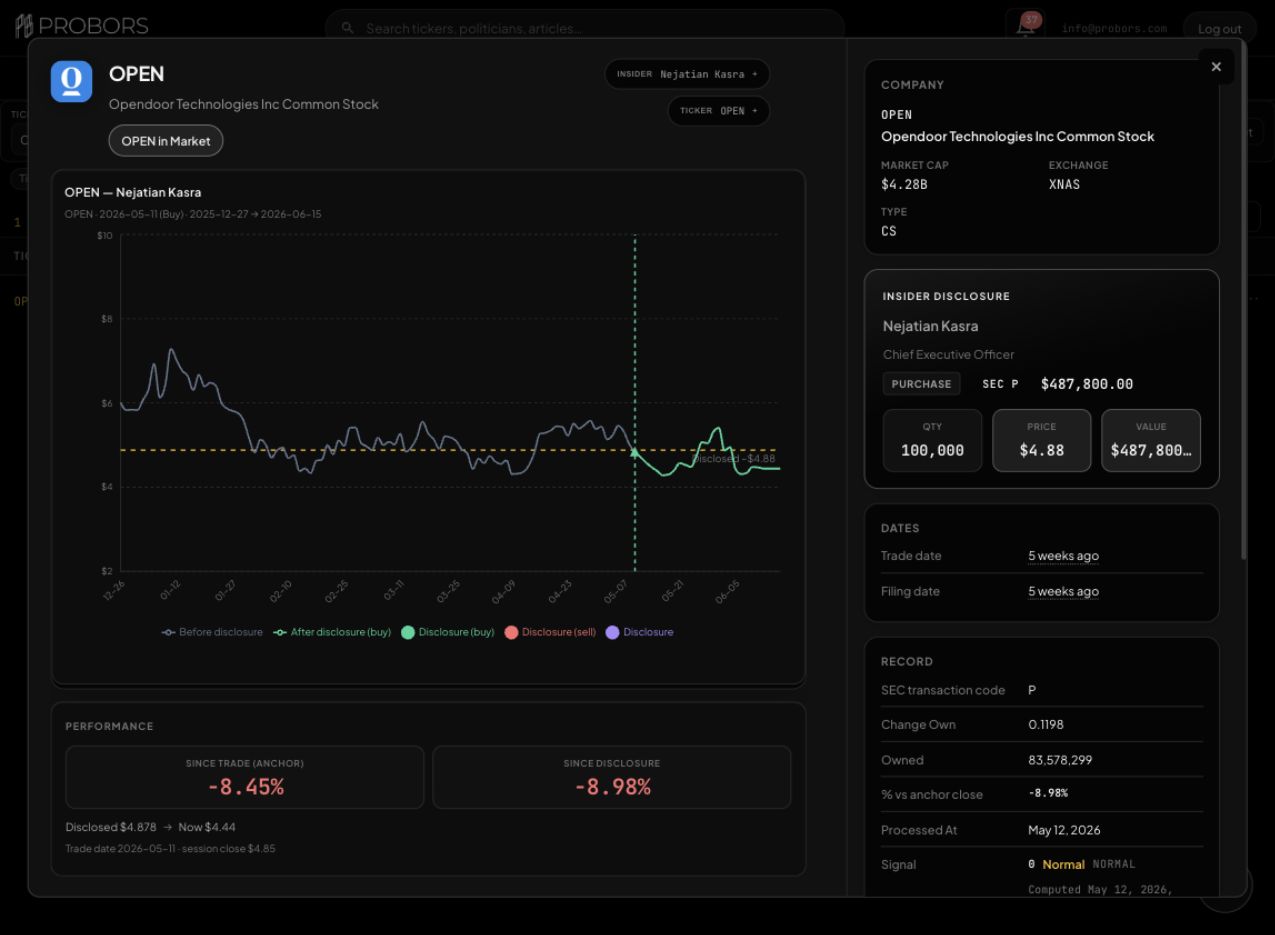
Real example: OPEN insider purchase by Kasra Nejatian
For a concrete Form 4 workflow, filter ProBors to ticker OPEN and insider Nejatian, then click the transaction row to open the context window. The filtered insider table shows one matching row for Opendoor Technologies Inc.: Kasra Nejatian, Chief Executive Officer, buy, 100,000 shares, about $4.88 per share, about $488,000 in transaction value. The clicked context view adds price history, filing timing, SEC code, ownership, and market snapshot details.
The official SEC filing confirms the details:
| Field | Example |
|---|---|
| Company / ticker | Opendoor Technologies Inc. (OPEN) |
| Reporting owner | Kasra Nejatian |
| Insider role | Chief Executive Officer; director and officer reporting person |
| Transaction code | P |
| Transaction date | May 11, 2026 |
| Filing / signature date | May 12, 2026 |
| Shares | 100,000 acquired |
| Price | $4.878 |
| Ownership | Direct (D) |
| SEC source | SEC Form 4 |
This is the kind of row where code and footnotes matter. The filing describes the transaction as an open-market purchase of common stock by the reporting person, which is more useful than a generic "insider activity" label. It still should be treated as research context, not a standalone buy signal.
5. Add market context
A Form 4 row becomes more useful when you know what the stock was doing.
Review:
- Price trend before and after the transaction date.
- Volume changes.
- Earnings or guidance dates.
- News or sector moves.
- Congressional or whale activity around the same ticker.
ProBors is designed for this context layer: insider activity, whale activity, congressional disclosures, market charts, watchlists, and AI research in one place.
Form 4 tracker comparison
| Workflow need | SEC EDGAR only | Standalone Form 4 tracker | ProBors |
|---|---|---|---|
| Official source access | Yes | Usually links back to SEC | Source context remains part of the workflow |
| Insider purchase filtering | Manual | Usually yes | Yes, with broader disclosure context |
| Cluster review | Manual | Varies | Built for insider, whale, and congress cross-checks |
| Congressional trade context | No | Usually no | Yes |
| Market chart context | Separate tab | Varies | Connected to ticker research |
| AI research summaries | No | Rare | Available inside the workflow |
| Watchlist workflow | No | Varies | Built for repeat monitoring |
Verification checklist before citing an insider purchase
Before you cite a Form 4 row in research, open the SEC filing and confirm that the table supports the summary.
Check:
- The reporting owner and insider relationship are clear.
- The transaction code reflects the action you are describing.
- Shares, price, transaction date, and filing date match the source filing.
- The ownership type is direct or indirect as stated in the filing.
- Footnotes do not change the interpretation of the row.
If the transaction is a grant, option exercise, gift, or technical conversion, do not describe it as a straightforward open-market insider purchase.
Sources and methodology
This guide is based on SEC Form 4 reporting workflows and ProBors product research patterns. Use official sources to verify specific rows:
- SEC investor bulletin on Forms 3, 4, and 5
- SEC Forms 3, 4, and 5 PDF
- SEC EDGAR search
- Example SEC Form 4: Opendoor Technologies Inc. / Kasra Nejatian
- House public financial disclosure portal
- Senate electronic financial disclosure search
ProBors should be used as research software for monitoring and triage. It does not provide personalized investment advice, guarantee future returns, or prove why an insider made a transaction.
Track insider buying with broader disclosure context
Use ProBors to review Form 4 activity, whale transactions, congressional trades, market context, and AI research from one workspace.
Get startedBottom line
A Form 4 insider buying tracker is useful when it helps you move beyond the headline. The important questions are who bought, what code was filed, how large the transaction was, whether other insiders or whales are active, and what the market was doing around the same ticker.
That is the ProBors angle: insider buying is more useful when it sits beside congressional disclosures, whale activity, watchlists, charts, and source-linked research.
Sources & methodology
Last updated:
ProBors uses public disclosure records, SEC filings, House and Senate financial disclosure portals, market data, and in-product workflow checks. Articles are written as research education, not investment advice.