Top whale tickers in early July 2026 are dominated by open-market sales, not purchases. In the last 14 days through July 6, 2026, ProBors whale leaderboards show zero open-market buys on names like CRWV, KYMR, and CRWD while print counts run into the hundreds. That sell-heavy backdrop is the first filter before you elevate any single Form 4 row. This guide maps the loudest whale tickers right now, a five-step triage framework for exit-heavy boards, recent large filings worth a second look, and what leaderboard volume does not prove. It is research context, not investment advice.
Why the July 2026 whale board skews sell-heavy
Whale activity is not one story—it is a leaderboard of large Form 4 prints ranked by frequency and reported value. In the current window, three patterns stand out:
- IPO and post-IPO tech (CRWV, CBRS, HNGE) show heavy insider and holder sales as lock-up windows and compensation plans convert into liquid shares.
- Biotech and healthcare (KYMR, UTHR, GH) cluster large fund and officer sales with multi-million-dollar reported values on single trade dates.
- Open-market purchases are rare at whale scale. In the most recent filing batch ProBors indexed around July 2, 2026, only a handful of code P rows cleared six figures—HDSN from Hartree Partners, LP was the largest at about $1.6 million.
A ticker with 200 whale-class prints and zero buys tells a different research story than a quiet small cap with one officer purchase. Start with the board, then drill into individual rows.
14-day whale leaderboard (as of July 6, 2026)
The table below reflects ProBors whale activity over the last 14 days as of July 6, 2026. Print counts include large Form 4 rows indexed in the platform; net reported value sums directionally (sales show as negative).
| Ticker | Company | 14-day prints | Sales | Buys | Net reported value |
|---|---|---|---|---|---|
| CRWV | CoreWeave | 285 | 185 | 0 | −$145.3M |
| TTMI | TTM Technologies | 251 | 239 | 0 | −$17.1M |
| CRWD | CrowdStrike | 217 | 217 | 0 | −$45.5M |
| VICR | Vicor | 197 | 170 | 0 | −$50.1M |
| KYMR | Kymera Therapeutics | 152 | 135 | 0 | −$358.7M |
| CBRS | Cerebras Systems | 148 | 130 | 0 | −$22.4M |
| HNGE | Hinge Health | 103 | 60 | 0 | −$230.9M |
| UTHR | United Therapeutics | 91 | 73 | 0 | −$30.8M |
| GOOGL | Alphabet | 57 | 10 | 0 | −$20.4M |
Over 30 days, DELL leads by print count (584 rows, zero buys, about −$398M net reported value), followed by CRWV (519 prints) and CRWD (457 prints). The 30-day view confirms this is a sustained exit-heavy cycle—not a one-week anomaly.
A five-step triage framework for loud whale tickers
Use the same checklist when a ticker tops the leaderboard so tax withholding rows and option exercises do not masquerade as discretionary flow.
1. Confirm the SEC transaction code
Open-market sales use code S; open-market purchases use code P. Grants (A), tax withholding (F), and option exercises (M, X) are different economic events. ProBors shows the code and trade type on each whale row—filter here before reacting to dollar size.
2. Compare print count to open-market direction
A ticker can show hundreds of whale-class rows while buys stay at zero. That pattern on CRWV or KYMR means the story is distribution volume, not a hidden accumulation signal. Cross-check whether your row is code S in a sell-heavy name.
3. Measure filing lag in calendar days
Form 4 is generally due within two business days after the transaction. A one-day lag on a July 1 trade filed July 2 is routine. Same-day filing on a large sale is also common. Longer gaps deserve a footnote read on SEC EDGAR.
4. Read signal scores as a sort key—not a verdict
ProBors signal scores weigh size, role, timing, and pattern history. A score of 5 on a multi-million-dollar CEO sale flags attention but does not prove bearish intent—it may reflect a 10b5-1 plan or post-IPO diversification. Sort by signal after filtering codes. For scoring details, see how ProBors trade signal scores work.
5. Cross-check chart and congressional context
Open the ticker workspace on ProBors: review price reaction since the trade date, any congressional markers, and whether the AI summary flags earnings or lock-up events. Whale flow plus politician activity on the same name is a stronger research prompt than either feed alone.
Recent large filings worth a second look
The table below shows deduplicated open-market whale rows from ProBors as of July 6, 2026, filed around July 2, 2026. Values are as reported in the platform; lag is calendar days between trade date and filing date.
| Ticker | Company | Insider | Type | Traded | Filed | Lag | Reported value | Signal |
|---|---|---|---|---|---|---|---|---|
| WRBY | Warby Parker | Gilboa David Abraham | Sale | July 1, 2026 | July 2, 2026 | 1 day | $7,191,541 | 5 |
| WRBY | Warby Parker | Blumenthal Neil Harris | Sale | July 1, 2026 | July 2, 2026 | 1 day | $6,445,119 | 5 |
| ALAB | Astera Labs | Dyckerhoff Stefan A | Sale | July 1, 2026 | July 2, 2026 | 1 day | $3,749,850 | 5 |
| XYZ | Block | Eisen Anthony Mathew | Sale | July 2, 2026 | July 2, 2026 | same day | $2,400,000 | 5 |
| LIME | Neutron Holdings | Bao Zhoujia | Sale | July 2, 2026 | July 2, 2026 | same day | $1,834,925 | 5 |
| CRWV | CoreWeave | Venturo Brian M | Sale | July 1, 2026 | July 2, 2026 | 1 day | $1,828,852 | 5 |
| UTHR | United Therapeutics | Rothblatt Martine A | Sale | July 2, 2026 | July 2, 2026 | same day | $1,634,790 | 5 |
| HDSN | Hudson Technologies | Hartree Partners, LP | Purchase | July 2, 2026 | July 2, 2026 | same day | $1,619,211 | 2 |
How to read this snapshot without overfitting:
- WRBY shows coordinated co-CEO sales on the same trade date with a consistent one-day filing lag—verify whether a Rule 10b5-1 plan or offering registration explains the timing before treating it as discretionary.
- CRWV appears on both the 14-day leaderboard and this recent-filings table. A single officer sale on a name with 285 whale prints in two weeks is context, not isolation.
- HDSN is the standout open-market purchase in this batch. One fund buy on a quiet name reads differently when mega-cap boards show zero buys—exactly why triage starts with the leaderboard, not one row.
How to research whale tickers on ProBors
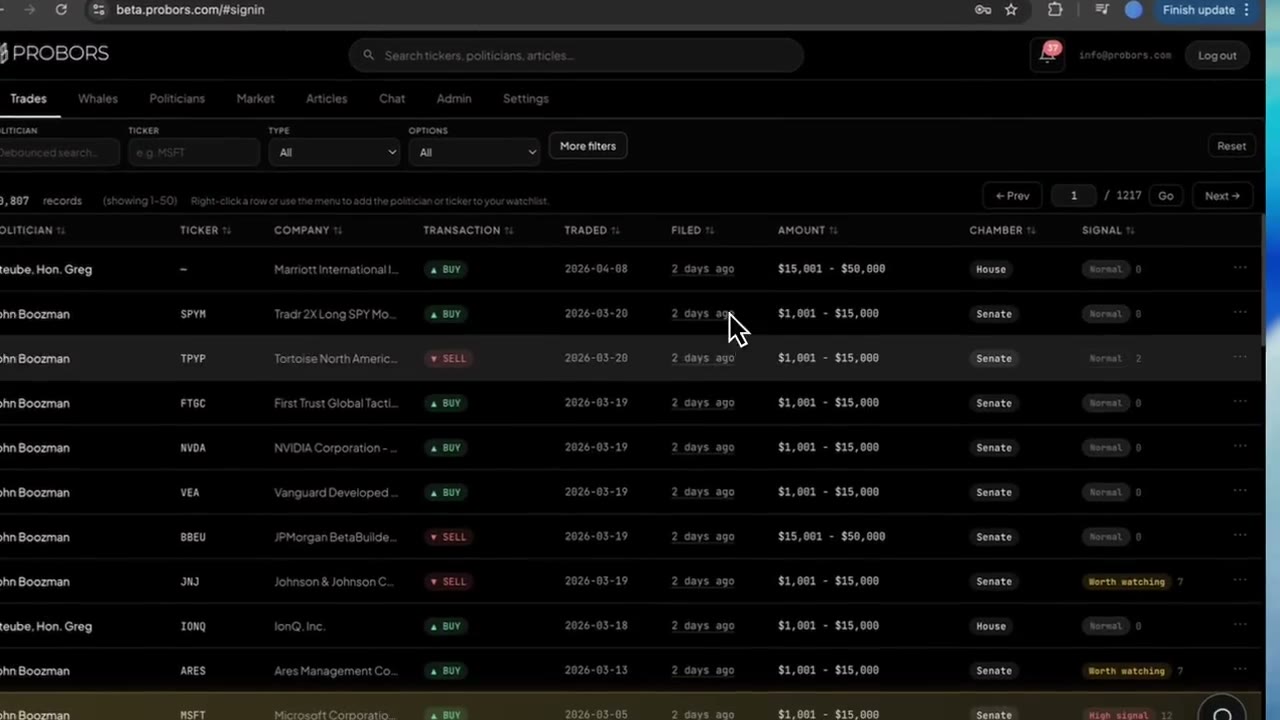
- Open the Whales tab from the dashboard and sort by filing date (newest first).
- Click Top tickers and toggle between 14-day and 30-day windows to see whether flow is sustained or spiking.
- Filter by ticker when a name like KYMR or UTHR hits your watchlist.
- Open a row to read transaction code, insider title, signal score, and footnote context.
- Jump to the Market workspace for the same ticker to overlay price action and congressional markers.
- Add tickers with recurring whale prints to a watchlist if you want alerts on the next filing—not on live price.
For tab navigation details, see the ProBors Whales tab guide. For the full triage checklist, see how to triage whale transactions on ProBors.
What this whale data does not prove
A sell-heavy whale leaderboard does not prove:
- That insiders traded on material non-public information
- That a ticker will fall because officers sold shares
- Exact share counts or post-trade holdings (Form 4 value fields are as reported, not always full position snapshots)
- That every code S row is discretionary—many reflect plans, tax events, or fund rebalancing
- That zero buys on a leaderboard ticker means no insider interest (smaller purchases below whale thresholds may exist elsewhere in Form 4 data)
Insider selling is often routine. The research value is prioritization: which tickers deserve a footnote read, a chart check, and a second pass against the original SEC filing.
FAQ
What counts as a "whale" transaction on ProBors?
ProBors surfaces large Form 4 filings that meet size thresholds for the Whales feed—typically high-dollar open-market prints and other reportable rows that stand out from routine compensation activity. The exact cutoff is applied during ingestion; use transaction code and reported value together, not size alone.
Why do so many top whale tickers show zero buys?
Post-IPO and high-growth names often see concentrated insider and early-investor sales as lock-ups expire and compensation vests. In a sell-heavy cycle, the leaderboard reflects distribution volume across many filers—not a market-wide bearish signal.
Should I short a stock because it tops the whale leaderboard?
No. Leaderboard volume is a research queue, not a trading signal. Verify each row on EDGAR, read footnotes for 10b5-1 plans, and treat the data as disclosure context. This is research context, not investment advice.
How often does ProBors refresh whale data?
Form 4 ingestion runs on a regular schedule. Check probors.com/status for the latest SEC Form 4 / Whales source health before citing rows in notes or publications.
Where can I learn more about insider buying clusters?
When multiple insiders buy on the same ticker in a short window, a different framework applies. See insider buying clusters: what to look for for open-market purchase triage.
Track whale flow on ProBors
Browse top tickers, filter Form 4 whales by signal score, and cross-check congressional and chart context in one workspace.
Get startedRelated reading
- How to triage whale transactions on ProBors
- Insider buying clusters: what to look for
- ProBors Whales tab guide
- Whale transaction tracking overview
- Why insider selling is usually not a signal
Sources
- SEC Form 4 overview — reporting requirements for insiders
- SEC EDGAR search — verify individual Form 4 filings
- SEC Section 16 reporting guide — insider transaction rules and deadlines
- Rows were checked in ProBors and should be verified against the original filing.
- Ingestion health: probors.com/status
Sources & methodology
Last updated:
ProBors uses public disclosure records, SEC filings, House and Senate financial disclosure portals, market data, and in-product workflow checks. Articles are written as research education, not investment advice.