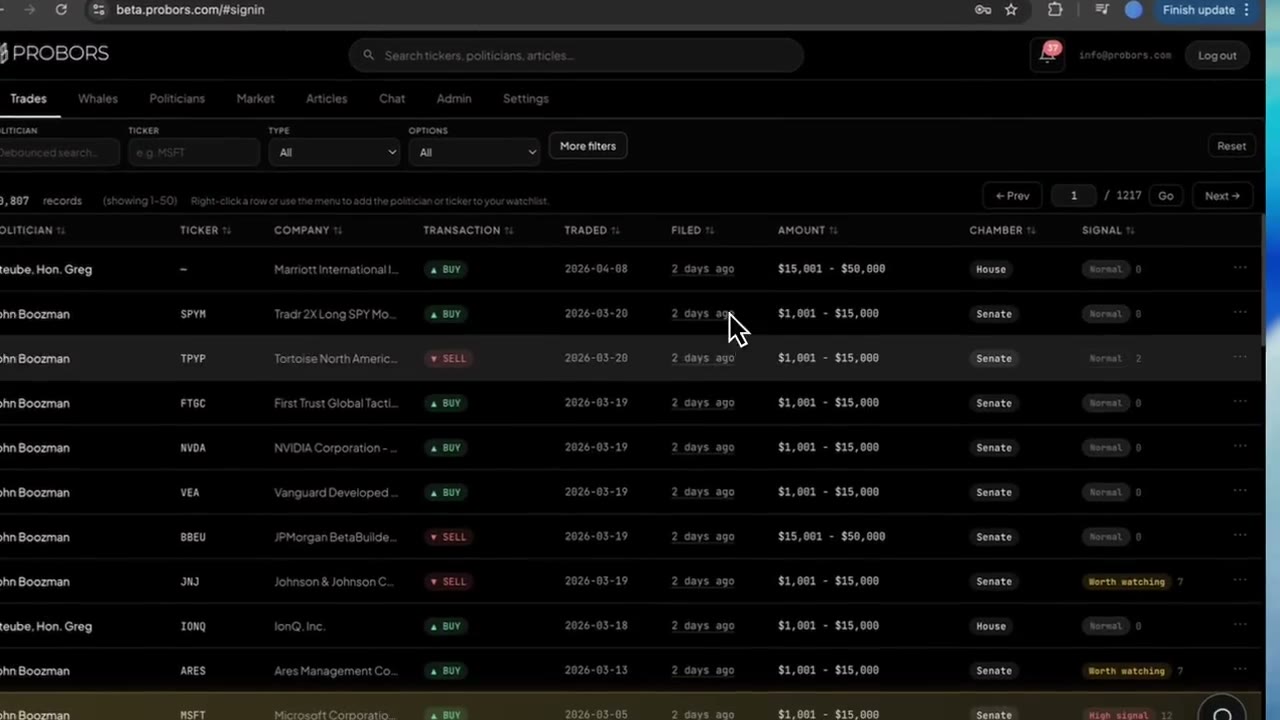
SEC EDGAR is the authoritative source for Form 4 insider filings and most public-company SEC submissions. ProBors is a research workspace that normalizes congressional STOCK Act disclosures, insider whale rows, signal scoring, and market context on the same ticker. If your only question is "what did this officer file yesterday?" EDGAR alone may be enough. If you routinely cross-check House and Senate trades, cluster insider activity, and track filing lag across chambers, jumping between EDGAR, House Financial Disclosure search, and Senate eFD adds friction fast. This is research context, not investment advice.
Quick answer
Choose SEC EDGAR and official STOCK Act portals when you need the raw filing PDF or XML for legal citation, audit trails, or one-off verification.
Choose ProBors when you run a repeat disclosure loop across congress, insiders, watchlists, and charts—and want signal-ranked tables without rebuilding the same joins every morning.
Many researchers verify final claims on EDGAR or .gov sources and use ProBors for daily triage. That combination is sound practice.
Side-by-side comparison
| Capability | SEC EDGAR + official STOCK Act sources | ProBors |
|---|---|---|
| Primary focus | Authoritative raw filings (Form 4, 10-K, etc.) and official PTR uploads | Unified congress + insider whale research workspace |
| Congressional trade search | Separate House and Senate portals; formats differ by chamber | House and Senate rows in one filterable feed |
| Insider Form 4 browsing | Full EDGAR search with original documents | Parsed rows with whale sizing, roles, and filing lag |
| Cross-chamber ticker view | Manual — you stitch House, Senate, and EDGAR yourself | Built-in — same ticker across congress and insiders |
| Trade signal scores | No | Yes on congress and whale rows for triage |
| Watchlist + inbox alerts | No native alert layer on EDGAR | Yes — ticker, politician, and disclosure-driven |
| Market charts next to filings | External charting site required | Built-in with optional disclosure markers |
| AI research on live disclosure data | No | Yes — table-style answers on trades and tickers |
| Best fit | Verification, legal citation, deep document review | Daily disclosure monitoring and cross-source triage |
What SEC EDGAR and official sources do well
Government-hosted filings remain the gold standard for source of truth. Researchers reach for them when they need to:
- Open the original Form 4 XML or HTML and read transaction codes line by line
- Confirm officer title, share count, and price fields before publishing
- Pull 10-K, 8-K, or proxy materials alongside insider activity
- Download House Periodic Transaction Reports from the House Clerk Financial Disclosure database
- Review Senate periodic transaction reports through Senate eFD search
EDGAR is free, permanent, and court-defensible. For a single-company deep dive where you will read every footnote, starting on EDGAR is the right instinct.
Where official sources stop and ProBors picks up
Official portals were not designed for cross-source daily monitoring. Common friction points:
- Split workflows — Form 4 on EDGAR, House PTR on the Clerk site, Senate rows on eFD; three logins, three search UIs, three export habits.
- No unified ticker lens — asking "what happened on NVDA across congress and insiders this month?" means manual reconciliation.
- Filing lag is on you — EDGAR shows filed date; comparing it to transaction date and to a Senate batch upload requires spreadsheet work.
- No alert layer — EDGAR does not email you when a tracked politician files or a whale line lands.
- No signal triage — every Form 4 and PTR row looks equally loud until you apply your own filters.
ProBors does not replace EDGAR for legal proof. It compresses the repeat research loop: filter, rank, watchlist, chart, then click through to verify on the original filing when a row matters.
How to combine both in a seven-step workflow
A practical hybrid workflow many disclosure researchers use:
- Start in ProBors for triage — sort recent congress or whale rows by filing date or signal score.
- Note transaction date and filed date — log both before inferring timing edge.
- Open the original filing — use the source link on the row or search EDGAR /
.govdirectly for citation. - Cross-check chamber — if the ticker is hot in the House, scan Senate rows on the same symbol in ProBors before closing the tab.
- Review market context — compare transaction date to price action; remember PTR and Form 4 deadlines allow multi-week lag.
- Add to a watchlist — let the next filing hit your inbox instead of refreshing EDGAR manually.
- Archive the EDGAR accession or PTR URL — keep the government link in your notes for anything you might publish.
Steps 1, 4, and 6 are where ProBors saves time; steps 3 and 7 are where EDGAR and official STOCK Act pages keep you honest.
Common mistakes when comparing EDGAR and ProBors
- Treating a parsed table as the legal record — always open the underlying Form 4 or PTR before external citation.
- Ignoring chamber differences — House PTR layout and Senate periodic reports use different fields; ProBors normalizes them, but verification still happens on
.gov. - Assuming EDGAR freshness equals trade date — insiders and members file on different calendars; lag can be days or weeks.
- Skipping EDGAR because a dashboard is faster — speed helps triage; authority lives on the government copy.
- Paying for a workspace you only use monthly — if you verify one filing a quarter, EDGAR alone may suffice.
When to choose each
Stay with EDGAR and official STOCK Act portals if you:
- Need primary-source documents for compliance, journalism, or litigation support
- Research one company deeply and rarely follow congressional overlap
- Do not need watchlists, alerts, or cross-chamber tables
- Prefer zero subscription cost and accept manual assembly
Add ProBors if you:
- Monitor dozens of tickers or politicians on a recurring schedule
- Cross-check congress and insider whales on the same symbol weekly
- Want signal-ranked triage before you spend time on EDGAR deep reads
- Need charts, watchlists, and AI summaries in the same session as disclosure rows
Use both if you publish or advise: ProBors for discovery, EDGAR and .gov links for the final footnote.
FAQ
Is ProBors a replacement for SEC EDGAR?
No. ProBors is a research workspace built on top of public disclosures. EDGAR and official STOCK Act uploads remain the authoritative copies. Use ProBors to find and rank rows; use EDGAR to verify anything you cite externally.
Can I get Form 4 data only from EDGAR?
Yes. Every Form 4 filed by reporting insiders appears in EDGAR. Third-party tools parse that feed into tables, alerts, and scores. The trade-off is assembly time, not data availability.
Does ProBors include House and Senate filings EDGAR does not?
Congressional periodic transaction reports are filed on House and Senate systems, not as standard EDGAR Form 4 rows. ProBors aggregates those chamber-specific disclosures alongside insider data so you do not maintain three parallel bookmarks.
Which is better for journalists on deadline?
EDGAR wins when you already know the accession number or exact filing date. ProBors wins when you need "largest congressional purchases filed this week" or a politician's recent tickers without building a spreadsheet first—then you confirm on .gov before publish.
Do I need both if I already use OpenInsider?
OpenInsider covers insider tables well. If you also track congress, ProBors adds that layer; EDGAR still backs verification. See our OpenInsider vs ProBors workflow guide for insider-specific comparisons.
Research disclosures faster, verify on EDGAR
Use ProBors to triage congress and insider rows, then open the original filing before you cite anything.
Get startedRelated reading
- How to read politician trade disclosures
- Form 4 insider buying tracker guide
- STOCK Act filing delay explained
- OpenInsider vs ProBors insider workflow
- How to combine congress and insider research
Sources
- SEC EDGAR full-text search
- SEC Form 4 overview
- House Clerk Financial Disclosure search
- Senate eFD financial disclosure search
- STOCK Act (Pub. L. 112-105)
- Rows were checked in ProBors and should be verified against the original filing. Ingestion health: probors.com/status.
Sources & methodology
Last updated:
ProBors uses public disclosure records, SEC filings, House and Senate financial disclosure portals, market data, and in-product workflow checks. Articles are written as research education, not investment advice.