
When a sitting member of the U.S. House of Representatives repeatedly buys stocks across multiple sectors in the same reporting cycle, it draws attention. Over the past week, Hon. Gilbert Cisneros disclosed a series of buys — including shares of Alibaba Group Holding Limited (NYSE: BABA) — alongside purchases in major U.S. equities such as Amazon, Microsoft, JPMorgan, and more.
In this article, we break down what these trades might indicate, offer key context on Alibaba (BABA) as a long-term equity, and explain why tracking political and insider transactions before headlines can give investors an informational edge.
Cisneros’s Recent Disclosure Activity
According to filed disclosures, Rep. Gilbert Cisneros reported multiple buys within the most recent 7-day cycle:
-
Alibaba Group Holding (BABA) — Buy recorded as $15,001 – $50,000
-
L Brands (LB) — Buy, same range
-
Logan’s Roadhouse (LGN) — Buy, $1,001 – $15,000
-
JPMorgan Chase (JPM) — Buy, $1,001 – $15,000
-
Alkermes (ALKT) — Buy, $1,001 – $15,000
-
AstraZeneca (AZSEY) — Buy, $1,001 – $15,000
-
Alphabet (GOOGL) — Buy and later Sale, both $1,001 – $15,000
-
Amazon (AMZN) — Buy(s) including a larger $15,001 – $50,000 range
-
Amcor (AMCR) — Buy, $1,001 – $15,000
-
Comcast (CMCSA) — Sale, $1,001 – $15,000
-
Cargill (CAG) — Buy, $1,001 – $15,000
-
Constellation Brands (STZ) — Buy, $1,001 – $15,000
-
Clearway Energy (CTRA) — Buy, $1,001 – $15,000
-
Mastercard (MA) — Buy, $1,001 – $15,000
-
McKesson (MCK) — Buy, $1,001 – $15,000
-
MercadoLibre (MELI) — Buy, $1,001 – $15,000
-
Merck (MRK) — Buy, $1,001 – $15,000
-
Meta Platforms (FB) — Buy, $1,001 – $15,000
-
Microsoft (MSFT) — Buy, $50,001 – $100,000

This pattern is heavy on diversification across industries, but the BABA purchase is one of the larger discrete allocations reported.
What Alibaba (BABA) Actually Is and Why It Matters
Alibaba Group is one of the world’s largest e-commerce and technology companies, with a diversified digital ecosystem spanning online marketplaces, cloud computing, financial services, logistics, and digital media. The company was founded in 1999 and has grown into a global player — with its ADRs listed on the NYSE — thanks to the scale of platforms like Taobao, Tmall, and Alibaba Cloud.
Stock Performance and Macro Context

-
Alibaba’s stock has gained strongly over the last year, with year-to-date returns in the range of roughly 70–80%.
-
The 52-week range shows significant volatility, with lows near ~$80 and highs above $190.
-
Recent trading has been choppy, partly due to U.S. economic sentiment and mixed Chinese economic data impacting Chinese tech ADRs.
-
BABA still trades materially below its yearly peak, suggesting near-term investor caution even amid longer-term growth narratives.
Alibaba’s fundamentals remain diversified. The company continues to invest heavily in cloud services and AI initiatives, and although these investments have weighed on earnings in certain periods, analysts still highlight growth potential tied to these segments.

Intercepting the Pattern: Political Trading as Data
Filings under the STOCK Act require U.S. policymakers to disclose their trades. These disclosures often arrive weeks after the trade date, but they still offer a layer of transparency not available in private markets.
In the case of Rep. Cisneros:
-
The multiple buys in a single reporting cycle suggest active portfolio management, not incidental trading.
-
The mix of large-cap U.S. stocks plus a major ADR like Alibaba points to a strategy that blends defensive and growth exposures.
-
The relatively larger allocation to tech giants (like MSFT and BABA) may reflect confidence in secular trends even amid economic headwinds.
It’s crucial to note that disclosures are not proof of any advantage or nonpublic information usage by policymakers. Instead, they provide publicly reportable behavior that can be analyzed for patterns over time.
Why the BABA Buy Stands Out
Among the disclosed purchases:
-
The BABA allocation sits in a higher disclosure range ($15,001 – $50,000) compared with many $1,001 – $15,000 positions.
-
Alibaba is a large, global technology and commerce platform with a history of volatility, growth, and transformation.
-
The size of the buy suggests a meaningful tactical choice rather than a token small lot trade.
When combined with broader market context — like Alibaba’s robust cloud growth and AI positioning — this signals an interesting convergence of political portfolio moves with structural business narratives. Zacks
Implications for Traders and Long-Term Investors
Traders and long-term investors can use political and insider trades as an additional data layer, not a standalone signal. Consider:
✔ Ownership trends rather than isolated trades ✔ Sector diversification among trades ✔ Macro conditions that may influence timing ✔ Correlation with fundamentals like revenue and cloud growth
Adding this behavioral layer to your strategy can help contextualize positioning in names like BABA before broad market sentiment shifts.
Track These Moves Before Headlines Hit
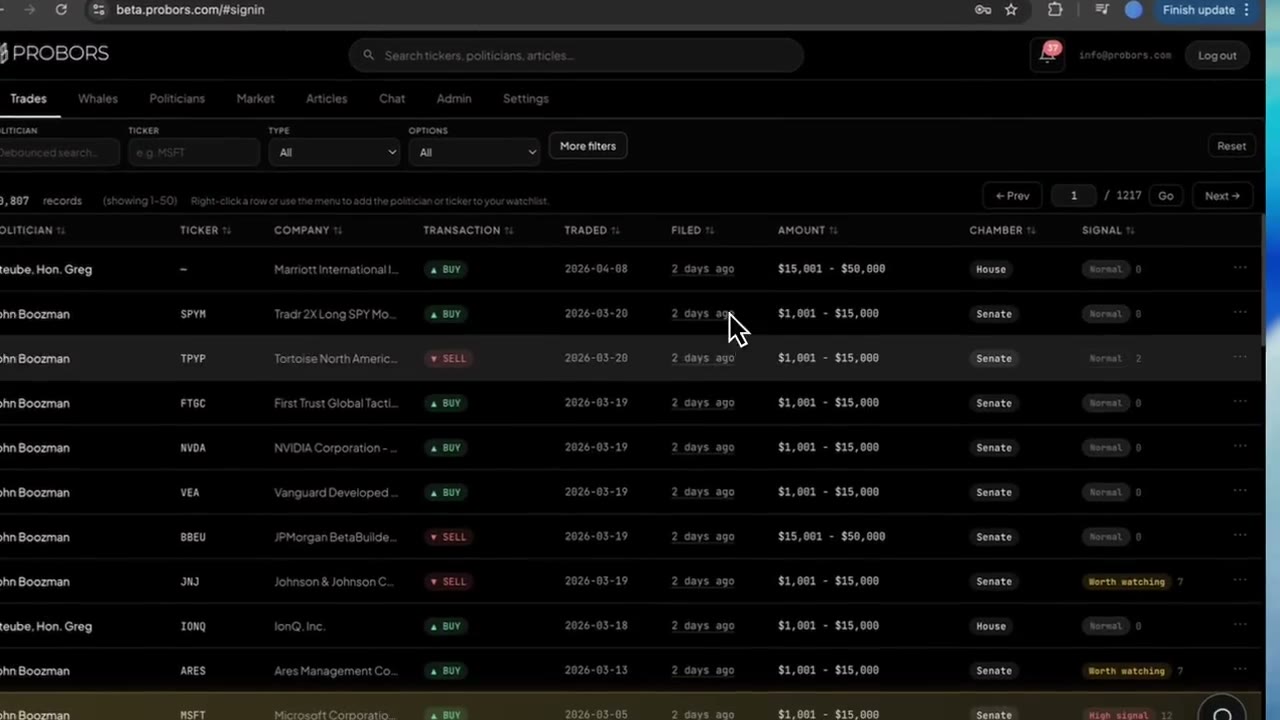
If you want to monitor political and insider trades as soon as they are filed, with ownership impact, trade filters, and pattern detection, check out ProBors.com — where trades show up before most aggregator delays.
👉 Track insider and politician trades in real time at ProBors.com
Sources & methodology
Last updated:
ProBors uses public disclosure records, SEC filings, House and Senate financial disclosure portals, market data, and in-product workflow checks. Articles are written as research education, not investment advice.