NVDA congressional disclosures draw attention because NVIDIA is a liquid mega-cap at the center of AI infrastructure debates—and because PTR rows on the name arrive from both the House and Senate on different timelines. This spotlight walks through recent NVIDIA rows in ProBors, how to read filing lag on a hot ticker, and what the disclosure record does not prove. It is research context, not investment advice.
Why NVDA shows up in congress trackers
NVIDIA appears in congressional Periodic Transaction Reports (PTRs) for the same reasons other large-cap tech names do: index exposure, broad retail familiarity, and portfolio rebalancing—not because every PTR row implies policy foresight.
Useful research questions on NVDA are narrower:
- Which members filed NVIDIA activity in the last 90 days?
- Was each row a purchase, sale, partial sale, or another transaction type?
- How many days passed between the transaction date and the public filing date?
- Does the amount range suggest a small rebalance or a larger position change?
- Did House and Senate activity cluster around the same calendar window?
A ticker spotlight should answer those fields from source-backed rows, then let you decide whether deeper chart or insider review is warranted.
Recent NVDA congressional rows (production snapshot)
The table below is a read-only snapshot from authenticated ProBors production data pulled 2026-06-19T07:10:00+00:00. The research pass covered roughly 90 days of congressional disclosures and a separate insider-activity sample for context.
Rows are sorted by filing date (newest first). Filing lag is calendar days between transaction date and filed date as reported in ProBors.
| Politician | Type | Traded | Filed | Lag (days) | Amount range | Chamber |
|---|---|---|---|---|---|---|
| Matthew Robert Van Epps | Sale | 06/16/2026 | 06/17/2026 | 1 | $1,001 – $15,000 | House |
| Sheldon Whitehouse | Sale | 05/08/2026 | 06/02/2026 | 25 | $100,001 – $250,000 | Senate |
| Daniel Meuser | Sale (Partial) | 04/24/2026 | 05/12/2026 | 18 | $1,001 – $15,000 | House |
| Gilbert Cisneros | Sale (Partial) | 04/14/2026 | 05/07/2026 | 23 | $1,001 – $15,000 | House |
| John McGuire | Purchase | 04/15/2026 | 05/01/2026 | 16 | $1,001 – $15,000 | House |
| Tim Moore | Sale | 03/24/2026 | 04/24/2026 | 31 | $15,001 – $50,000 | House |
| Daniel Meuser | Sale | 03/25/2026 | 04/14/2026 | 20 | $1,001 – $15,000 | House |
| Daniel Meuser | Sale | 03/25/2026 | 04/14/2026 | 20 | $1,001 – $15,000 | House |
| John Boozman | Purchase | 03/19/2026 | 04/14/2026 | 26 | $1,001 – $15,000 | Senate |
| John Boozman | Purchase | 03/19/2026 | 04/14/2026 | 26 | $1,001 – $15,000 | Senate |
| Elizabeth Fletcher | Sale | 04/08/2026 | 04/13/2026 | 5 | $1,001 – $15,000 | House |
| Gilbert Cisneros | Sale | 03/25/2026 | 04/06/2026 | 12 | $1,001 – $15,000 | House |
Snapshot summary (filed since 2026-03-21): 14 NVDA PTR rows in this window—10 sales, 4 purchases; 11 House, 3 Senate. Median filing lag: 20 days (range 1–31 days).
Always verify individual rows against the official source before citing them:
- House PTR search: disclosures-clerk.house.gov
- Senate eFD search: efdsearch.senate.gov
How to read the NVDA pattern without overfitting
Three patterns stand out in this window—and none of them are trading signals on their own.
1. Cross-chamber activity is normal on mega-caps
NVDA rows in the snapshot span both chambers. Senate sales (Whitehouse) and House partial sales (Meuser, Cisneros) can coexist without implying coordinated timing. Mega-cap names appear in many diversified portfolios. The research task is to separate coincident calendar overlap from causation.
2. Filing lag varies more than ticker direction
Van Epps filed an NVDA sale one day after the transaction date. Whitehouse’s Senate sale shows a 25-day gap between trade and filing. Fletcher’s House sale filed in five days. That spread is why congressional trackers must show both dates—see the STOCK Act filing delay guide for the legal 30/45-day framework.
3. Amount ranges change how you weight a row
Whitehouse’s disclosed range ($100,001–$250,000) is materially larger than the typical $1,001–$15,000 band that dominates this NVDA sample. Size does not prove intent, but it does affect how you prioritize follow-up: chart review, committee context, and whether the row is a one-off rebalance.
NVDA research workflow in ProBors
Use a ticker-first workflow when NVIDIA is already on your watchlist:
- Open Market → NVDA (or search
NVDAin the dashboard). - Scroll to the Congress trades table and sort by filed date.
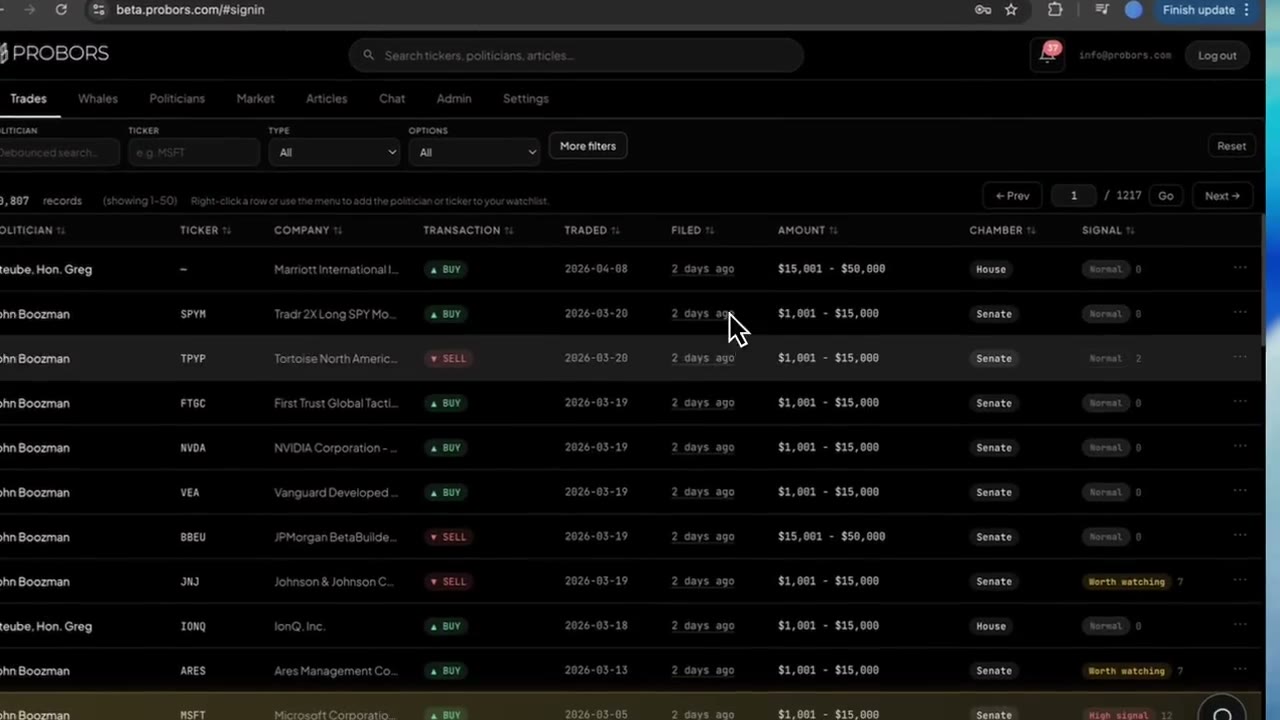
- Click a row to open trade context—transaction type, amount range, chamber, and signal tier.
- Toggle congress markers on the price chart to see where disclosures landed relative to daily bars.
- Cross-check Form 4 / whale activity on the same ticker before treating a PTR row as isolated.
- Add NVDA to a watchlist if you want alerts on the next filing—not on live price.
For chart marker details, see the market chart congress markers guide. For the full ticker workspace layout, see the market workspace guide.
Insider context: why congress rows are only half the picture
Congressional PTRs are one disclosure lane. NVIDIA also generates heavy Form 4 volume from executives and directors. The same production snapshot on 2026-06-19 showed recent insider activity on NVDA, including executive grants and sales filed in early June 2026.
That matters because social posts often blend “Congress sold NVDA” with “insiders sold NVDA” as if they are the same event. They are different filing regimes, different deadlines, and different interpretive rules. Keep PTR and Form 4 lanes separate in your notes.
What this NVDA data does not prove
A congressional disclosure table on NVIDIA does not prove:
- That members traded on non-public information
- That NVDA will rise or fall because a PTR was filed
- Exact share counts or dollar proceeds (ranges are bands, not precise fills)
- Real-time intent—most rows in this sample posted days or weeks after the transaction date
- Committee influence or policy outcomes tied to a single trade line
PTR data is a public record for transparency, not a timing edge. The useful output is a verified research trail: who filed, what type, when it traded, when it became public, and how that row compares to other disclosures on the same ticker.
Data freshness
ProBors publishes ingestion health at probors.com/status. When you cite an NVDA PTR row, log the pull timestamp above plus the official House or Senate source link from the row context.
Research NVDA disclosures in one workspace
Filter congressional PTRs by ticker, overlay markers on price, and cross-check insider filings on ProBors.
Get startedSources & methodology
Last updated:
ProBors uses public disclosure records, SEC filings, House and Senate financial disclosure portals, market data, and in-product workflow checks. Articles are written as research education, not investment advice.