Short answer: a House stock trading tracker helps you monitor Periodic Transaction Report (PTR) filings from U.S. representatives, but the useful workflow is not just spotting a ticker headline. You need transaction date, filing date, amount range, chamber, source document, and market context in one place.
ProBors ingests House PTR data on a recurring schedule alongside Senate and SEC Form 4 feeds. As of June 16, 2026, the platform tracks 735 politicians and 4,566 tickers across congressional and insider disclosures. This guide explains how to research House rows without misreading filing lag. It is research software, not investment advice.
What House PTR disclosures show
House members file PTRs when they buy, sell, or exchange reportable securities. The fields that matter for research are usually:
- Representative name
- Asset or ticker
- Transaction type (purchase, sale, partial sale, exchange)
- Transaction date
- Filing date
- Amount range
- Owner or account context when available
- Source chamber (
House)
House filings often use amount brackets (for example $1,001–$15,000 or $15,001–$50,000). Treat those as magnitude bands, not exact position sizes.
The filing date is almost always later than the transaction date. A trade that happened in early June may not appear in public data until mid-June. That gap is normal—and it is why delayed disclosures should not be read like real-time signals.
Verified House examples from ProBors data
These rows come from live ProBors API data pulled on June 16, 2026. Always verify against the official House disclosure portal before citing a specific trade.
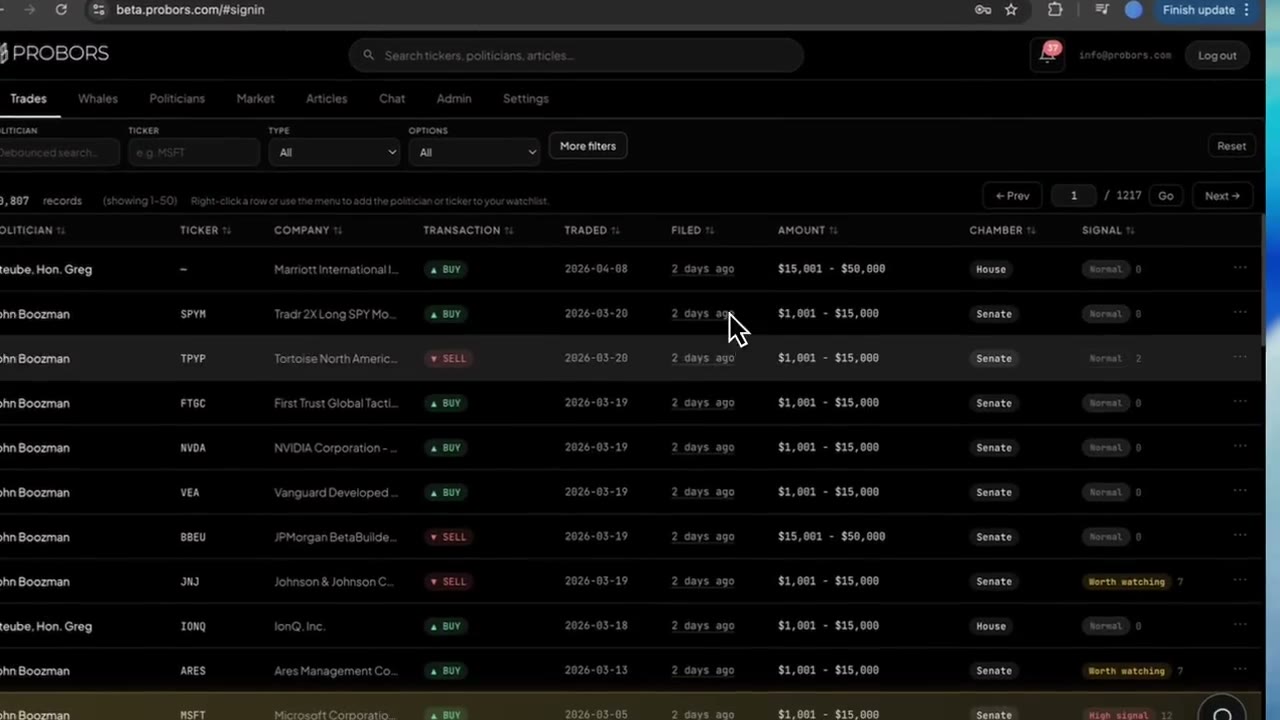
| Representative | Ticker | Type | Traded | Filed | Amount range | Source |
|---|---|---|---|---|---|---|
| Taylor, Hon. David J. | GOOGL | Purchase | 06/05/2026 | 06/11/2026 | $1,001 – $15,000 | House |
| Cisneros, Hon. Gilbert | IBM | Sale | 05/15/2026 | 06/05/2026 | $15,001 – $50,000 | House |
| Meuser, Hon. Daniel | NVDA | Sale (Partial) | 04/24/2026 | 05/12/2026 | $1,001 – $15,000 | House |
The GOOGL row shows a six-day gap between transaction and filing. The IBM sale filed about three weeks after the trade date. Both are typical PTR timing patterns—not bugs in the tracker.
House tracker workflow
Use this workflow when you monitor representatives by ticker or watchlist:
- Start with the ticker or representative name.
- Filter to House when you need chamber-specific PTR rows.
- Compare transaction date with filing date on every row.
- Review transaction type and amount range before inferring direction.
- Open trade context to see price movement and signal notes.
- Cross-check Senate, insider, and whale activity on the same ticker.
This turns House PTR browsing into a repeatable research loop instead of manual portal searches.
House vs Senate tracking
House and Senate disclosures answer the same STOCK Act requirement but live on different portals with different search UX. A good tracker should let you compare chambers without losing source context.
| Need | House clerk portal workflow | ProBors workflow |
|---|---|---|
| Official PTR access | Yes | Source chamber visible on each row |
| Ticker search | Manual | Built into filters |
| Filing lag review | Manual | Transaction vs filed dates in table |
| Senate comparison | Separate portal | Combined congress workflow |
| Insider and whale cross-check | Separate tools | Same workspace |
| Watchlist monitoring | Manual | Built for repeat tracking |
Official House disclosures remain the citation layer. ProBors is the research layer that helps you find, sort, and contextualize rows faster.
Cross-chamber ticker research: NVDA example
Ticker-level research often surfaces both chambers. On NVDA, ProBors currently shows Senate and House activity with different filing windows—for example:
- Sheldon Whitehouse (Senate): sale filed 06/02/2026 for a transaction dated 05/08/2026, amount range $100,001–$250,000.
- Daniel Meuser (House): partial sale filed 05/12/2026 for a transaction dated 04/24/2026, amount range $1,001–$15,000.
- Gilbert Cisneros (House): partial sale filed 05/07/2026 for a transaction dated 04/14/2026, amount range $1,001–$15,000.
The point is not that NVDA moved because of these filings. The point is that a House stock trading tracker should make chamber, timing, and size visible so you can decide whether the cluster deserves deeper review.
Data freshness and source health
ProBors publishes ingestion health at probors.com/status. On June 16, 2026, the House PTR source (house-ptr) showed healthy status with a roughly 15-minute expected cadence. Senate PTR and SEC Form 4 sources were also healthy.
When you cite a House trade in research notes, log both the transaction date and the ingestion snapshot date. PTR data is public, but it is not real time.
Politician portfolio context (optional layer)
House PTR rows show individual transactions. ProBors also surfaces politician portfolio return summaries for members with snapshot coverage—for example disclosed portfolio metrics for representatives such as Hakeem Jeffries and Josh Gottheimer as of June 16, 2026.
Portfolio returns are a separate lens from single-trade alerts. They can help you understand whether a PTR row fits a broader pattern, but they do not explain why a representative traded or predict future performance.
What to avoid
Avoid these common mistakes when using a House stock trading tracker:
- Treating filing date and transaction date as the same date.
- Converting an amount range into a fake exact dollar value.
- Ignoring partial sale or exchange transaction types.
- Assuming a representative's trade explains future stock performance.
- Citing a tracker screenshot without opening the official House source.
The reliable workflow is slower: source first, then context, then watchlist.
Sources and methodology
Verify any specific House row against official sources before citing it:
- House public financial disclosure portal
- House Periodic Transaction Report calculator
- Senate electronic financial disclosure search
- STOCK Act bill text
- ProBors data status page
ProBors is research software for monitoring and triage. It does not provide personalized investment advice, guarantee future returns, or prove why a representative made a transaction.
Monitor House PTR trades with ticker context
Search House and Senate disclosures, open trade context, and connect rows to market and insider activity on ProBors.
Get startedFAQ
What is a House stock trading tracker?
A House stock trading tracker helps you monitor disclosed representative transactions from PTR filings, including ticker or asset, transaction type, transaction date, filing date, amount range, and source chamber.
Are House PTR disclosures the same as Senate disclosures?
They are part of the same STOCK Act ecosystem, but the filing portals and report formats differ. A useful tracker should let you filter by chamber while keeping the original source context available.
Why does filing lag matter for House trades?
Filing lag matters because the trade may have happened days or weeks before the PTR became public. If you ignore that gap, a delayed disclosure can look like a fresh market signal when it is actually historical context.
How often does ProBors refresh House PTR data?
Check probors.com/status for live ingestion health. House PTR syncs on a recurring schedule (roughly every 15 minutes when healthy).
Bottom line
A House stock trading tracker is valuable when it helps you verify the PTR row and understand ticker context. Start with the source disclosure, separate filing date from transaction date, and use ProBors to connect House trades with Senate, insider, whale, and market activity in one workspace.
Related reading
Sources & methodology
Last updated:
ProBors uses public disclosure records, SEC filings, House and Senate financial disclosure portals, market data, and in-product workflow checks. Articles are written as research education, not investment advice.