Insider buying clusters are when two or more reporting owners file open-market purchases in the same company within a short window. That pattern can mean shared conviction—or a routine compensation-adjacent buy program that looks louder in aggregate than it is. The practical question is not “did insiders buy?” but whether the cluster is open-market, recent, sized meaningfully, and filed on time. This guide walks through a triage framework, recent examples from ProBors as of mid-June 2026, and what clustered Form 4 activity does not prove. It is research context, not investment advice.
Why clusters get attention
A single insider purchase might be small, indirect, or tied to a plan. A cluster raises different questions:
- Did more than one officer or director add exposure around the same calendar week?
- Are the transaction codes open-market purchases (code P), or grants and gifts mixed in?
- Are dollar values large relative to each insider’s history, or token amounts?
- Did filings arrive within the usual two-business-day Form 4 window, or with unusual delay?
- Does the same ticker also show whale-scale prints or congressional activity you already track?
Clusters are a prioritization signal. They help you decide which tickers deserve chart review, footnote reading, and a second pass against the original SEC filing—not automatic bullishness.
A five-step triage framework
Use the same checklist every time so loud micro-caps do not crowd out quieter but cleaner patterns.
1. Confirm the transaction code
Open-market purchases use SEC transaction code P. Grants (A), gifts (G), and option exercises are different stories. A “cluster” of grants is not the same as a cluster of discretionary buys. ProBors surfaces trade_type and the SEC code in the whale and Form 4 views—start there before you name a cluster.
2. Count distinct reporting owners
Two purchases from the same fund on consecutive days is accumulation by one economic actor. Three purchases from a CEO, CFO, and another officer on the same trade date is a different shape. Tag whether buyers are individuals, entities, or 10% holders.
3. Measure size and filing speed
Note share count, reported value, and filing lag in calendar days (filed date minus trade date). Form 4 is generally due within two business days after the transaction; longer gaps deserve a footnote check on SEC EDGAR.
4. Compare to the whale leaderboard—not just buys
In the last 14 days through mid-June 2026, ProBors whale activity skews heavily toward sales on liquid names: DELL (567 large prints, zero buys), CRWV (199 prints, zero buys), and CRWD (185 prints, zero buys) lead by transaction count. SOFI is an exception with one buy among 63 whale-class rows. A buy cluster on a small cap matters differently when mega-cap flow is exit-heavy—context keeps you from overfitting one ticker.
5. Cross-check congress and chart context
Before elevating a cluster, open the ticker workspace on ProBors: review price reaction, any congressional rows, and whether the AI summary flags earnings or corporate actions. For signal scoring details, see how ProBors trade signal scores work.
Recent cluster examples in ProBors
The table below shows deduplicated open-market purchase rows filed around June 18, 2026 in ProBors. Lag is calendar days between trade date and filing date as reported in the platform.
| Company / Ticker | Insider | Title | Traded | Filed | Lag | Reported value |
|---|---|---|---|---|---|---|
| Stellus Private Credit BDC (no ticker) | Ladd Robert T. | CEO and President | June 16, 2026 | June 18, 2026 | 2 days | $22,211 |
| Stellus Private Credit BDC (no ticker) | D'Angelo Dean | — | June 16, 2026 | June 18, 2026 | 2 days | $18,506 |
| Stellus Private Credit BDC (no ticker) | Huskinson W. Todd | CFO, CCO and Secretary | June 16, 2026 | June 18, 2026 | 2 days | $3,296 |
| YY Group Holding (YYGH) | HRT FINANCIAL LP | — | June 16, 2026 | June 18, 2026 | 2 days | $265,402 |
| YY Group Holding (YYGH) | HRT FINANCIAL LP | — | June 17, 2026 | June 18, 2026 | 1 day | $72,820 |
| Vision Marine Technologies (VMAR) | HRT FINANCIAL LP | — | June 16, 2026 | June 18, 2026 | 2 days | $68,967 |
| WhiteHorse Finance (WHF) | BOLDUC JOHN | — | June 18, 2026 | June 18, 2026 | same day | $49,908 |
How to read this snapshot without overfitting:
- Stellus shows a classic multi-insider cluster: three reporting owners with code P purchases on the same trade date and a consistent two-day filing lag. Values are mid-five-figure and low four-figure—not whale-scale, but the officer coverage is the story.
- YYGH is consecutive-day buying by one entity (HRT FINANCIAL LP), not three independent officers. Treat it as staged accumulation; verify the footnotes on EDGAR before inferring management alignment.
- VMAR pairs with the YYGH pattern from the same filer in the same week—useful for watchlist grouping, not proof of a sector thesis.
- WHF includes ongoing purchase activity from multiple insiders over May–June; the June 18 row filed same-day is timely but part of a longer program.
ProBors scored the VMAR row as Worth watching (signal score 6) while several Stellus rows scored lower—size, liquidity, and history matter as much as headcount.
What this does not prove
Clustered insider purchases do not by themselves show:
- Non-public information or illegal trading
- That price will rise on any horizon
- That every buyer shared the same rationale (DRIP-like programs, director fees, and coordinated entity buys all cluster visually)
- Exact dollars when the filing uses derived values or missing prices
Treat clusters as a reason to open the filing PDF, not as a trade trigger.
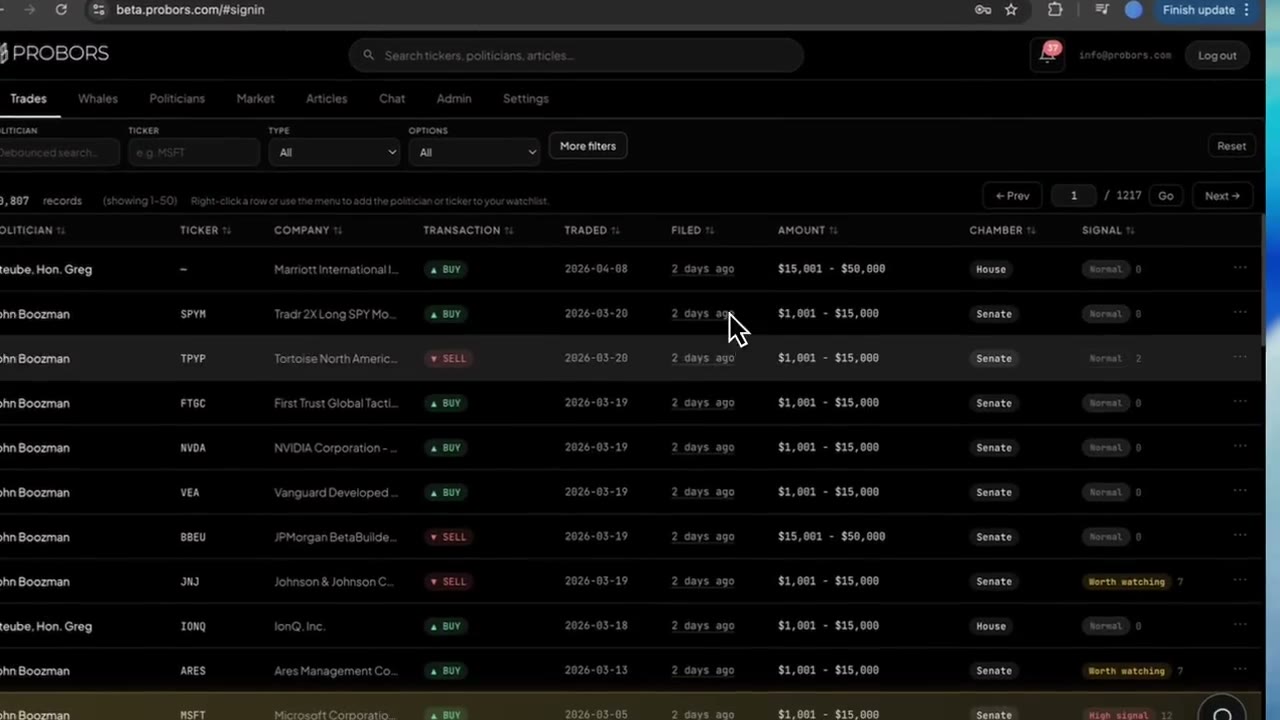
How to research insider clusters on ProBors
- Open Whales or the insider feed and filter to Purchase / code P.
- Sort by filing date to catch fresh multi-filer waves.
- Click a row for transaction value, ownership change, and SEC code context.
- Search the ticker (or company name when ticker is missing) in Market to layer chart and congressional markers.
- Add the name to a watchlist if you want the next filing—not intraday price alerts.
- Read footnotes on EDGAR before sharing the cluster externally.
For broader whale workflow tips, see whale transaction tracking. For purchase-versus-grant basics, see the Form 4 insider buying tracker.
FAQ
How many insiders count as a cluster?
There is no official threshold. Two independent officers buying within a week is worth a note; three or more on the same trade date is stronger for triage. Always separate entity accumulation from multiple human insiders.
Are insider buying clusters bullish?
They can indicate voluntary buying, but grants, gifts, and tiny purchases also cluster visually. Code P, size, and footnotes matter more than the headline count.
How fast should Form 4 purchases be filed?
The SEC generally expects Form 4 within two business days after the transaction. ProBors shows trade and filing dates side by side so you can spot late rows quickly.
Do whale leaderboards highlight buying clusters?
Whale leaderboards emphasize large prints by volume. In mid-June 2026 the 14-day board is dominated by sales on names like DELL and CRWD. Use ticker-level purchase filters to find buy clusters the leaderboard de-emphasizes.
Can I get alerts when a cluster forms?
Yes—add the ticker or insiders to a ProBors watchlist so new Form 4 purchases notify you on the next filing cycle. See ProBors watchlist alerts.
Triage insider clusters in one workspace
Filter Form 4 purchases, review signal scores, and compare whale activity with congressional context on ProBors.
Get startedRelated reading
- Form 4 insider buying tracker
- Whale transaction tracking
- ProBors trade signal scores
- Insider and whale tracker alternatives
Sources
- SEC Form 4 overview
- SEC investor bulletin: Forms 3, 4, and 5
- SEC EDGAR company search
- Rows were checked in ProBors and should be verified against the original filing.
- Ingestion health: probors.com/status
Sources & methodology
Last updated:
ProBors uses public disclosure records, SEC filings, House and Senate financial disclosure portals, market data, and in-product workflow checks. Articles are written as research education, not investment advice.