
Introduction
Recent politician stock trades and insider trading activity this week are offering investors fresh clues about market confidence as 2025 draws to a close. U.S. Senator Markwayne Mullin recently disclosed notable stock purchases, including Capital One Financial (COF) and Pentair (PNR), while insiders at several major companies have been actively selling shares according to newly filed SEC Form 4 documents. These combined political and corporate transactions help show where insiders and lawmakers are placing their bets — and where they might be trimming exposure. Understanding what stocks politicians are buying alongside insider behavior offers a deeper picture of market direction and sentiment going into 2026, especially amid ongoing debate over stock trading rules for public officials. This article breaks down the latest trades, what they might signal, and how investors can track these moves.
## Section 1: Key Findings & Overview ### Latest Politician Stock Trades Senator Markwayne Mullin, a Republican from Oklahoma and a known supporter of policies favored by the current administration, recently disclosed multiple trades from November: Bought $50,000–$100,000 in Capital One Financial Corp (NYSE: COF) 
-
Bought $15,000–$50,000 in Pentair PLC (NYSE: PNR)****

-
Sold $15,000–$50,000 of CSX Corp (NASDAQ: CSX)

These filings reveal Mullin is positioning toward financial and industrial sectors, while trimming transportation exposure. Investors may interpret such moves as inflation hedging and a tilt toward dividend-paying financial stocks, though the trade sizes remain modest relative to institutional levels.
Insider Trading Signals
New SEC Form 4 filings indicate several corporate insiders executed planned sales in late 2025:
-
At Snowflake Inc. (NASDAQ: SNOW), director Jeremy Burton sold
19,111 shares ($4.2M), reducing his direct holdings significantly. -

-
FormFactor Inc. (NASDAQ: FORM) CEO Mike Slessor sold 7,669 shares under a Rule 10b5-1 plan.
-
Atlassian Corp (NASDAQ: TEAM) director Scott Farquhar disposed 7,665 shares as part of his preplanned trading schedule.
-
Other recent insider activity includes a mix of small buys like in Blue Owl Capital (NYSE: OBDC) and widespread selling in various companies.
These filings showcase a combination of pre-arranged selling plans by executives and occasional open-market buys by other insiders — a pattern that often reflects personal liquidity choices rather than macro forecasts.
Section 2: Detailed Analysis
What Mullin’s Trades Might Mean
Senator Mullin’s COF purchase signals confidence in banking stocks, likely driven by expectations of stable interest income and resilience in credit markets. Capital One, known for consumer credit focus, can benefit from continued loan demand. His PNR buy exposes him to industrial water and fluid systems, which could perform well if infrastructure spending remains robust. Meanwhile, his CSX sale points to rotation away from freight and transportation — a sector sensitive to economic lulls.
The pattern suggests a slight tilt toward financials and industrial exposure and away from cyclicals tied to raw goods movement — perhaps mirroring broader investor sentiment on volatile economic indicators.
Examining Insider Selling
-
Snowflake’s insider sale is particularly notable because the director reduced direct ownership by ~83% post-transaction, a sharp reduction that can signal liquidity needs or portfolio diversification. Large insider sales, especially when reducing stakes materially, often draw market attention and may dampen sentiment.
-
FormFactor and Atlassian planned sales were executed under Rule 10b5-1 trading plans. These pre-arranged plans allow executives to sell without raising usual insider timing concerns, though shareholders often still watch volumes and timing closely.
-
Firmer open-market buys, like those in Blue Owl Capital Corp, show that not all insiders are reducing exposure; some see continued value in their company’s prospects.
Combining these insider moves suggests mixed signals — selling may reflect tax planning or rebalancing, while buys imply confidence in specific firms.
Section 3: Trends and Patterns
1. Sector Rotation Among Politicians & Insiders
Politicians like Mullin are diversifying into financial and infrastructure-related equities, contrasting with insider selling mainly in tech and services. This rotation might reflect policy expectations or risk management as market leadership shifts.
2. Continuing Debate on Political Trading Rules
As the debate grows around stock trading rules for elected officials — including recent House proposals to ban trading entirely for members and even for the president — investor attention on these disclosures intensifies, since potential regulation could reshape political portfolios.
3. Insider Sell/Buys Reflect Varied Confidence
The filings suggest executives and directors adopt personal strategies that do not uniformly signal confidence or concern. Sales via structured plans and isolated buys paint a nuanced picture rather than a unified insider forecast.
Section 4: Key Takeaways
-
Senator Mullin’s disclosed purchases of COF and PNR show a tilt toward financial and industrial names.
-
Significant insider selling — especially at Snowflake — could weigh on sentiment if interpreted as profit-taking.
-
Planned sales by executives under Rule 10b5-1 are common, and investors should distinguish routine selling from strategic moves.
-
Occasional insider buys like Blue Owl Capital purchases signal some confidence at the executive level.
-
Broader political trade regulation debates could heighten market sensitivity to politician disclosures.
Conclusion
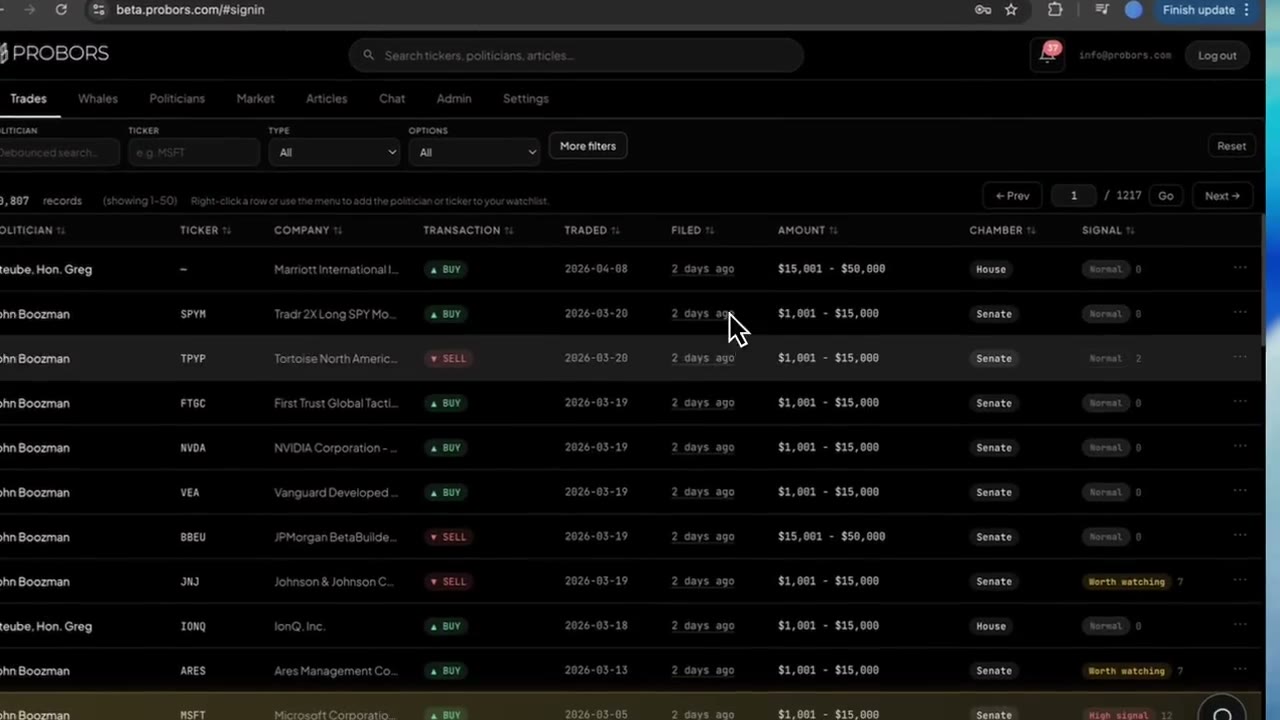
The latest politician stock trades and insider trading activity this week reveal a complex mix of strategies across sectors. With lawmakers like Senator Mullin allocating to banks and industrials, and corporate insiders managing portfolios through planned and opportunistic trades, investors have both signals to ponder and noise to filter. Tracking these developments on ProBors can help you understand where engagement and sentiment are shifting as the market heads into the new year.
Sources & methodology
Last updated:
ProBors uses public disclosure records, SEC filings, House and Senate financial disclosure portals, market data, and in-product workflow checks. Articles are written as research education, not investment advice.