A new periodic transaction report (PTR) for Rep. Nancy Pelosi (CA-11) discloses two spouse-owned call option purchases executed on May 29, 2026: deep, long-dated calls on Intel (INTC) and Uber (UBER). Both were bought as call options struck at $50 and expiring March 19, 2027. The disclosed amount ranges put the Intel position at $1,000,001–$5,000,000 and the Uber position at $500,001–$1,000,000—a combined disclosed range of roughly $1.5M to $6M. The filing (ID #20034836) was digitally signed on June 23, 2026, about 25 days after the trade date. This is a research breakdown of a public record, not investment advice.
The filing at a glance
The data below comes directly from House Filing ID #20034836. Owner field "SP" means the asset is held by the filer's spouse. Both lines are new purchases ("P") of call options ("[OP]").
| Owner | Asset | Type | Traded | Filed | Amount range | Option detail |
|---|---|---|---|---|---|---|
| Spouse | Intel Corp (INTC) | Purchase (calls) | May 29, 2026 | June 23, 2026 | $1,000,001–$5,000,000 | 200 calls, $50 strike, exp. 3/19/27 |
| Spouse | Uber Technologies (UBER) | Purchase (calls) | May 29, 2026 | June 23, 2026 | $500,001–$1,000,000 | 200 calls, $50 strike, exp. 3/19/27 |
A few details worth reading carefully:
- These are options, not common shares. The disclosure specifically lists 200 call contracts per name. Standard U.S. equity options represent 100 shares each, so 200 contracts reference roughly 20,000 underlying shares per position—but the disclosed dollar figure is a statutory range for the premium paid, not the notional value of the underlying.
- Both strikes are well below recent prices. As of the last completed U.S. trading session, ProBors shows INTC near $132 and UBER near $70. Calls struck at $50 on both names are deep in the money—a high-delta, long-dated structure (often called a LEAPS) that behaves much more like leveraged long stock than a cheap out-of-the-money bet.
- Long-dated expiration. A March 2027 expiry gives the position nearly a year of runway from the trade date, which is consistent with a directional long-term view rather than a short-term trade.
- Spouse-owned. The owner field is the filer's spouse, which is common across this member's disclosures.
Why the dates matter more than the headline
STOCK Act disclosures are periodic reports, not live trade alerts. In this filing:
- Transaction date: May 29, 2026
- Filing/signature date: June 23, 2026
- Lag: about 25 days
That gap is the difference between "a member just traded" and "a member's late-May trade just became public." By the time a disclosure like this circulates on social media, the market has usually already moved on both names. If you only read the headline ("new Pelosi buy"), you miss that the position was opened nearly a month earlier. For the mechanics behind this delay, see STOCK Act filing delay explained and how to compare filing date vs transaction date.
How to research this trade in ProBors
You can turn a single PTR line into proper context instead of a screenshot:
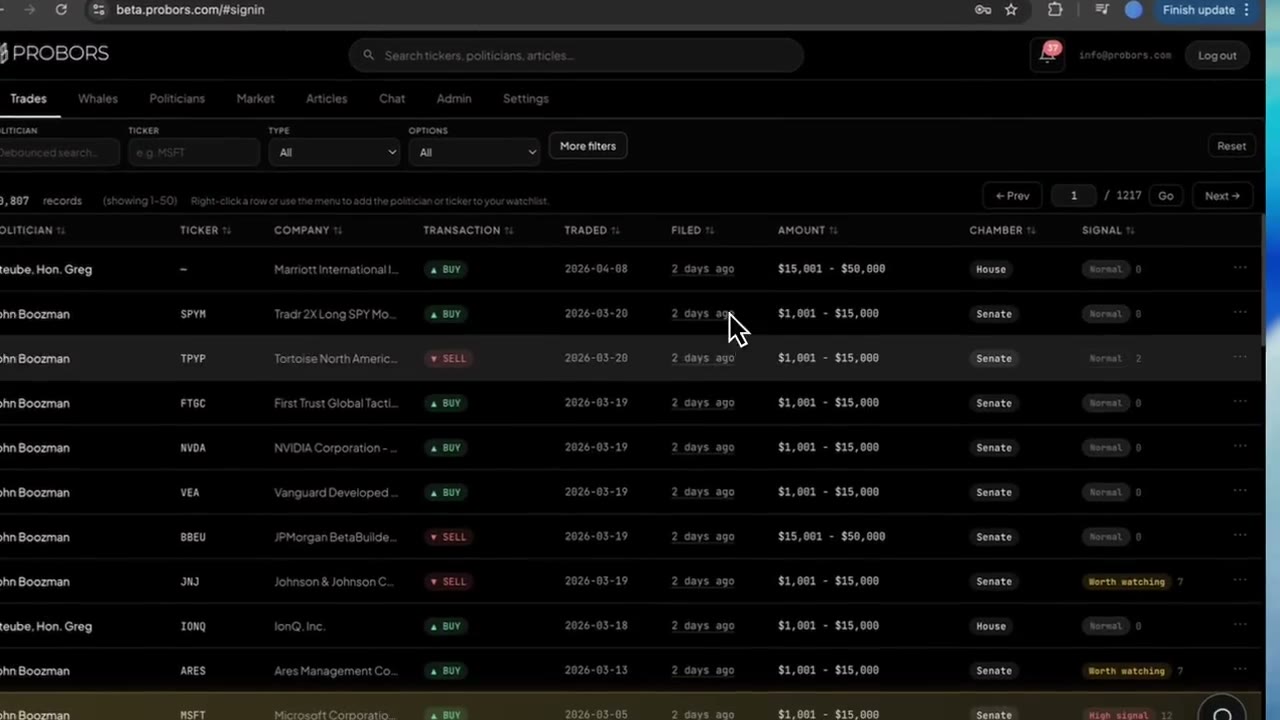
- Search the politician (resolve the exact name first) and open the INTC and UBER rows.
- Open each trade's context window to confirm owner, transaction type, amount range, trade date, and filing date against the source PDF.
- Pull up the market chart for INTC and UBER and mark the May 29 trade date and the June 23 filing date to see how price moved across both.
- Check insider (Form 4) and whale activity on the same tickers to see whether disclosed institutional or executive flow lines up or diverges.
- Add INTC and UBER to a watchlist if you want alerts on the next filing—not the last one.
Market context (for research, not as a signal)
ProBors market context for the two names, reflecting the last completed U.S. trading session:
| Ticker | Company | Last price | Sector |
|---|---|---|---|
| INTC | Intel Corp | ~$132 | Semiconductors |
| UBER | Uber Technologies | ~$70 | Ride-share / delivery / autonomy |
Recent INTC headlines have centered on U.S. semiconductor manufacturing and a reported Apple–Intel foundry partnership; UBER coverage has focused on robotaxi/autonomy partnerships and free-cash-flow strength. Context like this helps you frame a disclosure—it does not explain or justify why any specific transaction was made.
What this filing does not prove
- It does not prove the trades were based on non-public information.
- It does not give an exact dollar amount—every figure here is a statutory range, not a precise premium.
- It does not show current position size; options can be sold, rolled, or expire before the next report.
- It does not constitute a recommendation to buy, sell, or copy anything.
Congressional disclosure is a delayed, incomplete window into a portfolio. Use it for research and source verification, then do your own work on valuation, risk, and timing.
Research this Pelosi filing in context
Open the INTC and UBER disclosures, compare trade vs filing dates, and layer in insider and market context on ProBors.
Get startedFAQ
What exactly did the new Pelosi filing disclose?
Two spouse-owned call option purchases executed May 29, 2026: 200 Intel (INTC) calls and 200 Uber (UBER) calls, both struck at $50 and expiring March 19, 2027. Disclosed ranges are $1,000,001–$5,000,000 for INTC and $500,001–$1,000,000 for UBER (House Filing ID #20034836, signed June 23, 2026).
Are these stock purchases or options?
Options. The disclosure lists call contracts with a $50 strike and a March 2027 expiration—not direct common-stock buys. Because both strikes sit far below recent prices, they are deep in-the-money, long-dated calls.
How much was actually invested?
The filing only reports ranges. Combined, the two positions fall in a roughly $1.5M–$6M band for premium paid. Treat this as a range, not a precise figure.
Why is the trade dated May but only filed in June?
The STOCK Act allows a reporting window, so periodic transaction reports routinely appear weeks after the trade. Here the lag is about 25 days. Always separate the transaction date from the filing date before drawing conclusions.
Should I copy this trade?
No. This is a delayed public record, not a real-time signal or investment advice. Use it as a research starting point and verify everything against the official source.
Sources
- House Clerk Periodic Transaction Report #20034836
- House Financial Disclosure search
- STOCK Act (Pub. L. 112-105)
- House asset type codes reference
- Market figures reflect the last completed U.S. trading session as shown in ProBors and should be re-checked before citing.
Related reading
Sources & methodology
Last updated:
ProBors uses public disclosure records, SEC filings, House and Senate financial disclosure portals, market data, and in-product workflow checks. Articles are written as research education, not investment advice.