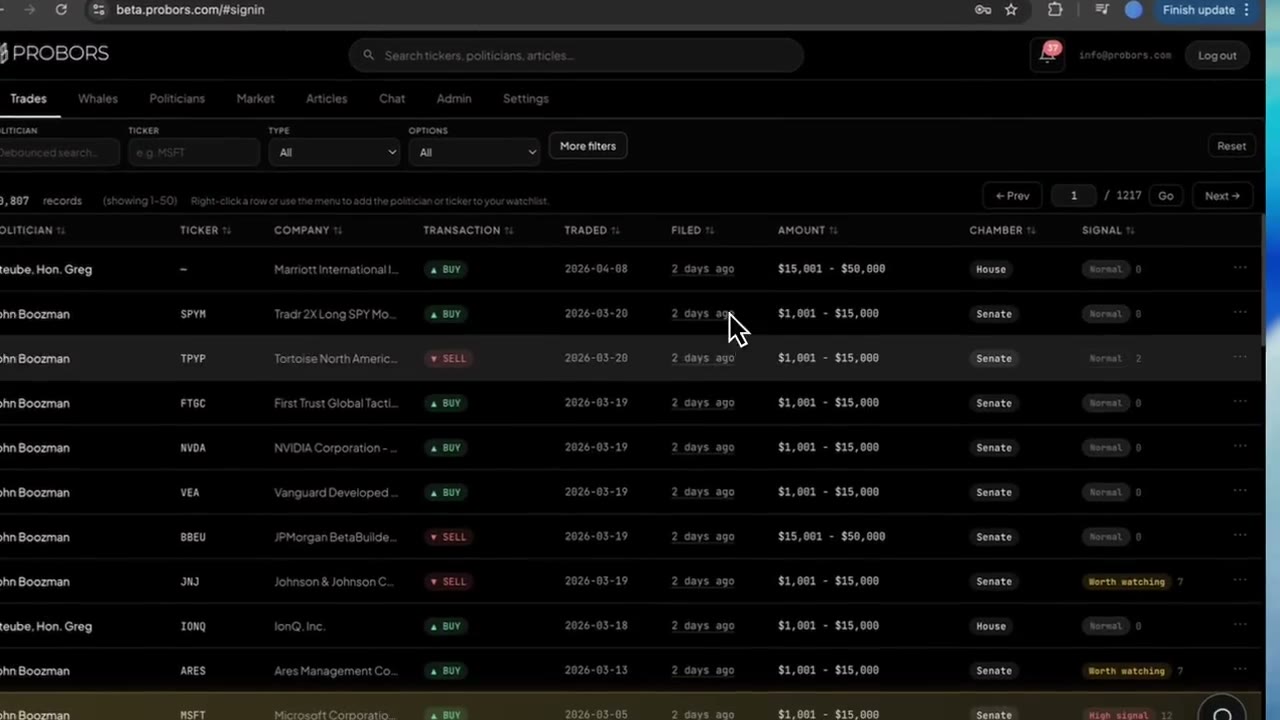
Combining congress and insider disclosure research means asking the same ticker question twice—once against STOCK Act filings and once against SEC Form 4 rows—without merging them into a single bullish or bearish headline. Congressional purchases and officer sales can coexist on liquid tech names; the research value is in timing, size brackets, transaction type, and whether both datasets point to the same story. ProBors keeps House PTR, Senate periodic, and whale/insider activity in one workspace so you can cross-check lag and signal labels side by side. This seven-step workflow shows how to run that combined scan. This is research context, not investment advice.
Why researchers pair congress with insiders
Congressional disclosures and Form 4 filings answer different questions:
- Congress reports what covered officials and family accounts traded, usually in amount ranges, with House and Senate lag patterns that differ sharply.
- Insiders report officer, director, and 10% holder activity with transaction codes (open-market purchase, sale, grant, exercise) and generally faster public filing than Senate periodic batches.
Pairing them helps when:
- A ticker appears in a political headline and you want to know whether corporate insiders were buying or selling in the same window
- A whale leaderboard flags heavy selling and you want to see whether any congressional lines moved the same direction
- You are building a watchlist and need to know which dataset should trigger the alert
The datasets are complementary, not confirmatory. Matching tickers do not prove coordination, shared information, or investable edge.
Seven-step combined workflow on ProBors
-
Start with a ticker or theme, not a narrative. Open probors.com with a concrete symbol (for example CRWD, GOOG, or INTC) or a sector watchlist. Write down your question first: "What did public disclosures show in May–June?" not "Is Congress bullish?"
-
Check data freshness. Visit probors.com/status before you cite rows. A missing congressional line during a quiet House cycle is different from a delayed Form 4 sync. Note whether House PTR, Senate PTR, and SEC Form 4 cards are healthy.
-
Run the congressional pass—split by chamber. Filter Congressional trades by your ticker. Run House and Senate views separately. Log transaction date, filing date, amount bracket, transaction type, and signal label per row. Senate batches filed in late June often cover May trades; do not pool chambers into one timeline.
-
Run the insider and whale pass on the same ticker. Open whale/insider activity for the identical symbol. Read transaction codes: open-market sale (S) versus grant (A) or exercise. Note filing lag—Form 4 is typically due within two business days, much faster than many Senate periodic reports.
-
Compare calendars, not conclusions. Place congressional rows and Form 4 rows on parallel timelines anchored on transaction date. A congressional purchase disclosed June 5 for a May 15 trade and a CEO sale filed June 29 for a June 26 trade are different events—even on the same ticker.
-
Read signal labels in dataset context. ProBors scores congressional and insider rows independently. A Worth watching Senate sale and a Normal insider grant on the same symbol are not a matched pair—they reflect different scoring inputs. Open row detail for reasons, then verify the linked source PDF or EDGAR filing.
-
Watchlist after verification. Add the ticker to a watchlist only after you have confirmed dates, types, and amounts in the original disclosure. Combined research is retrospective; alerts help with the next filing.
Example: CRWD across congress and insiders
Recent filings in ProBors as of July 1, 2026 show why a single-ticker search should span both datasets. CrowdStrike (CRWD) had a modest House purchase in May while insider sales from CEO George Kurtz continued through late June—a common pattern on liquid cybersecurity names, not a contradiction to resolve with one verdict.
| Name | Dataset | Type | Traded | Filed | Lag | Size | Signal |
|---|---|---|---|---|---|---|---|
| Gilbert Cisneros | House (Congress) | Purchase | May 15, 2026 | June 5, 2026 | 21 days | $1,001–$15,000 | Normal |
| George Kurtz | Insider (Form 4) | Sale | June 26, 2026 | June 29, 2026 | 3 days | ~$9,146 | Normal |
| George Kurtz | Insider (Form 4) | Sale | June 26, 2026 | June 29, 2026 | 3 days | ~$27,403 | Normal |
How to read this without overfitting:
- Cisneros (House, Normal) is a small bracket purchase with a three-week disclosure lag—typical House timing relative to Senate batches, but still stale for short-term price timing.
- Kurtz sales (Insider, Normal) are open-market sales filed within three days. ProBors also shows heavy CRWD whale activity in the prior 14 days—205 large prints with 193 sales and no open-market buys on the leaderboard—so individual CEO sales sit inside a broader exit-heavy window.
- Combined takeaway: Congress added a small purchase line; insiders were net selling at the officer level. That is a research lead for committee context and sector flow—not proof that members traded on insider information.
Use a table like this as a template: ticker → congressional chamber split → insider pass → lag comparison → source PDF check.
A second pattern: GOOG Senate sale vs insider flow
Senator Jerry Moran's Senate sale of Alphabet (GOOG), traded May 27 and filed June 25 (about 29 days later), carries a Worth watching label in recent ProBors data—a reminder that elevated congressional scores can appear on sales, not only purchases. Before merging that row with insider activity on GOOG, pull Form 4 lines for the same window and read transaction codes. Officer grants and planned sales can dominate insider feeds on mega-cap names while a single Senate line reflects portfolio rebalancing in a small bracket. The workflow is the same; the story is rarely symmetrical.
Common mistakes when combining datasets
- Treating ticker overlap as confirmation. Two public datasets mentioning the same symbol is expected on liquid stocks.
- Ignoring transaction type. A congressional call-option purchase and an insider grant are not comparable to an open-market sale.
- Sorting only by filing date across datasets. Senate periodic dumps and fast Form 4 filings will skew "what's new" views.
- Skipping amount brackets on congress rows. A $1,001–$15,000 House line and a six-figure insider sale carry different weight.
- Citing signal labels without sources. Always open the House PTR, Senate periodic report, or Form 4 before publishing or trading on a row.
For chamber-specific steps, see how to research a ticker across House and Senate. For insider prioritization, see how to triage whale transactions on ProBors.
What this does not prove
Overlapping tickers in congressional and insider feeds do not demonstrate coordination, material nonpublic information, or that either side had advance knowledge of the other's trade. Disclosure ranges understate exact size; lag varies by chamber and filer; and many insider sales are pre-planned. Combined research narrows what deserves a closer read—it does not replace fundamental analysis or official source verification.
FAQ
Should I start with congress or insiders?
Start with whichever dataset matches your question. Breaking political news → congress first, then insiders on the same ticker. Earnings-season insider wave → insiders first, then check whether any congressional lines exist for context.
Does ProBors show when congress and insiders traded the same week?
You can filter both datasets by ticker and compare transaction dates manually. There is no single "overlap score" that proves linkage—by design.
How is this different from signal-score filtering?
Signal filtering prioritizes rows within one dataset. Combined research cross-checks datasets after you have a ticker shortlist. Many researchers filter congress first, then run the insider pass on survivors.
Do House PTRs and Form 4 filings update on the same schedule?
No. Form 4 sync runs on a faster cadence than many Senate periodic batches. Check probors.com/status when either side looks incomplete.
Can I watch one ticker for both congress and insider alerts?
Yes. Add the stock to a ProBors watchlist and review inbox items by source type. Alerts mean new rows arrived—they do not interpret whether the filings agree.
Cross-check congress and insider filings in one workspace
Filter House and Senate trades, triage whale rows, and verify sources on ProBors before you cite a ticker.
Get startedRelated reading
- How to research a ticker across House and Senate
- How to triage whale transactions on ProBors
- How to filter congress trades by signal score
- Form 4 insider buying tracker
- ProBors data status page guide
Sources
- House Clerk Financial Disclosure (PTR) search
- Senate Financial Disclosures (eFD)
- SEC EDGAR search
- STOCK Act (Pub. L. 112-105)
- Rows were checked in ProBors and should be verified against the original filing.
- For ingestion health, see ProBors data status.
Sources & methodology
Last updated:
ProBors uses public disclosure records, SEC filings, House and Senate financial disclosure portals, market data, and in-product workflow checks. Articles are written as research education, not investment advice.