Congressional stock trades filed in the first week of July 2026 landed as one large House PTR batch and two Senate lines. As of July 7, 2026, ProBors shows 50 deduplicated disclosure rows with filing dates on July 2 and July 6—34 purchases and 16 sales across three politicians. Rep. Gilbert Cisneros accounts for 48 of those House rows filed July 2, while Sens. Gary Peters and Shelley Capito each filed a single Senate disclosure. Filing lag in this window runs from 2 days on Cisneros's freshest June 30 trades to 23 days on older June lines. This is research context, not investment advice.
Snapshot summary
ProBors sorts congressional disclosures by filing date. In the July 2–6 filing window:
- 50 rows after deduplication (identical politician, ticker, type, trade date, filing date, amount, and chamber removed)
- 3 politicians filed in this window: Cisneros (House), Peters (Senate), and Capito (Senate)
- Chamber split: 48 House rows, 2 Senate rows
- Transaction mix: 34 purchases, 16 sales
- Signal tiers: 2 High signal rows, 13 Worth watching, remainder Normal
- Filing lag: 2-day minimum (Cisneros June 30 trades filed July 2), 23-day maximum, 16-day median
- Asset types: common stock dominates the Cisneros batch; one municipal bond line and one partial-sale cluster stand out
The early-July wave looks different from the late-June Senate-heavy batch. This week is House-dominated, equity-heavy, and concentrated on a single member's periodic report rather than spread across municipal bond batches.
Recent disclosures worth a closer look
The table below shows deduplicated rows from ProBors as of July 7, 2026. Lag is calendar days between transaction date and filing date as reported in each disclosure. Rows without a listed ticker use the security description from the filing.
| Politician | Chamber | Ticker / asset | Type | Traded | Filed | Lag | Amount range | Signal |
|---|---|---|---|---|---|---|---|---|
| Gilbert Cisneros | House | MELI | Purchase | June 10, 2026 | July 2, 2026 | 22 days | $15,001–$50,000 | High signal |
| Gilbert Cisneros | House | CME | Sale (Partial) | June 16, 2026 | July 2, 2026 | 16 days | $1,001–$15,000 | High signal |
| Gilbert Cisneros | House | MSFT | Sale (Partial) | June 16, 2026 | July 2, 2026 | 16 days | $15,001–$50,000 | Worth watching |
| Gilbert Cisneros | House | AGX | Purchase | June 30, 2026 | July 2, 2026 | 2 days | $15,001–$50,000 | Worth watching |
| Gilbert Cisneros | House | CECO | Purchase | June 30, 2026 | July 2, 2026 | 2 days | $1,001–$15,000 | Worth watching |
| Gilbert Cisneros | House | LA Tax & Revenue notes | Purchase | June 24, 2026 | July 2, 2026 | 8 days | $100,001–$250,000 | Normal |
| Gary Peters | Senate | T | Purchase | June 29, 2026 | July 2, 2026 | 3 days | $1,001–$15,000 | Normal |
| Shelley Capito | Senate | Citigroup (C) | Sale | June 16, 2026 | July 6, 2026 | 20 days | $1,001–$15,000 | Worth watching |
How to read this without overfitting:
- Cisneros's July 2 batch is a periodic House PTR dump spanning trade dates from June 9 through June 30. Sixteen rows share a June 30 trade date with only a 2-day filing lag—that sub-batch reads like a timely end-of-month report, not a single reactive trade. The two High signal rows (MELI purchase, CME partial sale) sit on older June trade dates filed two to three weeks later.
- The municipal bond line (Los Angeles tax and revenue notes at $100,001–$250,000) is the largest bracket in this snapshot but carries a Normal signal because municipal securities lack equity tickers and follow different scoring rules.
- Peters's AT&T purchase is a small-dollar Senate line with a relatively fast 3-day lag—trade June 29, filed July 2.
- Capito's Citigroup sale filed July 6 is the only row outside the July 2 wave. ProBors flags it Worth watching partly because it is the first disclosed activity in that ticker for this member.
Filing lag in plain language
STOCK Act disclosures are periodic reports, not live trade feeds. In this early-July snapshot:
- Fastest: Cisneros's June 30 equity lines at 2-day lag—traded June 30, filed July 2
- Typical delay this batch: 16-day median across all 50 rows
- Slowest: Several Cisneros lines tied to June 9–10 trade dates filed 22–23 days later
- Senate contrast: Peters at 3 days, Capito at 20 days
When a headline says a representative "just disclosed" a dozen trades, check both dates. A July 2 filing may bundle transactions from mid-June through late June. For the rules behind that gap, see STOCK Act filing delay explained.
How to research this week's filings on ProBors
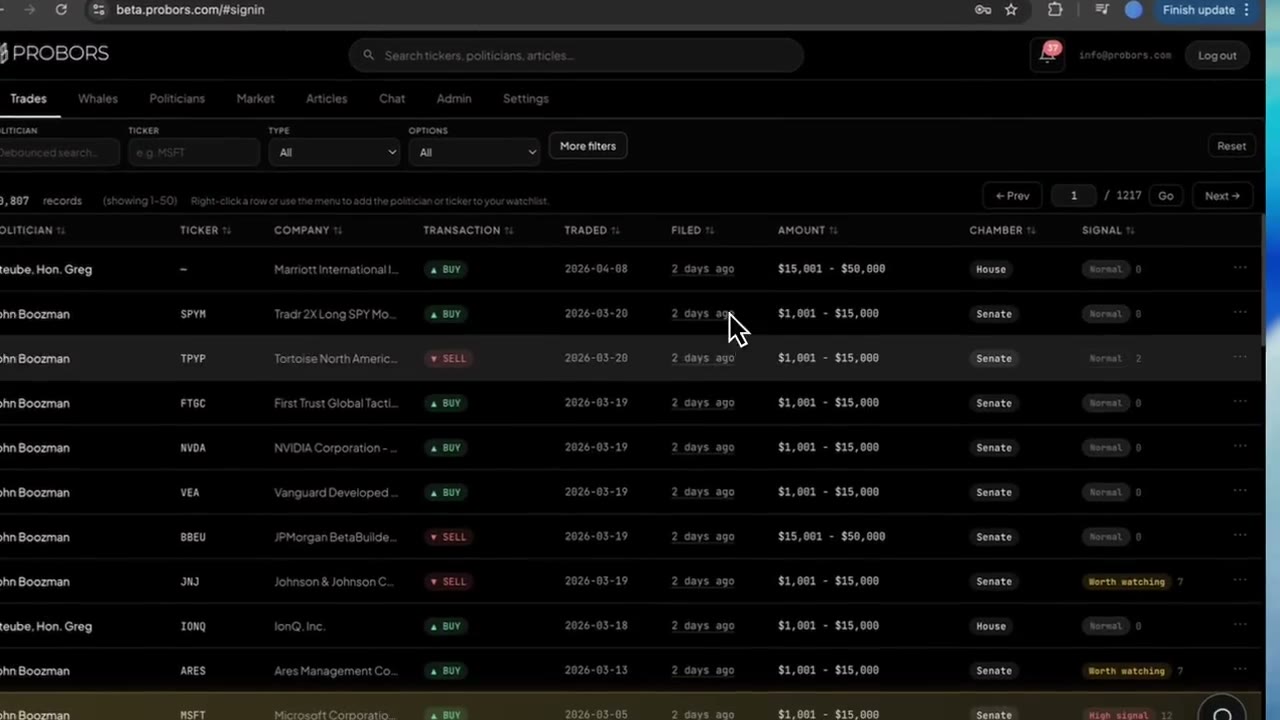
- Open Congressional trades and sort by filing date descending to mirror this snapshot.
- Filter by House when you want batches like Cisneros's July 2 PTR dump.
- Use the politician search to open a member profile and compare trade dates across multiple filings in one sitting.
- Sort by signal score when you want to triage High signal and Worth watching rows before reading every line.
- Cross-check any high-signal row against the original PTR or Senate eFD PDF before citing it in notes or journalism.
For chamber-specific workflows, see the House stock trading tracker and Senate stock trading tracker guides.
What this does not prove
This early-July filing wave does not show:
- That Cisneros's MELI or CME lines predict future price moves in those stocks
- That Capito's Citigroup sale reflects non-public information about the bank
- Exact dollar amounts—every row uses statutory brackets, not precise trade values
- Real-time congressional activity; most Cisneros rows reflect June transactions filed in early July
- That a large periodic PTR batch equals a coordinated trading strategy
Congressional disclosure is a lagging, incomplete window into politician portfolios. Use it for research context and source verification, not as a trading signal.
FAQ
Why is almost this entire batch from one House member?
Periodic PTR reports often land dozens of lines at once. A single July 2 filing with 48 Cisneros rows is typical House batch behavior—not evidence that one member traded 48 times in a single day. Check the trade date column for when each transaction actually occurred.
How should I read the June 30 sub-batch with 2-day lag?
Sixteen rows in this snapshot share a June 30 trade date and a July 2 filing date. That pattern suggests an end-of-month report filed promptly. Compare those rows with older June 16 lines in the same filing that carry 16-day lag.
What does "High signal" mean on Cisneros's MELI and CME rows?
ProBors signal scores weigh factors such as transaction type, size bracket, consensus activity, and post-trade price context. High signal helps triage—it does not certify intent or future performance. See how ProBors trade signal scores work.
Is Capito's Citigroup sale new information this week?
The trade occurred June 16; the filing became public July 6. The 20-day lag is typical for Senate periodic reports. The research value is calendar context and first-ticker activity for this member—not a same-day trade.
How does this compare to late June?
The late-June snapshot was Senate-heavy with municipal bond batches from McCormick. Early July flips to House-heavy with a single large equity PTR from Cisneros plus two Senate lines.
Track this week's congressional filings
Sort House and Senate disclosures by filing date, signal score, and ticker on ProBors.
Get startedRelated reading
- Congress trades filed late June 2026
- Congress trades filed mid-June 2026
- How to read politician trade disclosures
- Congress stock trading tracker hub
Sources
- House Clerk Financial Disclosure (PTR) search
- Senate Financial Disclosures (eFD)
- STOCK Act (Pub. L. 112-105)
- Rows were checked in ProBors and should be verified against the original filing.
- For ingestion health, see ProBors data status.
Sources & methodology
Last updated:
ProBors uses public disclosure records, SEC filings, House and Senate financial disclosure portals, market data, and in-product workflow checks. Articles are written as research education, not investment advice.