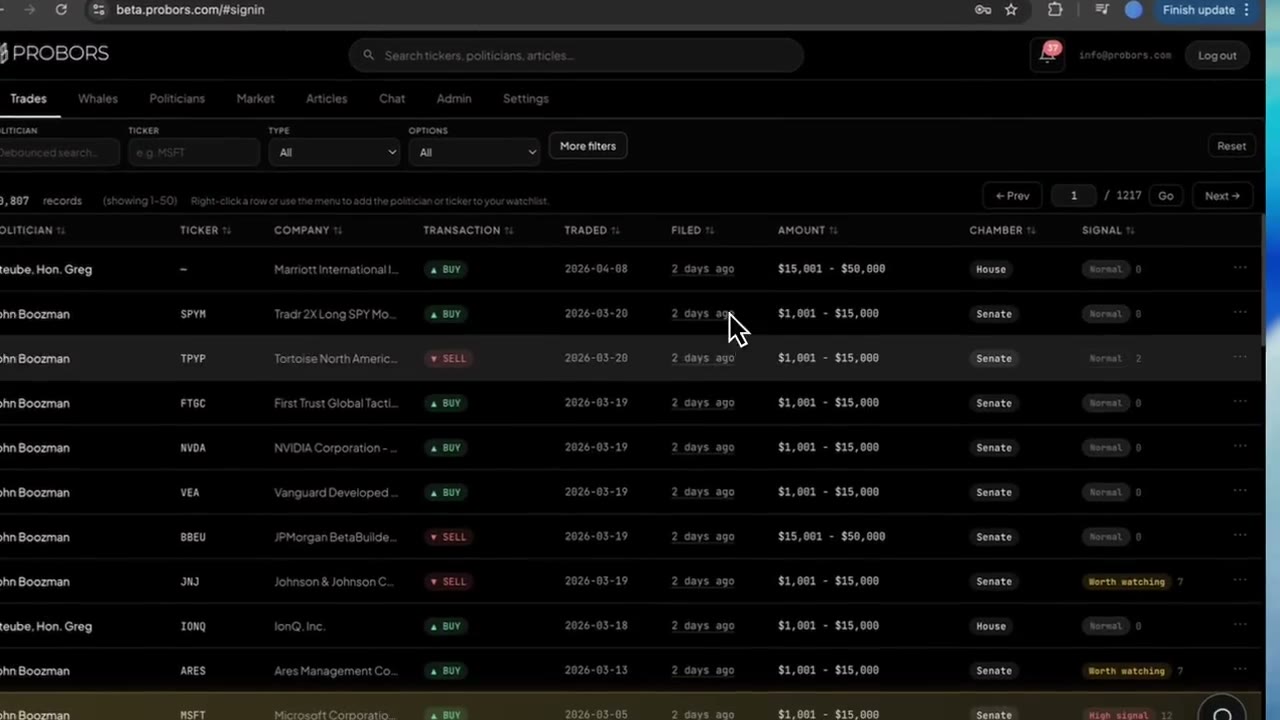
House Stock Watcher is a popular free site for browsing U.S. House Periodic Transaction Report (PTR) disclosures. ProBors is a paid research workspace that covers House and Senate STOCK Act rows, insider whale filings, signal scoring, watchlists, and market charts on the same ticker. If you only need occasional House PTR lookups, House Stock Watcher may be enough. If you monitor multiple politicians, cross-check chambers, and stack insider activity on the same symbol, ProBors is built for that daily loop. This is research context, not investment advice.
Quick comparison
| Capability | House Stock Watcher | ProBors |
|---|---|---|
| Primary focus | House PTR browsing and politician search | Unified congress + insider whale research workspace |
| Senate periodic transaction reports | No — House chamber only | Yes — House and Senate in one feed |
| Insider Form 4 / whale layer | No | Yes — whale tab with size and role context |
| Trade signal scores for triage | No | Yes on congress and whale rows |
| Watchlist + inbox alerts | No native alert inbox | Yes — ticker, politician, and disclosure-driven |
| Market charts next to filings | External charting required | Built-in with optional disclosure markers |
| AI research on live disclosure data | No | Yes — table-style answers on trades and tickers |
| Price | Free | Freemium / paid tiers |
What House Stock Watcher does well
House Stock Watcher helped mainstream House PTR research. Researchers reach for it when they want to:
- Search a representative by name and scroll recent trades
- See ticker, transaction type, amount range, and filing date in a simple table
- Bookmark a free site without creating an account
- Confirm that a headline about a House member matches a published PTR row
The site is straightforward and costs nothing. For a journalist verifying one House trade before publication, or a retail reader checking whether a viral clip matches a real disclosure, that simplicity is a feature.
House PTR source documents live on the House Clerk Financial Disclosure database. House Stock Watcher repackages that public data into a readable interface — the same role many free trackers play for one chamber.
Where House-only browsing stops
House Stock Watcher covers one chamber. Common friction points for repeat researchers:
- Senate rows live elsewhere — Senate periodic transaction reports publish through Senate eFD search. A House-only view cannot answer "did anyone in Congress file on this ticker?" without opening a second site.
- No insider overlap — Form 4 insider filings and whale-sized transactions are on SEC EDGAR, not House PTR portals. Ticker research often needs both chambers plus insiders.
- No alert layer — free browse sites rarely email you when a tracked politician files or when a watched ticker gets a new PTR line.
- No filing-lag tooling — you can read transaction date and filed date on each row, but there is no signal-ranked sort or cross-ticker lag view for daily triage.
- No market context — price action between transaction date and filing date requires a separate charting tab.
None of that makes House Stock Watcher wrong for casual use. It reflects a scope choice: House PTR browsing, not a full disclosure workspace.
Capability comparison (five features that matter)
| Feature | House Stock Watcher | ProBors |
|---|---|---|
| House PTR search by politician or ticker | Strong | Strong |
| Senate PTR in the same workflow | No | Yes |
| Insider / whale rows on the same ticker | No | Yes |
| Watchlist notifications | No | Yes |
| Signal-ranked triage + market charts | No | Yes |
When to choose House Stock Watcher
Choose House Stock Watcher if you:
- Check House PTR disclosures a few times a month, not daily
- Care about one chamber and rarely follow Senate filers
- Do not need insider Form 4 context on the same ticker
- Prefer a free, no-account bookmark for quick politician lookups
- Already use separate tools for charts, alerts, and Senate rows
Stay on House Stock Watcher when your entire workflow is "open the site, search a name, read the table, close the tab."
When to choose ProBors
Choose ProBors if you:
- Track politicians across House and Senate without juggling two portals
- Want watchlist alerts when a followed member files or a ticker gets new disclosures
- Stack congressional trades and insider whale rows before deciding what deserves a source PDF
- Need signal scores to sort noisy filing batches by size, timing, and repeat activity
- Want market charts beside the disclosure row instead of alt-tabbing to a charting site
- Run repeat research loops that combine filing date, transaction date, and chamber in one workspace
ProBors does not replace the House Clerk or Senate eFD portals for legal citation. It compresses the daily triage step so you open official filings only when a row survives your filters.
How to migrate without losing your politician list
If you are graduating from House-only browsing to a fuller workflow:
- Export your mental short list — note the five to fifteen House members you actually re-check, not every headline name.
- Add Senate peers on the same committees — if you follow defense tickers from House Armed Services members, add relevant Senate Armed Services filers to the same watchlist tier.
- Create ticker watchlists for overlap names — when MSFT, NVDA, or XLV appear in House PTRs you care about, watch the ticker in ProBors so Senate and insider rows surface in one place.
- Log filing lag on first review — note transaction date, filed date, and chamber before inferring timing; see how to compare filing date vs transaction date.
- Keep House Stock Watcher bookmarked during overlap — dual-checking one row against a familiar free table builds confidence in the new workflow.
- Verify on
.govbefore publishing — open the original PTR from the Clerk or Senate portal when a row matters for a story or post. - Prune alerts monthly — drop politicians and tickers you stopped opening; alert fatigue undoes the upgrade.
What this comparison does not prove
A paid workspace does not mean congressional disclosures predict returns. House Stock Watcher showing a buy does not prove inside information; ProBors surfacing a Senate row on the same ticker does not prove coordination. Filing lag, amount ranges, and committee context still require your own judgment and source verification.
FAQ
Is ProBors a House Stock Watcher clone?
No. ProBors covers House and Senate STOCK Act rows, insider whale filings, signal scores, watchlists, market charts, and AI-assisted tables. House Stock Watcher is a focused free interface for House PTR browsing.
Does House Stock Watcher include Senate trades?
No. Senate periodic transaction reports publish through the Senate eFD system. Researchers who need both chambers use a second tool or a unified tracker like ProBors.
Can I use both tools together?
Yes. Many researchers keep a free House browse bookmark for quick sanity checks and use ProBors for alerts, cross-chamber ticker views, and insider overlap. Verify final claims on official .gov sources either way.
Is House Stock Watcher enough for journalists?
For a single House PTR verification, often yes. For ongoing beat coverage that tracks Senate filers, filing lag across chambers, and insider context on the same company, a unified workspace saves time.
Does ProBors replace the House Clerk PTR PDF?
No. ProBors normalizes rows for research speed. Legal citation, compliance review, and audit trails should point to the original filing on disclosures-clerk.house.gov or efdsearch.senate.gov.
Track House and Senate disclosures in one workspace
Use ProBors to monitor congressional trades, insider whales, watchlists, and market context without splitting across free chamber-only sites.
Get startedRelated reading
- ProBors vs free congress trading trackers — broader free-tool comparison
- House stock trading tracker — PTR workflow and filing lag basics
- Best congress stock trading trackers — roundup of paid and free options
- How to research a ticker across House and Senate — cross-chamber workflow
- STOCK Act filing delay explained — why transaction date and filed date diverge
Sources
- STOCK Act (S. 2038, 112th Congress) — federal periodic transaction reporting requirement
- House Clerk Financial Disclosure database — official House PTR source
- Senate eFD search — official Senate periodic transaction reports
- House Committee on Ethics — financial disclosure guidance — PTR deadlines and filing rules
- Rows were checked in ProBors and should be verified against the original filing.
- Data ingestion health: probors.com/status
Sources & methodology
Last updated:
ProBors uses public disclosure records, SEC filings, House and Senate financial disclosure portals, market data, and in-product workflow checks. Articles are written as research education, not investment advice.