Dell whale insider sales are among the loudest Form 4 prints on ProBors right now. In the last 14 days through July 13, 2026, DELL ranks second on the whale leaderboard with 180 large filings, zero open-market purchases, and about $147 million in net reported selling. Most volume comes from Silver Lake-affiliated funds distributing shares in multi-million-dollar tranches—not a single CEO headline sale. This guide explains who is filing, how to triage PE-holder waves versus officer sales, recent rows worth a second look, and what the whale board does not prove. It is research context, not investment advice.
Why DELL dominates the July 2026 whale board
Dell Technologies sits in an unusual insider-flow position: a large-cap hardware name with sustained private-equity holder activity layered on top of routine officer filings. Three patterns explain why DELL keeps surfacing next to IPO-era names like CRWV:
- Fund-holder distribution dominates volume. Silver Lake entities—SL SPV-2, L.P., Silver Lake Partners IV, L.P., and related vehicles—file dozens of code S sales on the same trade dates, often split across multiple lines.
- Open-market purchases are absent at whale scale. The 14-day leaderboard shows zero buys on DELL while sales account for 160 of 180 whale-class prints.
- Officer sales are smaller but higher signal. Board member Radakovich Lynn Vojvodich filed a $5.1 million open-market sale in late June with a signal score of 10—one row amid hundreds of fund tranches.
Whale leaderboards rank by print frequency and reported value. DELL is loud because many entities file on the same calendar week, not because one insider made a single nine-figure exit.
Recent DELL whale filings in ProBors
The table below shows deduplicated whale rows from ProBors as of July 13, 2026. Each row is the largest open-market sale (code S) per reporting owner in the recent filing window. Reported values are as indexed in ProBors; sales appear as positive dollar amounts for readability.
| Insider / holder | Type | Traded | Filed | Lag | Reported value | Signal |
|---|---|---|---|---|---|---|
| Silver Lake Partners IV, L.P. | Sale | July 6, 2026 | July 8, 2026 | 2 days | $5,757,322 | 5 |
| Radakovich Lynn Vojvodich | Sale | June 22, 2026 | June 24, 2026 | 2 days | $5,061,262 | 10 |
| SL SPV-2, L.P. | Sale | July 6, 2026 | July 8, 2026 | 2 days | $5,000,850 | 5 |
| Silver Lake Partners V DE (AIV), L.P. | Sale | July 6, 2026 | July 8, 2026 | 2 days | $2,926,095 | 5 |
| Silver Lake Group, L.L.C. | Sale | June 26, 2026 | June 30, 2026 | 4 days | $2,823,210 | 10 |
| Silver Lake Technology Investors IV, L.P. | Sale | July 6, 2026 | July 8, 2026 | 2 days | $111,704 | 5 |
Filing lag here is routine: most rows arrived within two to four calendar days of the trade date, consistent with the standard Form 4 window. The July 6 trade cluster alone produced parallel filings from five Silver Lake vehicles on July 8—typical of fund distribution mechanics rather than a surprise discretionary exit.
A five-step triage framework for fund-heavy whale tickers
Use the same checklist when a ticker tops the whale board through PE-holder volume.
1. Tag the reporting owner type
Fund entities (L.P., SPV, Investors) file differently from individual officers and directors. A wave of fund sales may reflect lock-up releases, secondary distributions, or portfolio rebalancing—not management sentiment. Officer rows like Radakovich deserve a separate mental bucket.
2. Confirm the SEC transaction code
Open-market sales use code S. Option exercises (M), gifts (G), and other codes are different economic events. ProBors shows the code on each whale row—filter here before reacting to dollar size.
3. Count tranches on the same trade date
Five multi-million-dollar sales from related Silver Lake vehicles on July 6, 2026 are one distribution event split across filers. Do not count each line as an independent bearish signal.
4. Compare to the 14-day leaderboard
DELL at 180 prints and zero buys sits behind CRWV (200 prints) but ahead of CRWD (112 prints) in the current window. Context matters: heavy fund selling on a mature large cap reads differently than post-IPO insider exits on a newly public name.
5. Cross-check congressional and chart context
House PTR rows on DELL are smaller and slower. ProBors shows Rep. Ro Khanna filed a sale traded May 1, 2026 and disclosed June 9, 2026—a 39-day lag in the $1,001–$15,000 range. Rep. John McGuire filed a partial sale on June 4, 2026 the same day. Congressional activity on Dell is rebalancing-scale, not whale-scale. Open the DELL workspace on ProBors to compare price action, insider flow, and any politician markers on one chart.
How to research DELL whale flow on ProBors
- Open the Whales tab and filter by ticker DELL.
- Sort by filing date (newest first) to catch the latest Silver Lake tranche wave.
- Read transaction codes and insider names before sorting by reported value—fund rows inflate the queue.
- Note signal scores as a second sort. Scores of 5 flag attention on large fund sales; a score of 10 on an officer sale like Radakovich may deserve a footnote read on SEC EDGAR.
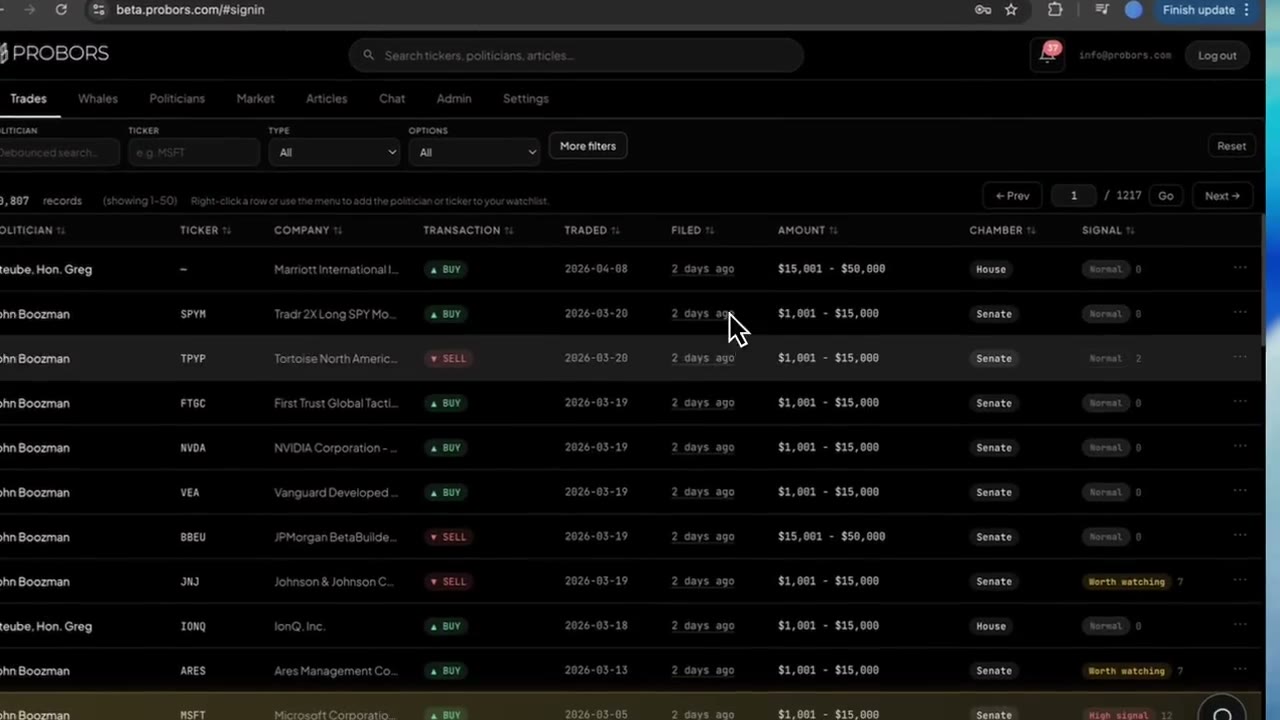
- Switch to the Trades tab with the same ticker to see whether any House or Senate PTRs overlap your insider window.
- Add DELL to a watchlist if you want alerts when new whale-class filings arrive. See ProBors watchlist alerts for setup steps.
For broader whale triage habits, see how to triage whale transactions on ProBors.
What this does not prove
Heavy DELL whale selling in July 2026 does not prove:
- That Dell management expects weaker earnings or guidance.
- That Silver Lake sales predict near-term share price direction.
- That every code S row is a discretionary bearish bet—many are fund mechanics.
- That congressional partial sales in small amount brackets confirm or contradict insider flow.
- That signal scores alone justify a trade—the scores prioritize research attention, not outcomes.
Form 4 disclosures document what was filed and when. They do not reveal motive, plan type, or whether a sale was tax-driven, estate planning, or pre-scheduled.
FAQ
Why are there so many Silver Lake filings on the same day?
Private-equity and fund vehicles often hold Dell through separate legal entities. When a distribution occurs, each entity files its own Form 4 lines. ProBors indexes each line as a whale row, which inflates print count relative to economic events.
Is a signal score of 10 on an officer sale more important than a score of 5 on a fund sale?
Usually for triage, yes—officer and director open-market sales carry different research weight than fund distributions. But a score of 10 still does not prove bearish intent; read the footnotes for 10b5-1 plans or other explanations on the original filing.
Does DELL congressional activity match the whale selling wave?
Not in size or timing. Recent House PTR rows on DELL are in the lowest disclosure brackets with lags of zero to about 39 days. Whale fund sales run in the millions on trade dates in June and July 2026. The feeds answer different questions.
How often should I recheck DELL whale filings?
Form 4 is generally due within two business days after a transaction. During active distribution windows, new tranches can appear several times per week. Check ProBors data status if rows look stale.
Where do I verify a specific row?
Open the original Form 4 on SEC EDGAR and compare trade date, transaction code, share count, and reporting owner to the ProBors row.
Track DELL insider and whale filings
Use ProBors to filter whale transactions by ticker, read signal scores, and compare insider flow with congressional disclosures on one workspace.
Get startedRelated reading
- Top whale tickers in July 2026 — where DELL ranks on the broader leaderboard
- How to triage whale transactions on ProBors — a repeatable framework for loud tickers
- Insider buying clusters: what to look for — the buy-side counterpart when purchases appear
- ProBors whales tab guide — filters, codes, and sorting on the whale workspace
Sources
- SEC Form 4 overview — insider transaction reporting requirements
- SEC EDGAR — Dell Technologies Form 4 search
- House STOCK Act disclosure information
- Senate financial disclosure (eFD)
- Rows were checked in ProBors and should be verified against the original filing. Ingestion health: probors.com/status.
Sources & methodology
Last updated:
ProBors uses public disclosure records, SEC filings, House and Senate financial disclosure portals, market data, and in-product workflow checks. Articles are written as research education, not investment advice.