Verifying congressional trade disclosures before sharing means confirming politician name, chamber, transaction type, both dates, amount bracket, and ticker against the original House PTR or Senate periodic report—not reposting a headline from a tracker screenshot. Social posts and newsletter blurbs often collapse a Senate batch filed in July into "Congress bought today," or treat a Treasury bill line like an equity purchase. ProBors surfaces structured rows with source links; the discipline is walking each field back to the filing before you cite it. This seven-step workflow is for journalists, researchers, and active traders who need a repeatable fact-check pass. This is research context, not investment advice.
Why verification matters more than speed
Congressional disclosure feeds move in batches, not tick-by-tick. A single Senate periodic transaction report can list ten trades spanning June with one July filing date. House PTR rows can land within a day of the trade—or sit in a weekly queue. Amount fields are ranges, not share counts. Tickers are sometimes missing on bond, bill, or fund lines.
A shareable summary should answer:
- Who filed, and which chamber?
- What asset type is this (stock, ETF, bond, bill, option)?
- When did the trade happen versus when was it disclosed?
- What size bracket does the form show?
- Does the original PDF match the structured row?
Skipping any step is how "Senator sold tech" becomes a mislabeled partial ETF sale from three weeks earlier.
Seven-step verification workflow on ProBors
-
Pause on the headline. Before you quote a row, write the claim in one sentence: "Sen. X purchased Y on date Z." If you cannot fill all three parts from the structured data—not from memory—open the row in ProBors first.
-
Confirm chamber and filing type. Filter Congressional trades to House or Senate separately. House PTRs and Senate periodic reports follow different calendars and lag patterns. A July 13 Senate filing date does not mean the trade happened July 13. See House and Senate chamber guides for context.
-
Log transaction date and filing date side by side. Compute calendar lag in whole days. Express it plainly: "filed about three weeks after the trade" or "1-day lag." Never describe a June trade disclosed in July as "this week's purchase." The filing date vs transaction date guide covers the common misread.
-
Read transaction type and asset class. Distinguish purchase, sale, partial sale, full sale, and option-related lines. A "Sale (Partial)" on an ETF is not the same narrative as dumping a single stock. When the ticker field is blank, use the security description from the filing (Treasury bill, municipal note, fund name) and say so in your summary.
-
Open the source disclosure. From trade detail in ProBors, follow the link to the House Clerk PTR or Senate eFD document. Confirm politician spelling, owner code (self, spouse, joint), amount bracket, and asset description. If the PDF disagrees with the structured row, trust the PDF and note the discrepancy.
-
Check for duplicates and amendments. Search the same politician and ticker for nearby filing dates. Senate batches often list multiple lines from one form; aggregators can surface duplicates if you sort only by ticker. Amended PTRs can change dates or amounts—verify you are not citing a superseded line. How to read politician trade disclosures covers amendment patterns.
-
Write the shareable line last. Only after steps 1–6, draft your post or bullet: name, chamber, asset, transaction type, trade date, filing date, lag, and amount bracket. Add "per STOCK Act filing" and link to the official disclosure when publishing externally. Skip price targets, vote predictions, or "signal" language unless your audience expects analysis—and label it as interpretation, not filing fact.
Examples: three rows worth verifying
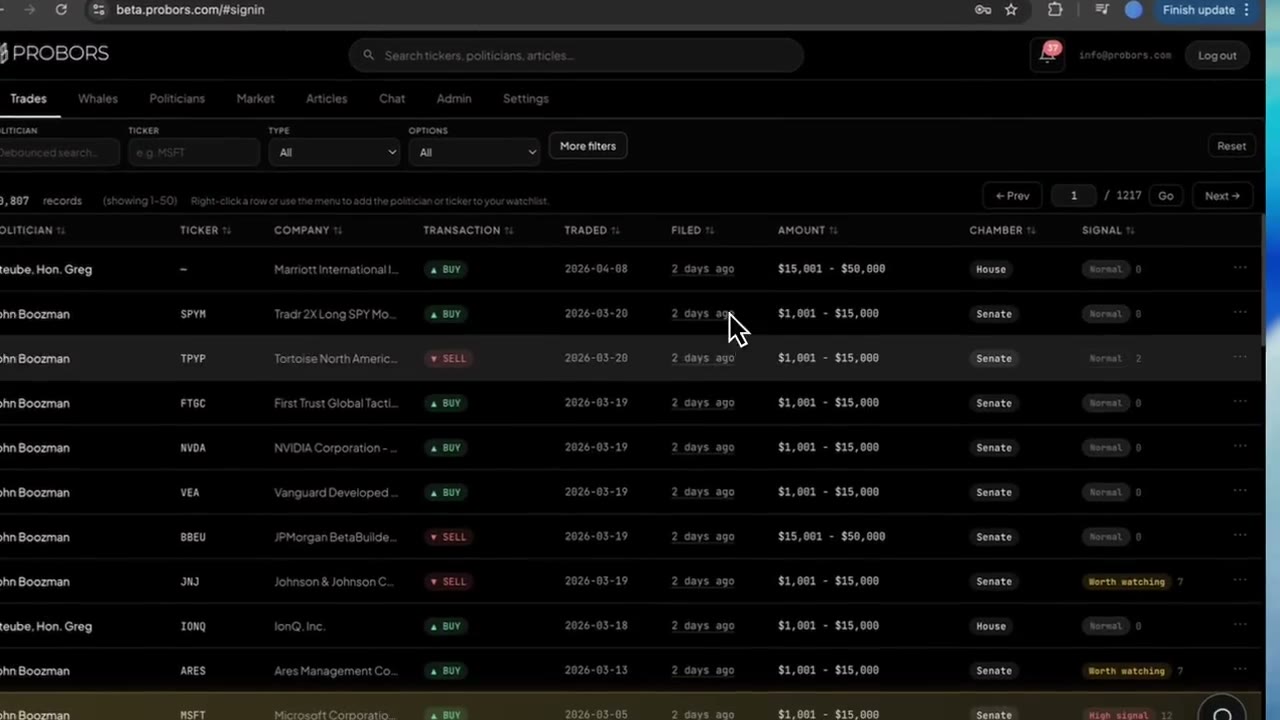
Recent filings in ProBors as of July 15, 2026 show why a quick screenshot is not enough. Each row below is real structured data; the verification notes explain what you would confirm in the source PDF before sharing.
| Politician | Chamber | Ticker / asset | Type | Traded | Filed | Lag | Amount range | Signal |
|---|---|---|---|---|---|---|---|---|
| John Boozman | Senate | FTGC | Sale (partial) | June 25, 2026 | July 13, 2026 | 18 days | $1,001–$15,000 | Normal |
| Rep. Rudy Yakym | House | Treasury bill (3-month, matures Oct. 2026) | Purchase | July 13, 2026 | July 13, 2026 | 0 days | $15,001–$50,000 | Normal |
| Rick Larsen | House | SPGI | Sale | July 8, 2026 | July 9, 2026 | 1 day | $1,001–$15,000 | Normal |
How to read each row before you share:
- Boozman / FTGC: A Senate partial sale of an ETF, traded June 25 and filed July 13—18-day lag. Worth citing as portfolio rebalancing inside a periodic batch, not a same-day Senate trade. Verify "Sale (Partial)" and the fund name in the Senate PDF; do not shorten to "Boozman sold commodities."
- Yakym / Treasury bill: No equity ticker—the line is a short-term Treasury bill purchase filed the same day. A headline saying "Yakym bought stocks July 13" would be wrong. Use the bill description and bracket; note this is a cash-management style asset, not an S&P 500 bet.
- Larsen / SPGI: A House equity sale with only a 1-day lag—among the freshest lines in the mid-July filing window. Still verify amount bracket and owner field in the House PTR before calling it a large or timely trade; $1,001–$15,000 is a small range.
Use tables like this as a checklist: every column should survive step 5 against the original filing.
Common verification mistakes
- Treating filing date as trade date. Especially on Senate periodic reports filed in July for June activity.
- Assuming every line has a ticker. Bills, notes, and some funds appear as text descriptions only.
- Ignoring partial vs full sale labels. Partial sales are routine portfolio trims; they are not always "dumping" language.
- Sharing signal labels as facts. ProBors signal tiers summarize research context—they are not in the STOCK Act form. Verify the filing first; discuss signals second.
- Skipping spouse or joint account codes. Owner context changes who executed the trade; mislabeling it misattributes the politician.
What this does not prove
Verification confirms what the public filing says, on which dates, in which chamber. It does not prove insider information, policy foreknowledge, illegal trading, or investable edge. A verified small-bracket sale weeks after the trade is still stale for market timing. Amount ranges are not exact dollars. Even a perfect fact-check is research context—not investment advice.
FAQ
How long should verification take per row?
For a single equity line with a clear ticker, two to four minutes: open ProBors row, open PDF, confirm six fields, draft one sentence. Senate batches with ten lines take longer—verify each line you plan to cite, not the entire form.
Should I verify in ProBors or on the government site first?
Start in ProBors for structured fields and the source link, then confirm on the House Clerk or Senate eFD PDF. ProBors speeds triage; the .gov document is the citation anchor.
What if the structured row and PDF disagree?
Trust the PDF, note the discrepancy, and avoid sharing until you understand whether an amendment or parsing edge case caused the mismatch. Check ProBors data status if multiple rows look off.
Is a 1-day lag always "breaking news"?
No. Fast House PTR timing still reflects a prior trade date and a small bracket. Fresh filing date does not mean market-moving size or intent.
Do I need to verify every trade in a viral batch?
Verify every trade you name. You can summarize batch size ("ten lines filed July 13") without listing each ticker—but any specific politician-plus-symbol claim needs the full seven-step pass.
Fact-check disclosures before you share
Open congressional rows with source links, signal context, and chamber filters on ProBors—then verify every field against the original filing.
Get startedRelated reading
- How to read politician trade disclosures
- How to compare filing date vs transaction date
- STOCK Act filing delay explained
- Congress trades filed mid-July 2026
- SEC EDGAR vs ProBors disclosure workflow
Sources
- House Clerk Financial Disclosure (PTR) search
- Senate Financial Disclosures (eFD)
- STOCK Act (Pub. L. 112-105)
- Senate STOCK Act guidance
- Rows were checked in ProBors and should be verified against the original filing.
- For ingestion health, see ProBors data status.
Sources & methodology
Last updated:
ProBors uses public disclosure records, SEC filings, House and Senate financial disclosure portals, market data, and in-product workflow checks. Articles are written as research education, not investment advice.