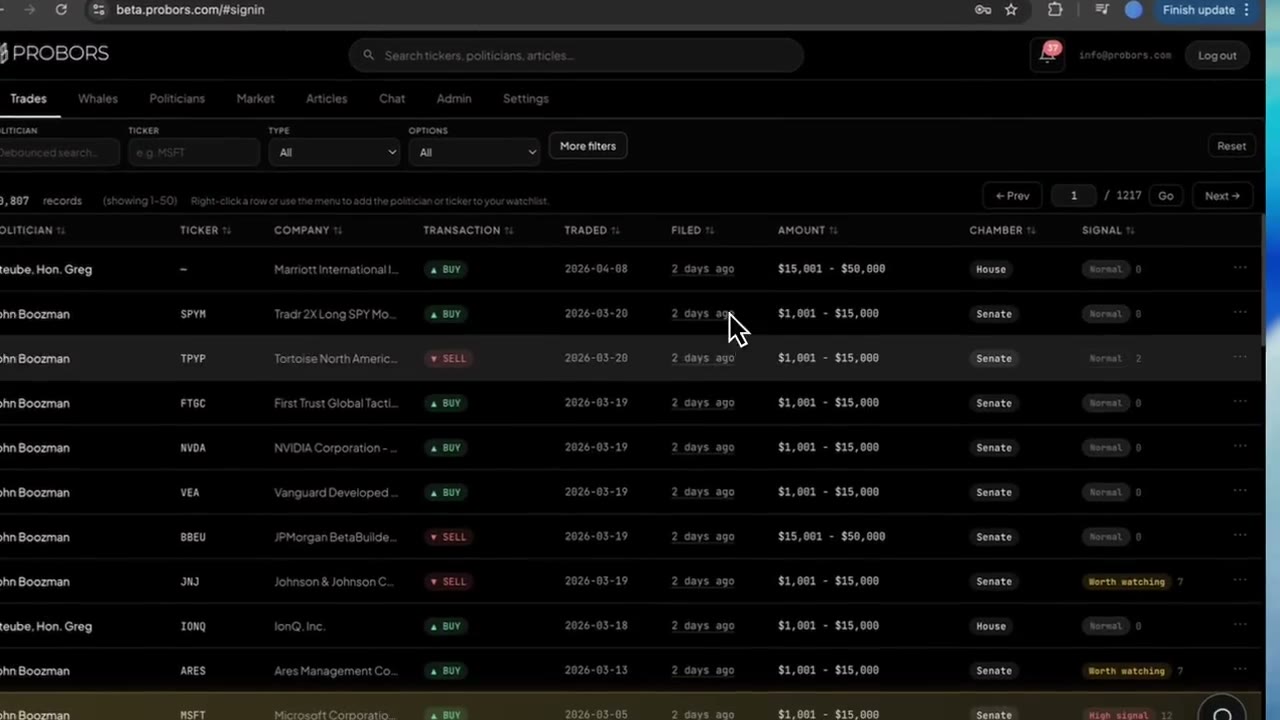
Benzinga is a familiar name for retail traders who already pay for news, squawk audio, and market headlines. ProBors is a disclosure-first workspace built around congressional STOCK Act rows, insider whale filings, signal scoring, and watchlists on the same ticker. If you only need occasional politician trade headlines inside a broader news feed, Benzinga may be enough. If you monitor filings daily, cross-check House and Senate rows, and stack insider activity before opening a source PDF, ProBors is the better fit. This is research context, not investment advice.
Quick comparison
| Capability | Benzinga (Pro / news stack) | ProBors |
|---|---|---|
| Primary focus | Broad market news, headlines, and trader-oriented alerts | Unified congress + insider whale disclosure research |
| Congressional trade coverage | Headlines and curated politician-trade stories | Searchable House and Senate STOCK Act rows with filing metadata |
| Senate + House in one workflow | Varies by product tier; often headline-driven | Yes — both chambers in one trades feed |
| Insider Form 4 / whale layer | General insider news; not a dedicated whale triage tab | Yes — whale tab with size, role, and signal context |
| Trade signal scores for triage | No dedicated congress signal rank | Yes on congress and whale rows |
| Watchlist + inbox alerts on politicians/tickers | News and squawk alerts; disclosure-specific watchlists vary | Yes — politician, ticker, and disclosure-driven |
| Market charts beside filings | Yes — charting is a core Benzinga strength | Built-in with optional disclosure markers |
| AI research on live disclosure tables | Limited / not disclosure-table native | Yes — table-style answers on trades and tickers |
| Best fit | Traders who want news + squawk in one subscription | Researchers running repeat disclosure loops |
What Benzinga does well
Benzinga earned its audience by compressing fast-moving market news into readable headlines and audio. Researchers already on Benzinga Pro often use it to:
- Catch politician trade stories while scanning the broader tape
- Hear squawk commentary when a congressional filing hits the news cycle
- Keep charts, calendars, and headline alerts in a trader-native interface
- Stay inside one subscription that also covers earnings, FDA, and macro headlines
For a retail trader who checks congress disclosures only when a headline pings, that bundling is efficient. Benzinga does not replace official STOCK Act portals — it surfaces narratives around public filings that still live on House Clerk and Senate eFD systems.
Where headline-first congress coverage stops
Congressional disclosure research breaks when the workflow is reactive only. Common friction points for repeat researchers on a news-first stack:
- Headlines lag the filing — a story may summarize one trade days after the PTR row was published; triage needs filed date and transaction date side by side, not just the article timestamp.
- Chamber gaps — a headline about a House member does not automatically surface Senate rows on the same ticker from the same week.
- No insider overlap on the ticker — Form 4 whale prints and STOCK Act rows often belong in the same notebook before you infer anything about timing.
- Amount brackets get flattened — news copy often rounds "$1,001–$15,000" into "small purchase"; structured fields preserve the official range.
- Alert fatigue without signal rank — busy filing weeks produce dozens of rows; without size- and timing-aware scoring, everything looks equally loud.
None of that makes Benzinga wrong for traders who primarily want squawk and headline velocity. It reflects a product scope choice: market news first, structured disclosure tables second.
Capability comparison (six features that matter)
| Feature | Benzinga | ProBors |
|---|---|---|
| Structured House + Senate PTR search | Headline / story driven | Strong — filter by politician, ticker, chamber, dates |
| Filing lag visibility (traded vs filed date) | Depends on article; not always in the alert | Yes — both dates on every normalized row |
| Insider / whale rows on the same ticker | Insider news, not a unified whale triage view | Yes |
| Watchlist notifications on politicians you track | News alerts; disclosure-specific lists vary | Yes — dedicated watchlist inbox |
| Signal-ranked triage on busy filing days | No | Yes |
| Cross-dataset research (congress + insiders + charts) | Requires tab switching | One workspace |
When to choose Benzinga
Choose Benzinga if you:
- Already pay for squawk, earnings headlines, and charting in one bundle
- Open politician trade stories only when they appear in your news feed
- Rarely need to sort raw PTR rows by filing date across both chambers
- Do not run watchlists on fifteen or more politicians and tickers
- Prefer audio commentary over self-serve disclosure tables
Stay on Benzinga when your entire congress workflow is "read the headline, maybe click through, move on."
When to choose ProBors
Choose ProBors if you:
- Track politicians across House and Senate without waiting for a news write-up
- Want watchlist alerts when a followed member files, not only when a story publishes
- Stack congressional trades and insider whale rows on the same symbol before drawing timing conclusions
- Need signal scores to sort noisy filing batches by size, repeat activity, and lag
- Run repeat research loops that combine filing date, transaction date, chamber, and market chart in one tab
- Use AI tables to answer questions like "largest Senate purchases in the last fourteen days" without exporting CSVs
ProBors does not replace Benzinga squawk or FDA headline speed. Many researchers keep a news subscription for tape commentary and use ProBors for the structured disclosure layer underneath.
How to use both without duplicate work
If you are evaluating a upgrade path from news-only congress coverage:
- List your actual follow set — note the five to twenty politicians and tickers you re-open each month, not every viral name.
- Log one week of headline lag — when Benzinga publishes a politician trade story, check the original filed date on the STOCK Act row; that gap tells you whether structured alerts would help.
- Pick one ticker with cross-chamber activity — compare whether House-only headlines missed Senate rows on the same symbol.
- Add insider context — open whale filings on that ticker in ProBors before treating the congress row as isolated.
- Create watchlists for survivors — politicians and tickers that survived your filters deserve alerts; drop the rest to avoid noise.
- Keep Benzinga for squawk — audio and breaking headline speed still matter on earnings and macro days.
- Verify on
.govbefore publishing — open the original PTR from the Clerk or Senate portal when a row matters for a story or social post.
What this comparison does not prove
A disclosure workspace does not mean congressional filings predict returns. Benzinga highlighting a politician purchase does not prove inside information; ProBors surfacing a high-signal Senate row does not prove coordination with insiders. Filing lag, amount ranges, committee assignments, and subsequent amendments still require your own judgment and source verification.
FAQ
Is ProBors a Benzinga replacement?
No. Benzinga is a broad market news and squawk product. ProBors is a disclosure research workspace for congressional STOCK Act rows, insider whales, signal scores, watchlists, and market context on the same ticker. Many users keep both.
Does Benzinga include every congressional filing?
Benzinga covers politician trade news as part of its editorial and alert stack. That is not the same as a searchable, chamber-complete PTR table with filed date, transaction date, and amount brackets on every row. Researchers who need exhaustive triage usually add a dedicated disclosure tool.
Can I get congress alerts on Benzinga?
Benzinga offers news and squawk alerts that can include politician trade headlines depending on your subscription and settings. ProBors adds politician- and ticker-specific watchlist notifications tied to normalized disclosure rows.
Which tool is better for journalists?
Journalists on deadline often start with whichever headline arrives first. For beat coverage that tracks filing lag, cross-chamber rows, and insider overlap on the same company, a structured workspace like ProBors saves time — with official .gov verification before publication.
Do I need to pay for both?
Not necessarily. Casual readers who only react to headlines can stay on Benzinga alone. Researchers who monitor disclosures weekly or daily usually justify a dedicated tracker; whether that replaces or complements Benzinga depends on how much you rely on squawk and general market news.
Run congress and insider research in one workspace
Use ProBors to monitor House and Senate filings, whale activity, watchlists, and market context — then keep Benzinga squawk for headline speed if you already subscribe.
Get startedRelated reading
- ProBors vs Capitol Trades — another paid-vs-specialist comparison
- Best congress stock trading trackers in 2026 — broader roundup
- House Stock Watcher vs ProBors — free House-only browse vs full workspace
- How to combine congress and insider research — workflow when stacking datasets
- How to verify congressional trade disclosures before sharing — source-check steps before you publish
Sources
- STOCK Act (S. 2038, 112th Congress) — federal periodic transaction reporting requirement
- House Clerk Financial Disclosure database — official House PTR source
- Senate eFD search — official Senate periodic transaction reports
- SEC EDGAR — insider filings — Form 4 and other Section 16 disclosures
- Rows were checked in ProBors and should be verified against the original filing.
- Data ingestion health: probors.com/status
Sources & methodology
Last updated:
ProBors uses public disclosure records, SEC filings, House and Senate financial disclosure portals, market data, and in-product workflow checks. Articles are written as research education, not investment advice.