Congressional trade amount ranges are not exact dollars. Periodic Transaction Reports (PTRs) filed under the STOCK Act ask members to pick a value bracket for each purchase, sale, or exchange—not to report share counts or precise proceeds. A line that reads "$15,001 - $50,000" might represent a $16,200 sale or a $49,800 sale; you cannot tell from the public form alone. Treat every amount field as a magnitude band for disclosure research, not a position-sizing input. This is research context, not investment advice.
The official House PTR brackets
The House Committee on Ethics PTR form instructions require filers to select the category that matches the gross amount of the transaction. The standard brackets are:
| Bracket | What it signals |
|---|---|
| $1,001 – $15,000 | Smallest reportable band above the $1,000 threshold |
| $15,001 – $50,000 | Mid-small trade |
| $50,001 – $100,000 | Mid trade |
| $100,001 – $250,000 | Larger trade |
| $250,001 – $500,000 | High bracket |
| $500,001 – $1,000,000 | Very high bracket |
| $1,000,001 – $5,000,000 | Multi-million band |
| $5,000,001 – $25,000,000 | Rare for individual equity lines |
| $25,000,001 – $50,000,000 | Rare |
| Over $50,000,000 | Rare |
Senate periodic transaction reports follow the same core STOCK Act framework. The Senate eFD search portal publishes Senate filings after submission. Bracket labels may look slightly different in the PDF layout, but the underlying rule is the same: pick a range, not an exact figure.
Why Congress reports ranges instead of exact sizes
Three design choices explain the bracket system:
Privacy and proportionality. Annual financial disclosure has long used ranges so the public can see conflicts of interest without publishing a member's full brokerage statement. PTRs inherited that pattern for transaction-level reporting.
Gross amount, not gain or loss. House guidance is explicit: use the gross sale or purchase price, even when the trade was a net loss. A sale that returned $5,000 on a $7,000 cost basis still reports in the bracket that covers $5,000—not the $2,000 loss. See the 2025 House instruction guide on the "Amount of Transaction" column.
Filer convenience. Members and staff select a checkbox on an electronic form. Exact share counts would require reconciling every partial sale, dividend reinvestment, and spouse-account trade against broker statements under tight deadlines.
The result: trackers like ProBors display the bracket text from the filing. They do not—and cannot—infer the true dollar total inside the band.
Examples from recent filings
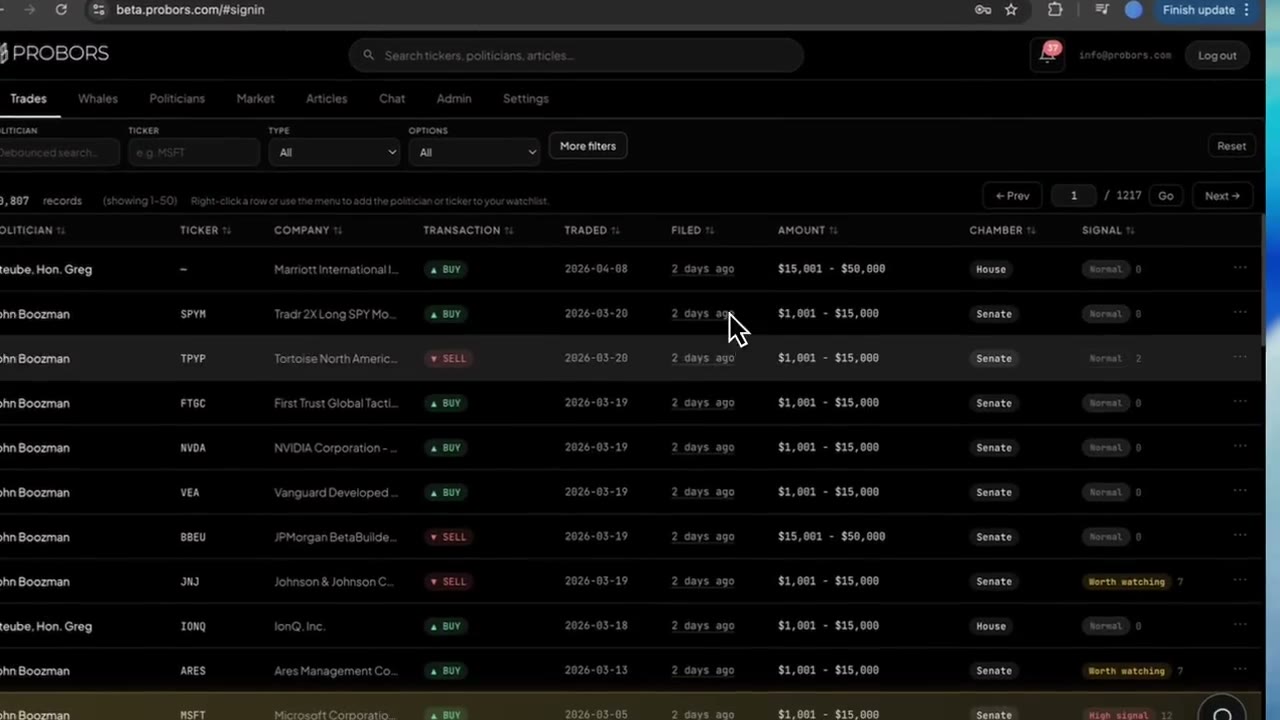
Recent filings in ProBors as of July 18, 2026 show how the same bracket label hides very different stories:
| Politician | Chamber | Ticker | Type | Amount bracket | Trade date | Filed |
|---|---|---|---|---|---|---|
| Sen. Tommy Tuberville | Senate | PG | Sale | $15,001 – $50,000 | June 8, 2026 | July 16, 2026 |
| Rep. Kevin Hern | House | XOM | Exchange | $100,001 – $250,000 | July 2, 2026 | July 3, 2026 |
| Rep. Gilbert Cisneros | House | DSGX | Purchase | $1,001 – $15,000 | June 30, 2026 | July 2, 2026 |
| Rep. Debbie Wasserman Schultz | House | ICHR | Sale | $2,722.50 | June 17, 2026 | July 14, 2026 |
Three rows use standard PTR brackets. The Wasserman Schultz line shows an exact dollar figure tied to a retirement-account sale description—a reminder that asset type and owner code can change how the amount column renders. Always open the source PDF before treating any amount as exact.
A $1,001–$15,000 purchase and a $100,001–$250,000 exchange are not comparable in portfolio impact even when they share a filing week. Rank by bracket order, not by headline count.
Common mistakes when reading amount fields
-
Treating the bracket midpoint as the trade size. "$15,001 – $50,000" is not "$32,500." Summing midpoints across ten rows produces fiction.
-
Adding brackets across multiple trades. Three purchases in the lowest band are not "$45,000 of buying." Each line is independent unless the filing explicitly groups them.
-
Comparing bracket to market cap or float. A $1,001–$15,000 sale in a mega-cap stock is immaterial to the company; the same bracket in a micro-cap name is a different research question. The bracket does not tell you which case you have.
-
Ignoring partial sales and exchanges. House PTRs distinguish partial sales and exchanges. A "$100,001 – $250,000" exchange (like the Exxon line above) is not the same narrative as a full exit.
-
Equating spouse trades with member conviction. Amount brackets do not identify who initiated the trade. Check the owner column in the PDF.
-
Using brackets for P&L math. Without share count and cost basis, you cannot compute return from a PTR line alone.
How to research amount brackets on ProBors
- Open Congressional trades and filter by politician or ticker.
- Sort by filed date or signal score depending on whether you care about recency or triage.
- Read the amount column as a bracket label copied from the filing—not a computed position size.
- Open trade detail and follow the link to the House Clerk or Senate eFD document. Confirm the bracket checkbox matches the structured row.
- Note transaction type (purchase, sale, partial sale, exchange) before you write a summary.
- Cross-check filing delay separately; a large bracket disclosed five weeks late is a different story than a prompt filing.
For portfolio-level sizing, use annual financial disclosure reports and external holdings research—not PTR brackets alone.
What this does not prove
Amount brackets are transparency tools, not trading signals. A high bracket purchase does not prove:
- The member personally chose the trade (spouse or dependent accounts are common)
- The position size relative to net worth (annual disclosure is the better source for that)
- Forward returns or informational advantage
- That aggregators summed the trade correctly (verify the PDF)
A low bracket sale does not prove the member exited a large legacy position—partial sales can sit in the smallest band.
FAQ
What is the smallest reportable congressional trade?
The STOCK Act threshold is $1,000 gross per transaction. PTR forms start reporting at the $1,001 – $15,000 bracket. Trades at or below $1,000 are generally not listed on periodic transaction reports.
Can two politicians with the same bracket have very different actual trade sizes?
Yes. "$15,001 – $50,000" could mean $15,100 or $49,900. Never rank politicians by bracket alone without opening each filing.
Do insider Form 4 filings use the same ranges?
No. SEC Form 4 reports share counts and dollar values under different rules. Comparing a PTR bracket to an insider's exact share line mixes disclosure regimes. See how to read politician trade disclosures for congress-specific fields.
Why does ProBors sometimes show an exact dollar amount?
Most rows mirror the bracket text from the source PTR. Occasional exact figures usually reflect how a specific asset line was entered on the House or Senate form. Treat them as filing text, not tracker calculations—and verify in the PDF.
Should I add up amount brackets to estimate total buying?
No. Summing brackets across rows or politicians produces misleading totals. If you need aggregate exposure, use annual financial disclosure schedules or build a manual spreadsheet from verified PDFs with explicit assumptions.
Read amount brackets in context
Search congressional trades on ProBors, open the source PTR, and compare filing lag before you size the story.
Get startedRelated reading
- How to read politician trade disclosures
- STOCK Act filing delay explained
- How to verify congressional trade disclosures before sharing
- House stock trading tracker
- Senate stock trading tracker
Sources
- House Committee on Ethics — Financial Disclosure
- House PTR form and instructions (CY 2025)
- House instruction guide — amount of transaction column
- Senate eFD periodic transaction search
- STOCK Act (Pub. L. 112-105)
- Rows were checked in ProBors and should be verified against the original filing. See data status for ingestion health.
Sources & methodology
Last updated:
ProBors uses public disclosure records, SEC filings, House and Senate financial disclosure portals, market data, and in-product workflow checks. Articles are written as research education, not investment advice.