Congressional stock trades filed in late July 2026 arrived as a narrow but readable Senate-heavy wave after the broader mid-July batch. As of July 21, 2026, ProBors shows 15 deduplicated disclosure rows with filing dates from July 14 through July 17—spread across three members, with Sen. Tommy Tuberville contributing eleven Senate sale lines filed on July 16. Filing lag in this window runs from 11 days on Rep. Laurel Lee's July options activity to 38 days on Tuberville's early-June trade dates. This is research context, not investment advice.
Snapshot summary
ProBors sorts congressional disclosures by filing date. In the July 14–17 filing window:
- 15 rows after deduplication (identical politician, ticker, type, trade date, filing date, amount, and chamber removed)
- 3 politicians filed in this window: Tuberville (11 rows), Lee (3 rows), and Debbie Wasserman Schultz (1 row)
- Chamber split: 4 House rows, 11 Senate rows
- Transaction mix: 15 sales, including one put-option sale and no purchases
- Signal tiers: 0 High signal rows, 5 Worth watching, 10 Normal
- Filing lag: 11-day minimum (Lee's July 6 NOK put-option sale filed July 17), 38-day maximum, 38-day median
- Notable clusters: Tuberville's July 16 Senate batch (11 equity and utility sales from early-June trade dates) and Lee's July 17 House trio (NOK put option, NOK stock sale, and GE sale)
The late-July wave is smaller than mid-July's nine-member batch but still useful for researchers tracking periodic PTR dumps. Over the prior 14 days, Amphenol (APH) appears twice in purchase-only congressional activity in ProBors—mostly outside this tight filing window—while this week's filed rows concentrate on defensive trimming across utilities, staples, and defense names.
Recent disclosures worth a closer look
The table below shows deduplicated rows from ProBors as of July 21, 2026. Lag is calendar days between transaction date and filing date as reported in each disclosure.
| Politician | Chamber | Ticker / asset | Type | Traded | Filed | Lag | Amount range | Signal |
|---|---|---|---|---|---|---|---|---|
| Laurel Lee | House | NOK | Sale - Put Option | July 6, 2026 | July 17, 2026 | 11 days | $1,001–$15,000 | Worth watching |
| Tommy Tuberville | Senate | MA | Sale | June 8, 2026 | July 16, 2026 | 38 days | $15,001–$50,000 | Worth watching |
| Tommy Tuberville | Senate | AWK | Sale | June 8, 2026 | July 16, 2026 | 38 days | $15,001–$50,000 | Worth watching |
| Tommy Tuberville | Senate | Accenture (ACN) | Sale | June 8, 2026 | July 16, 2026 | 38 days | $1,001–$15,000 | Worth watching |
| Debbie Wasserman Schultz | House | ICHR | Sale | June 17, 2026 | July 14, 2026 | 27 days | $2,722.50 | Worth watching |
| Tommy Tuberville | Senate | LMT | Sale | June 8, 2026 | July 16, 2026 | 38 days | $15,001–$50,000 | Normal |
| Tommy Tuberville | Senate | PFE | Sale | June 8, 2026 | July 16, 2026 | 38 days | $15,001–$50,000 | Normal |
| Laurel Lee | House | GE | Sale | June 16, 2026 | July 17, 2026 | 31 days | $1,001–$15,000 | Normal |
How to read this without overfitting:
- Tuberville's July 16 batch spans eleven Senate sale lines filed on one date, with most trade dates tied to June 8–9, 2026. The cluster mixes higher-bracket sales (MA, AWK, LMT, PFE, PG, NEE, DUK, CSX) with smaller lines (TSCO, WAB). That pattern looks like periodic portfolio trimming filed weeks after the trades—not same-day activity.
- Lee's July 17 trio is the freshest House activity in this window: a NOK put-option sale and stock sale both tied to July 6 trade dates, plus a GE sale from mid-June. The put-option line carries the highest signal score in this batch.
- Wasserman Schultz's ICHR sale filed July 14 is the only row outside the July 16–17 cluster. The amount field shows a specific dollar figure rather than a statutory bracket—verify the original House PTR PDF before citing the exact number.
- Accenture appears without a standard ticker code in the source row; ProBors indexes the security description from the filing text.
Filing lag in plain language
STOCK Act disclosures are periodic reports, not live trade feeds. In this late-July snapshot:
- Fastest: Lee's NOK put-option sale at 11-day lag—traded July 6, filed July 17
- Typical delay this batch: 38-day median across all 15 rows
- Slowest: Most Tuberville lines tied to June 8 trade dates filed 38 days later on July 16
- House contrast: Lee's GE sale carries a 31-day lag from a June 16 trade date; Wasserman Schultz's ICHR line shows 27-day lag
When a headline says a senator "just disclosed" a dozen sales, check both dates. A July 16 filing may bundle transactions from the first week of June. For the rules behind that gap, see STOCK Act filing delay explained.
How to research this week's filings on ProBors
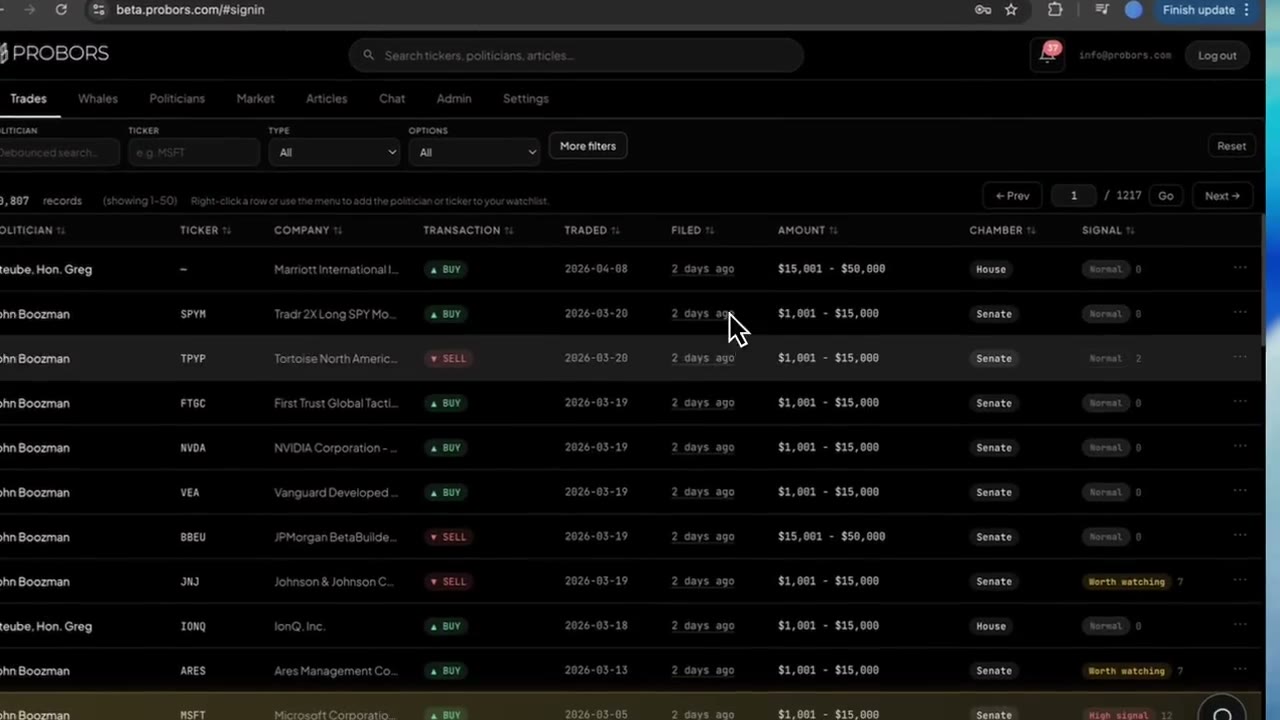
- Open Congressional trades and sort by filing date descending to mirror this snapshot.
- Filter by Senate when you want batches like Tuberville's July 16 PTR dump.
- Search the politician name to open a member profile and compare trade dates across multiple filings in one sitting.
- Sort by signal score when you want to triage Worth watching rows before reading every line.
- Cross-check any notable row against the original PTR or Senate eFD PDF before citing it in notes or journalism.
For chamber-specific workflows, see the House stock trading tracker and Senate stock trading tracker guides.
What this does not prove
This late-July filing wave does not show:
- That Tuberville's utility and defense sales predict sector weakness or policy shifts
- That Lee's NOK put-option sale reflects non-public information about Nokia
- Exact dollar amounts for most rows—statutory brackets apply unless the filing lists a specific figure
- Real-time congressional activity; most rows reflect June transactions filed in mid- to late July
- That a large periodic PTR batch equals a coordinated trading strategy or a single trading decision
Congressional disclosure is a lagging, incomplete window into politician portfolios. Use it for research context and source verification, not as a trading signal.
FAQ
Why is Tuberville's July 16 batch so large?
Periodic Senate PTR reports often land many lines at once. Eleven sale rows filed on July 16 with trade dates mostly from June 8 is typical batch behavior—not evidence that one senator sold eleven positions on a single day. Check the trade date column for when each transaction actually occurred.
How does this compare to mid-July?
The mid-July snapshot covered 41 rows across nine members filed July 7–13, with Boozman and McCormick each contributing ten-line batches. Late July is smaller—15 rows across three members—with Tuberville dominating the Senate side and Lee carrying the House options activity.
What does "Worth watching" mean on Lee's NOK put-option row?
ProBors signal scores weigh factors such as transaction type, size bracket, consensus activity, and post-trade price context. Worth watching helps triage—it does not certify intent or future performance. See how ProBors trade signal scores work.
Why does Wasserman Schultz's ICHR row show an exact dollar amount?
Some House PTR lines report a specific sale figure instead of a bracket range. Treat that as filing-text context and confirm against the original disclosure before repeating the number elsewhere.
Are there any purchases in this window?
No. All 15 deduplicated rows in this July 14–17 filing window are sales or option-related sales. That does not mean Congress stopped buying stocks—it reflects which PTR lines happened to file in this narrow date range.
Track this week's congressional filings
Sort House and Senate disclosures by filing date, signal score, and ticker on ProBors.
Get startedRelated reading
- Congress trades filed mid-July 2026
- Congress trades filed early July 2026
- How to read politician trade disclosures
- Congress stock trading tracker hub
Sources
- House Clerk Financial Disclosure (PTR) search
- Senate Financial Disclosures (eFD)
- STOCK Act (Pub. L. 112-105)
- Rows were checked in ProBors and should be verified against the original filing.
- For ingestion health, see ProBors data status.
Sources & methodology
Last updated:
ProBors uses public disclosure records, SEC filings, House and Senate financial disclosure portals, market data, and in-product workflow checks. Articles are written as research education, not investment advice.