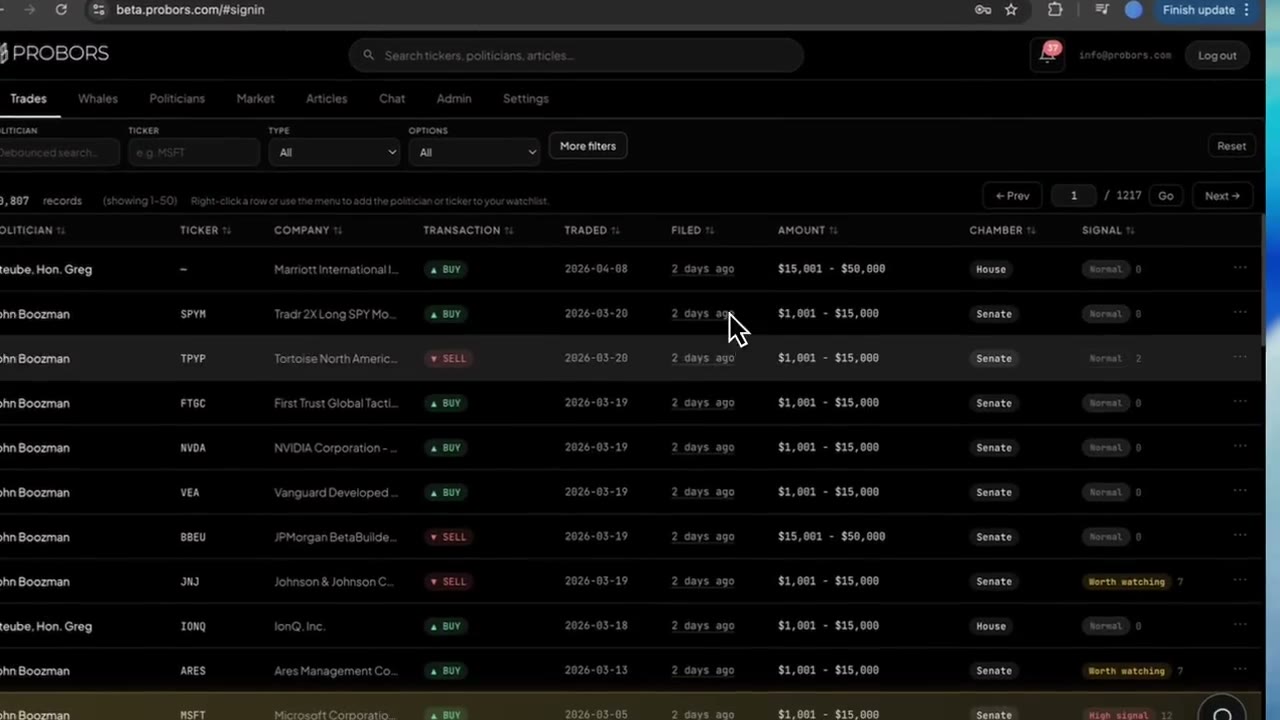
GuruFocus is a long-running value-investing platform built around guru portfolios, insider performance rankings, and screeners. ProBors is a disclosure-first workspace for congressional STOCK Act filings, insider whale rows, signal scoring, and market context on the same ticker. If your morning routine starts with "which gurus bought this name?" GuruFocus may still be the right anchor. If you routinely cross-check House and Senate PTR rows, cluster Form 4 activity, and need alerts when a politician files—not when a screen updates—ProBors targets that loop. This is research context, not investment advice.
Quick answer
Choose GuruFocus when guru holdings, insider performance history, and deep fundamental screeners drive your research.
Choose ProBors when congressional disclosures, whale-sized insider lines, filing-lag triage, and watchlist alerts belong in the same pass as chart review.
Many researchers keep GuruFocus for portfolio and valuation context and add ProBors for daily disclosure monitoring. That split is common and reasonable.
Side-by-side comparison
| Capability | GuruFocus | ProBors |
|---|---|---|
| Primary focus | Guru portfolios, value screeners, insider performance stats | Disclosure-first congress + insider whale workspace |
| Congressional STOCK Act trades | Add-on module; not the core product | Yes — House PTR and Senate periodic rows in one feed |
| Insider Form 4 browsing | Strong with guru-style performance rankings | Strong with whale notional context and filing lag |
| Guru / 13F portfolio tracking | Core strength | Limited — not the primary use case |
| Fundamental valuation screeners | Extensive (Piotroski, GF Score, etc.) | No — disclosure and market context, not valuation models |
| Trade signal scores on disclosure rows | No | Yes on congress and whale rows for triage |
| Watchlist + inbox alerts | Yes for guru and insider events | Yes for ticker, politician, and disclosure-driven alerts |
| AI research on live disclosure data | No | Yes — table-style answers on trades and tickers |
| Market charts next to filings | External charting typical | Built-in with optional disclosure markers |
| Best fit | Value investors tracking guru clones and fundamentals | Daily congress + insider disclosure loops |
What GuruFocus does well
GuruFocus built its audience around who owns what and how insiders have performed historically. Typical GuruFocus workflows include:
- Following cloned portfolios of named investors and fund managers
- Ranking insiders by historical buy/sell returns on a ticker
- Running value screeners with decades of fundamental data
- Screening for net-net, high-yield, or low-PE baskets
- Setting alerts when a tracked guru adds or trims a position
If your thesis starts with "is this stock cheap on a 10-year basis?" or "did Seth Klarman add shares last quarter?", GuruFocus remains a credible specialist.
Where GuruFocus stops and ProBors picks up
GuruFocus treats congressional trades as one module among many—not the spine of the product. Politician disclosures under the STOCK Act publish through separate House and Senate systems with different filing rhythms, amount brackets, and lag patterns. That is the gap ProBors targets.
Researchers who only use GuruFocus often still need another tool when the question becomes:
- Did any House or Senate member trade this ticker in the last 90 days—and how late was the filing?
- Does insider whale activity overlap with a politician purchase on the same symbol?
- Can I alert on new PTR filings without manually checking clerk portals?
- Can I score and sort disclosure rows before opening every PDF?
ProBors is designed for that second layer: congress rows, insider whales, signal scores, watchlists, and charts in one workspace.
When the tools complement each other
A practical split many teams use:
- GuruFocus for guru holdings, valuation screens, and insider performance history on a watchlist.
- ProBors for new STOCK Act filings, whale-sized insider lines, and cross-chamber ticker review.
- Official sources — SEC EDGAR and House/Senate disclosure sites — for final verification before publishing or trading.
Neither tool replaces reading the original filing. Both are triage layers on public data.
When to choose each
Stay with GuruFocus (or lead with it) if you:
- Rarely research congressional disclosures
- Need guru portfolio cloning and deep fundamental screeners daily
- Rely on insider performance rankings as a primary filter
- Want valuation models and historical financials in the same subscription
Add or switch to ProBors if you:
- Stack politician trades and insider whales on the same ticker regularly
- Need watchlist alerts for new PTR or Form 4 rows
- Want signal scores and AI tables for disclosure triage
- Prefer one dashboard for congress, whales, and price charts
- Screen by filing lag before reading tickers
How to test both without duplicating work
- Pick one ticker you already follow—ideally one with recent congressional or insider activity.
- On GuruFocus, review guru holdings and insider performance stats for that name.
- On ProBors, search the same ticker across congressional trades and whale rows.
- Compare filing dates vs transaction dates on any disclosure row you find.
- Decide which tool answered your actual morning question faster.
If step 3 surfaces rows step 2 never showed, you have a workflow gap worth closing.
FAQ
Is ProBors a GuruFocus replacement?
Not for valuation screeners or guru portfolio cloning. ProBors is a better fit when congressional and insider disclosure triage is the daily habit—not when you primarily run Piotroski or GF Score screens.
Does GuruFocus cover Senate and House trades?
GuruFocus offers politician trade data as part of its broader platform. ProBors treats House PTR and Senate periodic rows as first-class data with chamber filters, filing-lag context, and signal scoring in the same feed as insider whales.
Can I use both tools on the same watchlist?
Yes. Many researchers keep GuruFocus for fundamentals and guru context, then run ProBors for new filings and alerts. Verify any claim on the original House or Senate disclosure before acting on it.
Which tool is better for insider buying alerts?
GuruFocus excels at insider performance rankings tied to guru-style investing. ProBors excels at whale-sized Form 4 rows with notional context, plus the ability to cross-check the same ticker for congressional activity in one pass.
Do either tool guarantee profitable trades?
No. Both surface public disclosure data. Filing lag, amount ranges, and legal trading windows mean disclosed activity is often weeks old and may not predict future returns.
Track congress and insider disclosures in one workspace
Use ProBors to monitor STOCK Act filings, whale transactions, signal scores, and market context on the same ticker.
Get startedRelated reading
- ProBors vs Fintel: insider data vs full disclosure research
- OpenInsider vs ProBors: insider workflow comparison
- How to combine congressional and insider research
- Best insider trading trackers in 2026
- ProBors vs Capitol Trades
Sources
- U.S. House Financial Disclosure database — official House PTR source documents
- U.S. Senate eFD search — official Senate periodic transaction reports
- SEC EDGAR — authoritative Form 4 insider filings
- STOCK Act overview (Congress.gov) — legal framework for congressional financial disclosures
- Rows were checked in ProBors and should be verified against the original filing.
- Ingestion health: probors.com/status
Sources & methodology
Last updated:
ProBors uses public disclosure records, SEC filings, House and Senate financial disclosure portals, market data, and in-product workflow checks. Articles are written as research education, not investment advice.