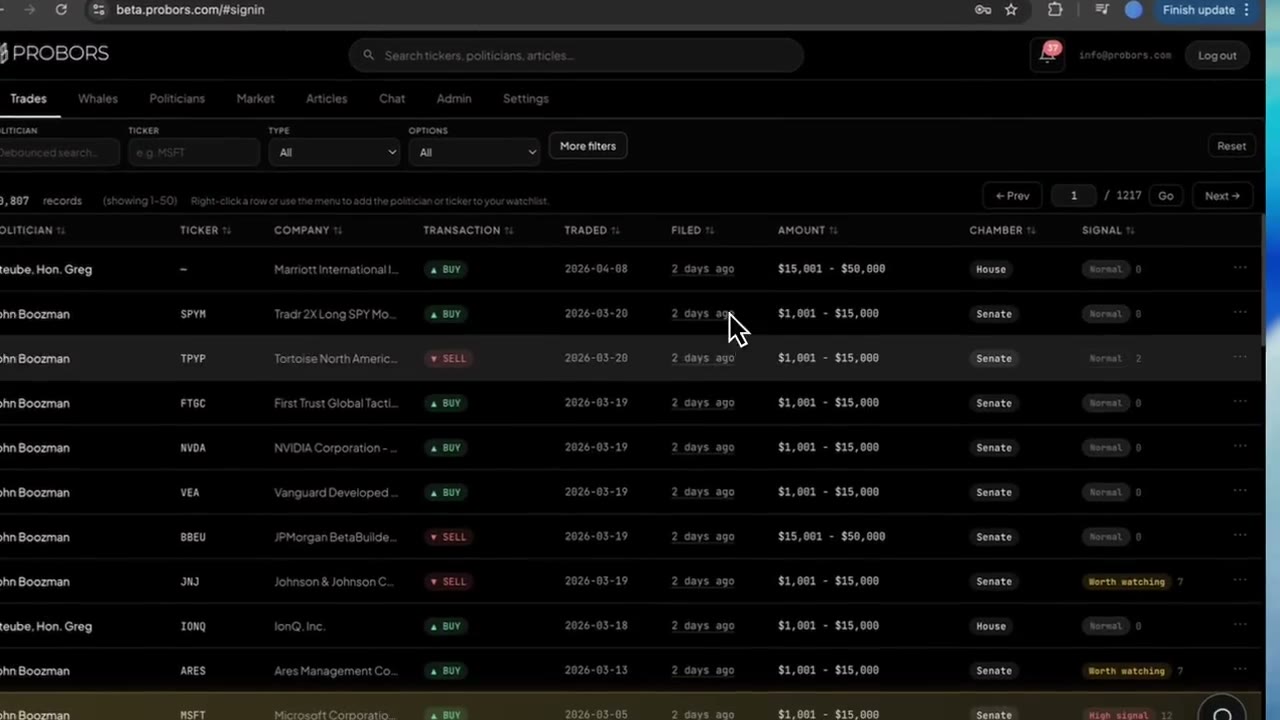
Screening congressional trades by filing lag is how you stop treating a July filing date as if the trade happened yesterday. ProBors shows both the transaction date and the filing date on every row; the gap between them—often zero days for a House PTR, often four weeks for a Senate periodic batch—is the first filter serious researchers apply before reading tickers or signal labels. This six-step workflow walks through setting lag buckets on ProBors, separating timely House disclosures from delayed Senate dumps, and deciding which rows still deserve attention after the market has moved. This is research context, not investment advice.
Why filing lag belongs in your first filter
Congressional disclosure feeds sort cleanly by filing date, but price relevance usually tracks the transaction date. A senator can file eleven June sales on one July afternoon; a House member can disclose a July 20 trade the same calendar day. If you only scan "what filed this week," you mix fresh rows with trades the public could not have known about for a month.
Filing lag screening helps when you:
- Start a morning congressional scan and need to know which rows are still timely
- Write headlines or newsletter blurbs and want to avoid calling a five-week-old trade "breaking"
- Compare House and Senate rhythms without re-reading every PDF
- Pair lag context with signal score filtering so a Worth watching label on a 38-day-old row gets interpreted correctly
Lag is a triage dimension. It does not tell you whether a trade was legal, smart, or predictive—only how stale the public record is relative to the transaction.
Six-step lag-screening workflow on ProBors
-
Open Congressional trades on probors.com and sort by filing date descending so the newest batches appear first. Note today's date before you read any ticker.
-
Add both date columns to your mental checklist. For every shortlisted row, write transaction date and filing date side by side. Compute calendar lag in whole days. Express it plainly: "same-day filing," "11-day lag," or "filed about five weeks after the trade."
-
Set lag buckets that match your question. A practical starting split:
- 0–7 days: timely House PTRs and fast Senate outliers—closest to "actionable disclosure timing"
- 8–30 days: routine Senate periodic batches and slower House queues—still worth reading, but price may have already moved
- 31+ days: late batches, amended catch-ups, or multi-month Senate dumps—research context, not breaking news
Adjust buckets for your beat. Journalists writing "this week's Congress trades" should treat anything above 14 days as background, not lead material.
-
Filter by chamber before you judge lag. Senate periodic transaction reports routinely cluster with 25–45 day lags in ProBors data. House PTR rows often show 0–3 day lags. A 28-day Senate purchase and a same-day House sale are both "normal" for their chamber—compare within chamber, not across chambers on lag alone.
-
Cross-check amount bracket and transaction type inside each bucket. A 38-day-lag $15,001–$50,000 sale tells a different story than a same-day $5,000,001–$25,000,000 sale. Option lines, partial sales, and missing tickers on bond or bill rows need the same lag discipline as equity purchases.
-
Open the source disclosure for anything you plan to cite. From trade detail in ProBors, follow the link to the House Clerk PTR or Senate eFD document. Confirm both dates match the structured row. If the PDF disagrees, trust the PDF. Only then add the row to a watchlist or draft your shareable summary.
Examples: same filing week, different lag stories
Recent filings in ProBors as of July 22, 2026 show why lag screening comes before ticker hype. The table below is deduplicated—identical politician, ticker, type, trade date, filing date, amount, and chamber appear once.
| Politician | Chamber | Ticker / asset | Type | Traded | Filed | Lag | Amount range | Signal |
|---|---|---|---|---|---|---|---|---|
| James Himes | House | HD | Sale | July 20, 2026 | July 20, 2026 | 0 days | $15,001–$50,000 | Normal |
| Laurel Lee | House | NOK | Sale - Put Option | July 6, 2026 | July 17, 2026 | 11 days | $1,001–$15,000 | Worth watching |
| Jerry Moran | Senate | GOOG | Purchase | June 23, 2026 | July 21, 2026 | 28 days | $1,001–$15,000 | Worth watching |
| Alan Armstrong | Senate | WMB | Sale | June 24, 2026 | July 21, 2026 | 27 days | $5,000,001–$25,000,000 | Normal |
| Tommy Tuberville | Senate | MA | Sale | June 8, 2026 | July 16, 2026 | 38 days | $15,001–$50,000 | Worth watching |
How to read these without overfitting:
- Himes HD (0-day lag) is a same-day House sale—timely by STOCK Act standards, but individually unremarkable in signal scoring. Lag screening here tells you the row is fresh; it does not elevate the trade by itself.
- Lee NOK put option (11-day lag) sits in the middle bucket: faster than a typical Senate batch, slower than same-day House PTRs. The Worth watching label reflects option activity and context—not a reason to ignore the 11-day delay when writing a headline.
- Moran GOOG and Armstrong WMB (27–28 day lag) are classic late-July Senate filings for June trades. Worth watching on Moran does not erase the fact that the purchase happened nearly a month before disclosure.
- Tuberville MA (38-day lag) belongs in the long bucket. Useful for portfolio-pattern research on that member; poor fit for "Congress sold today" framing.
Use a table like this to calibrate your buckets weekly. If every row in your short-lag view is a Senate batch filed in July for June trades, widen the date window or lower your lag ceiling—not because the data is wrong, but because your question changed.
Common mistakes when screening by lag
- Equating filing date with trade date. "Filed July 21" is not the same as "traded July 21."
- Applying one lag threshold to both chambers. Senate batches and House PTRs follow different calendars; see filing date vs transaction date.
- Ignoring lag when a signal score is high. A Worth watching label on a five-week-old row is still a lagging data point.
- Treating all long-lag rows as suspicious. Many Senate periodic reports arrive on a predictable delay; lateness alone is not evidence of wrongdoing.
- Skipping the PDF after lag math. Structured fields can mis-parse unusual asset descriptions; always verify at the source.
How to research filing lag on ProBors
Beyond the six-step workflow above:
- Sort Congressional trades by filing date, then scan the lag column before opening tickers.
- Filter to House only or Senate only when your question is chamber-specific.
- Open a politician profile to see whether long-lag batches are routine for that member or an outlier.
- Check data ingestion status if filing dates look stale relative to the official portals.
For a deeper explanation of why delays exist and what the STOCK Act requires, read stock-act-filing-delay-explained.
FAQ
What is a normal filing lag for congressional trades?
House PTR rows in ProBors often show 0–7 day lags. Senate periodic transaction reports commonly cluster around 25–45 days, though individual rows vary. There is no single "normal" across both chambers.
Should I ignore trades with lag over 30 days?
Not necessarily. Long-lag rows are weak for breaking-news timing but useful for politician pattern research, portfolio tracking, and comparing batch behavior across members. Screen them into a separate bucket instead of deleting them.
Does ProBors compute filing lag automatically?
Yes. Where both dates exist in the source disclosure, ProBors displays filing delay in trade context and uses it in signal scoring. Always verify unusual rows against the original House or Senate filing.
Can I filter congressional trades by lag on ProBors?
Use filing date and transaction date together: sort by filing date for freshness, then mentally bucket rows by the lag between the two dates. Pair with chamber filters and signal score floors for a tighter daily list.
Does short lag mean the trade is more important?
Short lag means the public record is more timely—not that the trade is larger, rarer, or more predictive. A same-day $1,001–$15,000 sale can be less research-worthy than a timely large bracket row with cross-market context.
Screen disclosures with lag context
Sort congressional trades by filing date, compare transaction timing, and verify source PDFs on ProBors.
Get startedRelated reading
- STOCK Act filing delay explained
- How to compare filing date vs transaction date
- How to filter congress trades by signal score
- Senate stock trading tracker
- House stock trading tracker
Sources
- STOCK Act (S. 2038, 112th Congress) — statutory basis for periodic transaction reports
- House Clerk — Financial Disclosure (PTR) guidance
- Senate Select Committee on Ethics — Financial Disclosure
- ProBors data status — ingestion health for recent filings
- Rows were checked in ProBors and should be verified against the original filing.
Sources & methodology
Last updated:
ProBors uses public disclosure records, SEC filings, House and Senate financial disclosure portals, market data, and in-product workflow checks. Articles are written as research education, not investment advice.