Insider Monkey is widely read for curated articles on hedge fund holdings, insider purchases, and market commentary. ProBors is built for hands-on disclosure research: Form 4 whales, congressional STOCK Act filings, signal scoring, watchlists, and market context on the same ticker. If you only want headline summaries of what insiders bought last week, Insider Monkey may be enough. If you need to verify rows, cross-check congress, and alert on new filings daily, the workflow gap shows up quickly. This is research context, not investment advice.
Quick answer
Choose Insider Monkey when you want editorial roundups, hedge fund portfolio commentary, and narrative context around well-known insider stories.
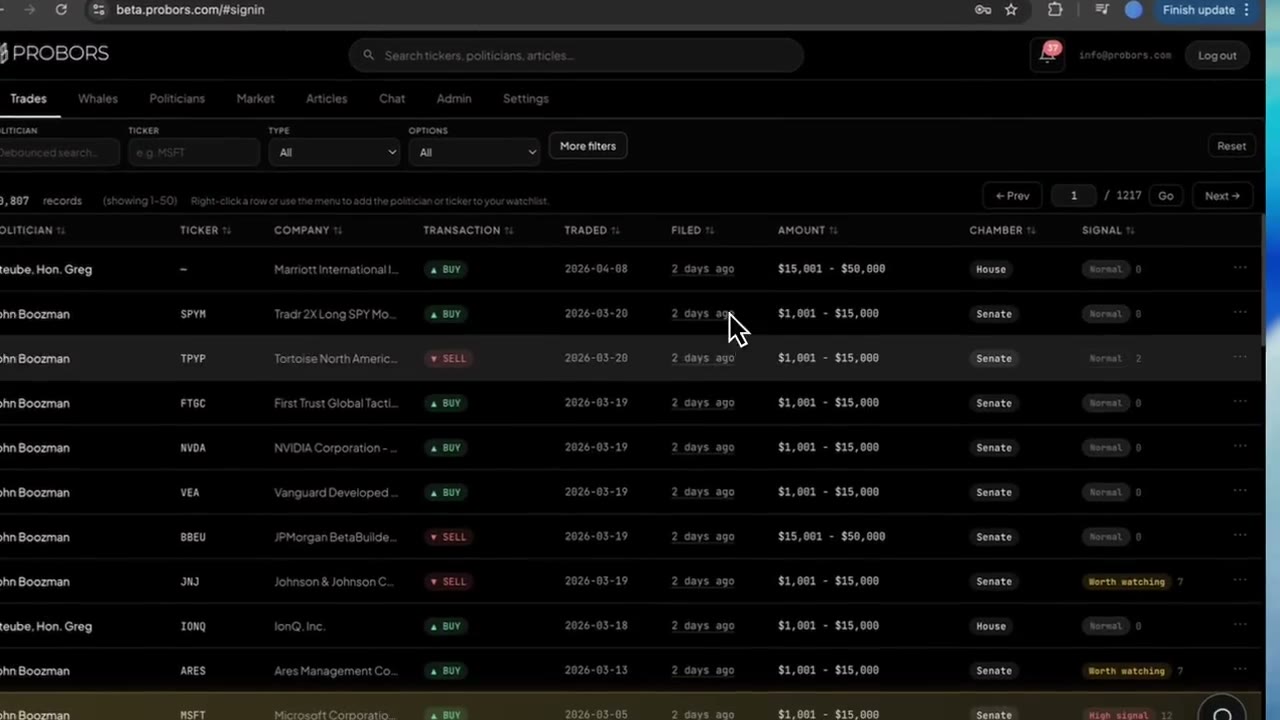
Choose ProBors when your work looks more like a research desk: sort fresh Form 4 and PTR rows, compare filing date to transaction date, stack politician activity on the same symbol, and verify against the original SEC or STOCK Act source before sharing.
Many readers keep Insider Monkey in a news feed and use ProBors when a headline ticker deserves a deeper pass. That combination is normal.
Side-by-side comparison
| Capability | Insider Monkey | ProBors |
|---|---|---|
| Primary format | Articles, rankings, and commentary | Searchable disclosure tables and profiles |
| Form 4 insider browsing | Curated lists in posts; not a full live screener | Full insider and whale rows with filters and drill-down |
| Congressional STOCK Act trades | Occasional coverage in articles | Core module — House PTR and Senate periodic rows |
| Custom watchlists + inbox alerts | No | Yes — ticker, politician, and disclosure-driven |
| Trade signal scores on rows | No | Yes on congress and whale disclosures |
| Market charts next to filings | External | Built-in with optional disclosure markers |
| AI research on live disclosure data | No | Yes — table-style answers on trades and tickers |
| Best fit | Headline discovery and hedge fund context | Daily verification and cross-source triage |
What Insider Monkey does well
Insider Monkey built its audience around readable explainers rather than raw filing tables. Researchers use it to:
- See which stocks appear in recurring “insider buying” or hedge fund holding roundups
- Read narrative context around well-known fund managers and 13F themes
- Discover tickers worth a second look before opening a dedicated tracker
- Stay oriented on macro and sector stories that surround disclosure news
For casual scanning — “what are people talking about this week?” — the editorial format is efficient.
Where Insider Monkey stops and ProBors picks up
Article-first sites summarize conclusions. They are not built for repeatable verification loops. When your question shifts from “what was highlighted?” to “show me every Form 4 on this ticker in the last 60 days, then check congress,” you need a workspace.
ProBors covers gaps that listicles typically do not:
- Row-level verification — open the filing link, compare transaction type codes, and note amount brackets without relying on a summary paragraph
- Congress on the same ticker — see whether House or Senate disclosures overlap an insider cluster
- Whale sizing — separate large notional Form 4 lines from routine plan-driven sales
- Filing lag awareness — compare traded date and filed date on every row, not just the story publish date
- Alerts — watchlist notifications when a tracked politician or ticker files again
That matters when you publish notes, build a personal watchlist, or cross-check a viral headline before treating it as fact.
How a ProBors workflow differs from reading Insider Monkey posts
If an Insider Monkey headline flags a ticker, this six-step loop is what many ProBors users run next:
- Open the ticker in ProBors — start from the symbol named in the article, not the summary alone.
- Sort insider and whale rows by filing date — note role, transaction type, and size band on each line.
- Switch to congressional disclosures on the same symbol — check whether any PTR rows landed in a similar window.
- Read signal scores as triage hints — open row detail for reasons; scores are not buy or sell instructions.
- Review the market chart — compare transaction date to price action; remember filings often arrive days or weeks later.
- Verify against the original source — open the SEC Form 4 or official House/Senate filing before citing the row.
Steps 2–6 are where a disclosure workspace saves time compared with chasing follow-up articles.
Common mistakes when comparing the two
- Treating a roundup as a complete filing history — articles highlight notable rows; they rarely list every Form 4 in a window.
- Confusing publish date with filing date — a story can run days after the underlying disclosure landed.
- Ignoring congressional overlap — insider headlines on a hot ticker deserve a STOCK Act check in the same pass.
- Skipping transaction type codes — grants, exercises, and 10b5-1 plan sales read differently from open-market purchases.
- Paying for a research tool without a repeat workflow — if you only read one insider article per month, editorial sources may suffice.
When to choose each
Stay with Insider Monkey (or lead with it) if you:
- Want narrative context and hedge fund portfolio themes in one feed
- Do not need row-level filters, alerts, or cross-chamber tables
- Research congressional disclosures rarely or never
- Prefer free reading over a structured verification workspace
Add or switch to ProBors if you:
- Verify insider headlines against primary filings before sharing
- Stack Form 4 whales and politician trades on the same ticker regularly
- Need watchlist alerts instead of waiting for the next article
- Want signal scores, AI tables, and charts in one tab
What this does not prove
A mention in an Insider Monkey article or a row on ProBors does not prove insider knowledge, future returns, or illegal trading. Form 4 and STOCK Act filings are self-reported, can be amended, and often arrive after prices have already moved. Editorial selection bias means roundups emphasize notable stories, not exhaustive datasets. Always read the original filing before acting on any disclosure table.
FAQ
Is ProBors a replacement for Insider Monkey?
Not necessarily. Insider Monkey excels at editorial discovery and hedge fund commentary. ProBors excels at hands-on disclosure triage across insiders, whales, and congress. Many researchers use both: headlines from articles, verification in ProBors.
Does Insider Monkey show congressional trades?
Coverage varies by article. It is not a dedicated STOCK Act tracker with filters, alerts, and politician profiles. ProBors treats House and Senate disclosures as a core layer alongside insider rows.
Which tool is better for hedge fund 13F research?
Insider Monkey publishes more narrative content around institutional holdings and fund rankings. ProBors focuses on Form 4 insiders, whale-sized lines, and congressional disclosures rather than deep 13F analytics. For 13F-heavy work, consider pairing either source with a specialist institutional tool.
Can I use ProBors without paying?
ProBors offers tiers with different limits. Insider Monkey publishes free articles with optional premium research products. Compare current plans on probors.com against how often you verify filings yourself.
How do I verify a row before citing it?
Open the linked original filing on SEC EDGAR for Form 4 lines or on the official House or Senate disclosure site for congressional rows. Cross-check dates, ticker spelling, and transaction type before treating any table row as final.
Verify insider headlines in one workspace
Use ProBors to triage Form 4 whales, STOCK Act filings, watchlists, and market context on the same ticker.
Get startedRelated reading
- OpenInsider vs ProBors
- ProBors vs Fintel
- Best insider trading trackers in 2026
- Insider and whale tracker alternatives
- How to triage whale transactions on ProBors
Sources
- SEC Form 4 overview — official form instructions for insider ownership reports
- SEC investor bulletin: Forms 3, 4, and 5 — filing timing and insider definitions
- SEC EDGAR search — primary source for Form 4 verification
- STOCK Act public disclosure resources — Senate guidance on periodic transaction reports
- Rows were checked in ProBors and should be verified against the original filing.
- Data ingestion status: probors.com/status
Sources & methodology
Last updated:
ProBors uses public disclosure records, SEC filings, House and Senate financial disclosure portals, market data, and in-product workflow checks. Articles are written as research education, not investment advice.