A weekly congressional disclosure review is a fixed Friday (or Monday) ritual: scan what became public in the last seven days, separate timely House PTRs from delayed Senate batches, verify anything you might cite, and prune your watchlist—not an endless scroll of every trade headline. ProBors sorts congressional rows by filing date, surfaces signal labels, and links each line to the original House Clerk or Senate eFD source. This seven-step workflow turns that feed into a repeatable research pass you can finish in under an hour. This is research context, not investment advice.
Why a weekly cadence beats daily panic scrolling
Congressional disclosure volume is bursty. A quiet Tuesday can precede a Thursday afternoon dump of House PTRs, while Senate periodic reports often land weeks after the trades inside them. Checking Twitter hourly trains you to react to stale transaction dates; a weekly review trains you to answer a steadier question: what entered the public record since my last pass?
A good weekly review covers:
- Filing-date window — rows that filed in the last 7 days, regardless of when the trade happened
- Chamber rhythm — same-day House PTRs vs multi-week Senate lag
- Watchlist follow-ups — politicians and tickers you already track
- Verification queue — anything worth sharing gets a PDF check before it leaves your notes
Daily alerts still matter for breaking batches; the weekly pass is where you reconcile lag, duplicates, and portfolio context.
Seven-step weekly workflow on ProBors
-
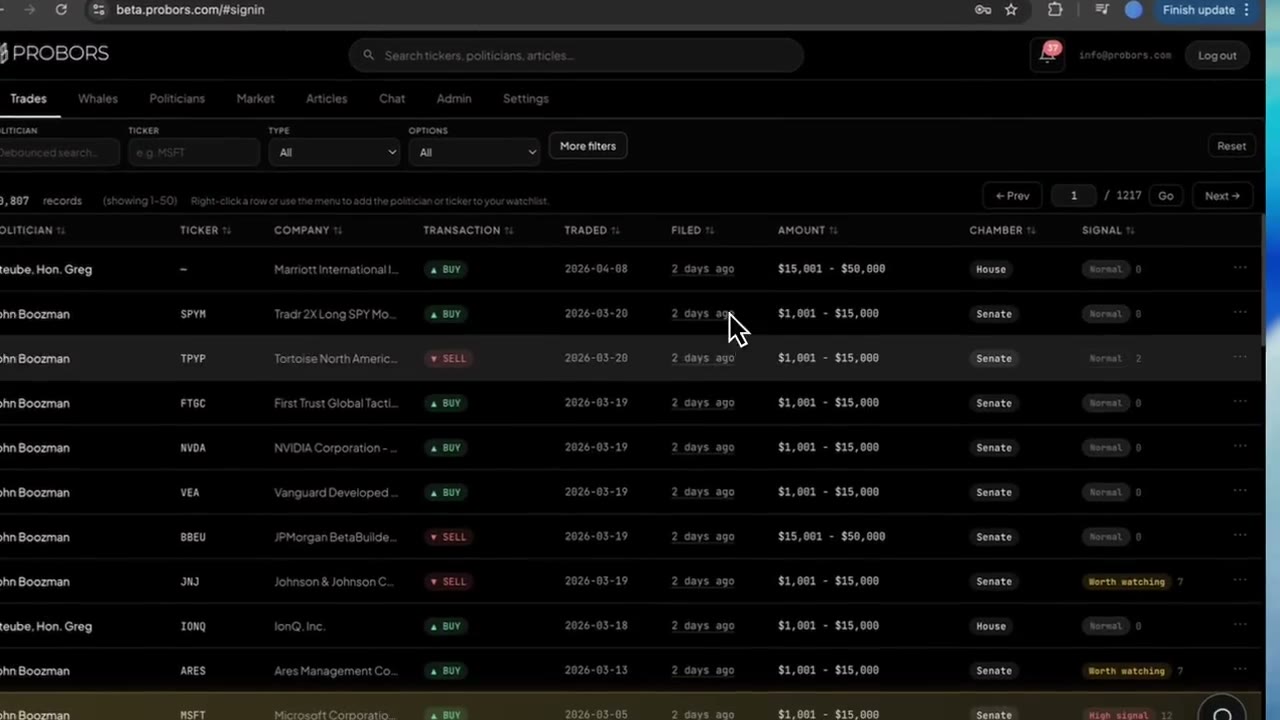
Pick a fixed slot and date window. Block 45–60 minutes the same day each week. Open Congressional trades on probors.com, sort by filing date descending, and filter mentally to filings from the last seven calendar days. Write today's date at the top of your notes before you read tickers.
-
Run a lag screen before signal labels. For each shortlisted row, log transaction date, filing date, and lag in whole days. Bucket rows into same-week (0–7 days), routine Senate delay (8–30 days), and stale batches (31+ days). See how to screen congress trades by filing lag for bucket definitions—lag is triage, not a verdict on the trade.
-
Split House and Senate passes. House PTRs often file within a day of the trade; Senate rows in the same filing-date window may reflect June activity filed in late July. Scan House rows for timely equity lines first, then read Senate batches as portfolio context. Mixing chambers without labeling lag produces false "Congress bought X today" stories.
-
Shortlist by signal label, then open row detail. Worth watching rows deserve a PDF check—not automatic sharing. Normal labels on mega-cap partial sales may be routine rebalancing. Open disclosure context for truncated descriptions, especially on structured notes and funds. Pair with how to filter congress trades by signal score when you need scoring context.
-
Cross-check watchlist items. Open your ProBors watchlist inbox for the week. Did a tracked politician file a new batch? Did a watched ticker appear on both chambers? Run the combined pass from how to combine congress and insider research only when both sides fired—overlap is a research prompt, not confirmation.
-
Verify before you cite or share. For any row leaving your private notes, follow the source link to the House Clerk PTR or Senate eFD filing. Confirm politician name, owner code (self, spouse, joint), amount bracket, and asset type. Check for duplicate lines and amendments. Use how to verify congressional trade disclosures before sharing as a pre-flight checklist.
-
Prune and update the watchlist. Remove items you did not open in 30 days. Add one new politician or ticker only if step 6 passed. The weekly review is also where disclosure research watchlists stay usable—without pruning, alerts become noise.
Examples from a late-July weekly pass
Recent filings in ProBors as of August 1, 2026 show why the weekly window matters. The table below is deduplicated—identical politician, ticker, type, trade date, filing date, amount, and chamber appear once.
| Politician | Chamber | Ticker | Type | Traded | Filed | Lag | Amount range | Signal |
|---|---|---|---|---|---|---|---|---|
| Pete Sessions | House | ARCC | Sale | July 24, 2026 | July 24, 2026 | 0 | $1,001–$15,000 | Normal |
| Sam Liccardo | House | NVDA | Sale (Partial) | July 21, 2026 | July 22, 2026 | 1 | $15,001–$50,000 | Normal |
| Jerry Moran | Senate | GOOG | Purchase | June 23, 2026 | July 21, 2026 | 28 | $1,001–$15,000 | Worth watching |
How to read these in a weekly review:
- Sessions + ARCC: Same-day House filing with a Normal label on a small bracket sale. Fits the "timely House PTR" lane—worth logging if you track Sessions or BDC exposure, not automatic headline material.
- Liccardo + NVDA: One-day House lag on a partial NVDA sale. Routine mega-cap disclosure timing; compare against any insider NVDA rows the same week before treating it as a sector signal.
- Moran + GOOG: Senate purchase with a 28-day lag filed in a July 21 batch. The filing date lands in your weekly window, but the trade date is late June—lag screening prevents calling this "fresh" Alphabet activity.
Use rows like these to practice step 2 before you expand the shortlist.
What this does not prove
A weekly review organizes public STOCK Act rows that entered ProBors during your window. It does not predict returns, prove politicians traded on non-public information, or replace reading original filings. Filing lag varies by chamber and filer; amount fields remain ranges. A Worth watching label is triage inside ProBors—not a recommendation to buy or sell.
FAQ
Friday or Monday—which day works best?
Pick the day after your market week ends and keep it fixed. Many researchers prefer Friday afternoon to capture House PTRs that land late in the week; others use Monday morning to include weekend-published Senate batches. Consistency matters more than the specific day.
How is this different from a daily congressional scan?
Daily scans answer "what filed since yesterday?" Weekly reviews answer "what changed in my research picture this week?"—including lag context, watchlist pruning, and verification of rows you might cite. Both can coexist; this workflow prevents daily headline reflexes on stale Senate trade dates.
Should I include insider and whale filings in the same session?
Optional. This workflow focuses on congressional STOCK Act rows. If your watchlist includes insiders or whales, add a 15-minute Form 4 pass after step 7, or run whale triage on a separate cadence so congressional lag discipline stays intact.
What if no rows filed in my seven-day window?
Check ProBors data status for ingestion health, widen to a 14-day filing window, and review Senate batches that may have traded earlier but filed recently. Quiet weeks happen—use the time for watchlist pruning and PDF backlog instead of forcing narratives.
Do I need to read every line in a large House PTR?
No. Filter by signal label, ticker, or politician first. Large PTRs can list dozens of lines; your weekly pass should shortlist, not exhaustively parse every bracket on every fund line unless that politician is in your Tier B watchlist.
Run your weekly disclosure pass in one workspace
Sort congressional trades by filing date, screen lag, open source PDFs, and update your watchlist on ProBors.
Get startedRelated reading
- How to screen congress trades by filing lag
- How to build a disclosure research watchlist
- How to verify congressional trade disclosures before sharing
- Congress trades filed in late July 2026
- Senate stock trading tracker
Sources
- House Clerk Financial Disclosure (PTR) search
- Senate Financial Disclosures (eFD)
- STOCK Act (Pub. L. 112-105)
- Senate Select Committee on Ethics — Financial Disclosure
- Rows were checked in ProBors and should be verified against the original filing.
- For ingestion health, see ProBors data status.
Sources & methodology
Last updated:
ProBors uses public disclosure records, SEC filings, House and Senate financial disclosure portals, market data, and in-product workflow checks. Articles are written as research education, not investment advice.