Stale Senate disclosure batches look like breaking news when they hit your feed—a single filing date with dozens or hundreds of rows—but the transaction dates inside often stretch across months or years. ProBors shows both dates on every Senate line, so you can separate a routine periodic backlog from a timely disclosure before you write a headline or add a ticker to a watchlist. This six-step workflow walks through spotting batch dumps, triaging lag, verifying the original eFD PDF, and deciding what still deserves follow-up after the market has moved. This is research context, not investment advice.
Why Senate batches need a different workflow than House PTRs
House Periodic Transaction Reports often land within a few days of the trade. Senate periodic transaction reports follow a different rhythm: members may file one large batch that covers activity from several prior months, and filing date alone tells you almost nothing about when the trade happened.
A stale batch usually shows these patterns:
- One filing date, many rows — dozens of lines sharing the same filed date
- Wide trade-date spread — transaction dates from 2024, 2025, and 2026 inside the same PDF
- Lag measured in months, not days — 200-day, 500-day, or even 800-day gaps between trade and filing
- Missing or muted signal labels — ProBors may not score very old rows the same way it scores fresh Senate lines
General lag screening helps you bucket any row. This workflow is for when you already see a backlog dump and need to decide what it means without treating August filing activity as August trading activity.
Six-step workflow on ProBors
-
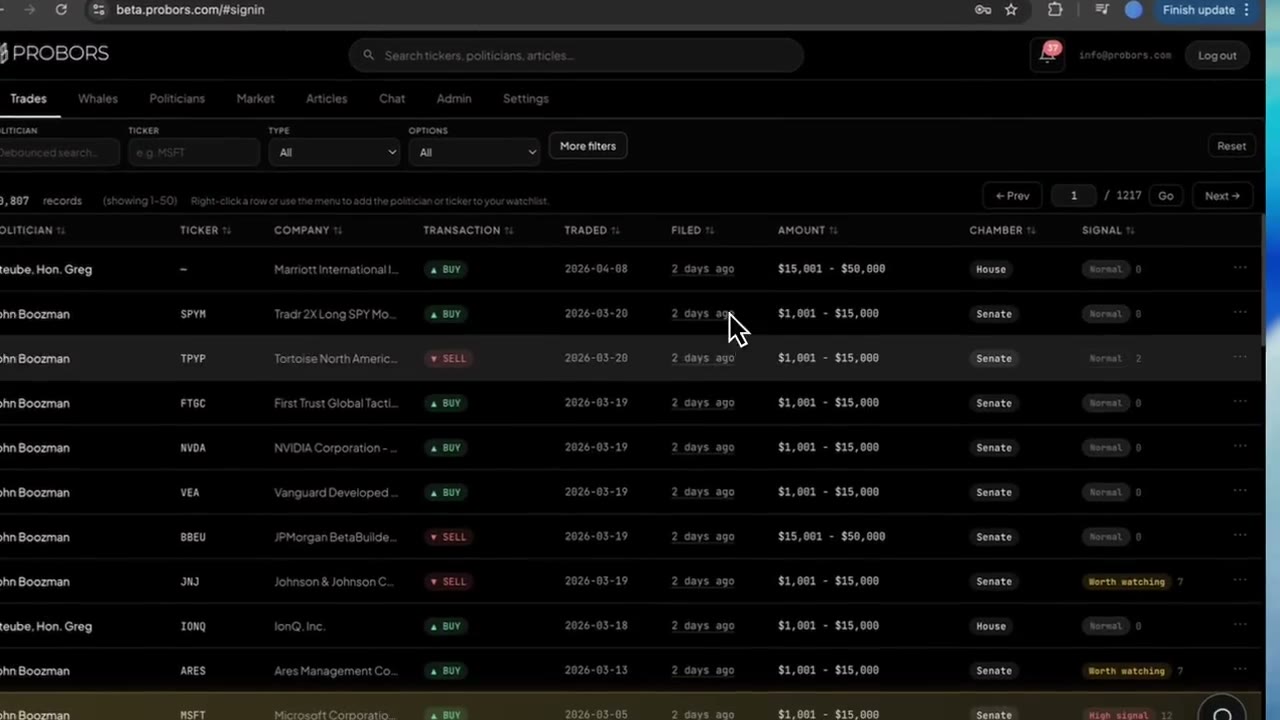
Spot the batch shape first. Open Congressional trades on probors.com, filter by Senate, and sort by filing date descending. When one politician name dominates a single filing date with dozens of rows, pause before reading tickers—that is likely a periodic batch, not a one-day trading spree.
-
Log filing date and trade-date range. Write the filed date at the top of your notes, then scan the batch for the earliest and latest transaction dates. A batch filed August 5 with trade dates from March 2024 through December 2025 is a backlog disclosure spanning more than a year—not a same-week portfolio move.
-
Compute lag per row in whole days. For each line you might cite, subtract transaction date from filing date. Express lag plainly: "880-day lag," "about eight months," or "231-day lag." Compare those numbers to a fresh Senate row in the same week—Shelley Moore Capito's July 21 trades filed August 4 carry 14-day lag, a completely different category from an 800-day backlog line filed the next day.
-
Separate backlog rows from the freshest lines in the same batch. Even inside a stale dump, the newest transaction dates matter. Sort mentally by trade date within the batch. December 2025 sales disclosed in August 2026 are still old news, but they are more recent than March 2024 option sales in the same filing.
-
Open the Senate eFD PDF before sharing anything. Follow the source link on any row you might cite. Confirm owner code (self, spouse, joint), asset type, amount bracket, and whether the line is stock, option, or fund interest. Backlog PDFs are long; search within the document for the ticker or trade date you care about. Use how to verify congressional trade disclosures before sharing as a pre-flight checklist.
-
Decide follow-up with market context, not filing date. For backlog rows, open the market workspace for the ticker and look at price action around the transaction date, not the filing date. A March 2024 sale disclosed in August 2026 is archival portfolio context. A 14-day-lag Senate trim filed the same week is a different research question. Prune watchlist alerts tied to backlog noise unless you specifically track that member's periodic filing pattern.
Examples from recent filings: backlog vs fresh Senate rows
Recent filings in ProBors as of August 8, 2026 show why one Senate filing week can contain two unrelated stories. Thomas Tuberville filed 149 Senate lines on August 5, 2026—a classic backlog dump with trade dates from March 2024 through December 2025 and lag from 231 days to 880 days. Shelley Moore Capito filed five Senate sales on August 4 tied to July 21 trade dates—14-day lag on every line.
| Politician | Chamber | Type | Traded | Filed | Lag | Amount range | Signal |
|---|---|---|---|---|---|---|---|
| Thomas Tuberville | Senate | Sale | March 8, 2024 | August 5, 2026 | 880 days | $1,001 - $15,000 | — |
| Thomas Tuberville | Senate | Sale | March 12, 2024 | August 5, 2026 | 876 days | $15,001 - $50,000 | — |
| Thomas Tuberville | Senate | Sale | December 17, 2025 | August 5, 2026 | 231 days | $50,001 - $100,000 | — |
| Shelley Moore Capito | Senate | Sale | July 21, 2026 | August 4, 2026 | 14 days | $1,001 - $15,000 | Normal |
| Shelley Moore Capito | Senate | Sale | July 21, 2026 | August 4, 2026 | 14 days | $15,001 - $50,000 | Worth watching |
How to read this without merging the batches:
- Tuberville's August 5 dump is dominated by sales with transaction dates in 2024 and 2025. The 880-day AMAT line reflects a March 2024 trade—not August 2026 activity. ProBors shows no signal label on these stale rows; that is expected, not a missing feature.
- Capito's August 4 batch is a compact five-line trim with uniform 14-day lag—routine Senate periodic timing. The MSFT sale carries a Worth watching label; the other four lines are Normal. That is fresh-batch triage, not backlog archaeology.
- Workflow takeaway: Filter by politician name, compare lag spread inside the batch, then verify PDF sections before citing either story.
For a wider early-August filing window that includes House batches alongside these Senate patterns, see Congress trades filed early August 2026.
Common mistakes when stale batches hit the feed
- Headlining by filing date. "Senator sold MSFT on August 5" is wrong when the trade date is October 2025 or March 2024 inside a backlog PDF.
- Pooling backlog and fresh Senate rows in one table sorted only by filing date. Capito's 14-day trim and Tuberville's 800-day line are not the same disclosure category.
- Treating row count as trading intensity. 149 lines on one filed date usually means catch-up reporting, not 149 separate decisions that week.
- Skipping asset type on old option lines. Tuberville's AMAT row includes option context in the security description—verify in the PDF before comparing to outright stock sales.
- Ignoring amount brackets on archival rows. A $1,001–$15,000 sale disclosed two years late is still a small bracket, not evidence of a large exit timed to recent news.
FAQ
What counts as a stale Senate disclosure batch?
A stale batch is usually many Senate rows sharing one filing date with transaction dates spread across months or years and lag often exceeding 30 days—sometimes hundreds of days. One politician filing 50+ lines on a single date is a common shape.
How is this different from screening by filing lag?
Screening by filing lag buckets any congressional row into timely, routine, or stale categories. This workflow is for when you already see a Senate backlog dump and need to triage trade-date spread, PDF length, and market context inside that batch.
Should I trust signal labels on very old Senate rows?
Often not for triage. ProBors may omit signal labels on rows with extreme lag because the score is designed for fresher disclosure timing. Read the row anyway for portfolio context, but do not expect Worth watching labels on 800-day backlog lines.
Where do Senate backlog filings come from?
Senate members file periodic transaction reports through the Senate eFD system. Reporting calendars, amendments, and catch-up batches can produce large single-date filings. See STOCK Act filing delay explained for the rules behind the gap.
How do I verify a row inside a long backlog PDF?
Open the source PDF from the row detail, search for the ticker or transaction date, confirm owner and amount bracket, and check for duplicate or amended lines. Rows were checked in ProBors and should be verified against the original filing.
Separate backlog dumps from fresh Senate filings
Use ProBors to filter Senate trades by politician, compare transaction and filing dates, and open original eFD sources before you cite a batch.
Get startedRelated reading
- Senate stock trading tracker
- How to screen congressional trades by filing lag
- STOCK Act filing delay explained
- Congress trades filed early August 2026
- How to verify congressional trade disclosures before sharing
Sources
- Senate eFD financial disclosure search
- Senate STOCK Act guidance
- Congress.gov STOCK Act overview
- ProBors data status — ingestion health for congressional filings
- Rows were checked in ProBors and should be verified against the original filing.
Sources & methodology
Last updated:
ProBors uses public disclosure records, SEC filings, House and Senate financial disclosure portals, market data, and in-product workflow checks. Articles are written as research education, not investment advice.