TAK whale insider sales landed in a coordinated batch filed on August 12, 2026. ProBors shows 15 open-market Form 4 lines (code S) from 13 Takeda Pharmaceutical reporting owners, all with a trade date of August 10, 2026 and roughly $9.3 million in combined reported value. CEO Julie So-Young Kim and R&D president Andrew Stewart Plump account for the largest single-owner totals in the cluster—not a one-off officer exit but a broad executive filing wave. This guide explains the August batch, how it differs from louder tech whale boards, a five-step triage framework, and what the filings do not prove. It is research context, not investment advice.
Why the August 10 TAK cluster stands out
Takeda Pharmaceutical (TAK) is an ADR-listed global pharma name. It does not dominate the 14-day whale leaderboard the way CRWV, APPF, or ANET do in mid-August 2026—those tickers show hundreds of prints driven by post-IPO sales, tax withholding (F), and large disposition waves. The TAK story is different:
- Many executives, one trade date. Thirteen distinct reporting owners filed code S sales tied to August 10, 2026—spanning the CEO, R&D president, business-unit heads, and functional officers.
- Uniform filing lag. Rows indexed in ProBors show a 2-day lag between the August 10 trade date and the August 12 filing date—routine for Form 4, but useful when you are triaging freshness.
- Open-market sales, not grants. The August batch is overwhelmingly code S. That is a different research lens than July disposition (D) activity on the same ticker, where fund-related lines can show much larger reported values.
A coordinated executive sale wave often reflects compensation vesting, tax withholding paired with sales, or a pre-scheduled program—not necessarily a discretionary bearish call on the ADR.
Recent TAK whale filings in ProBors
The table below shows deduplicated whale rows from ProBors as of August 13, 2026. Each row is the August 10, 2026 open-market sale total per reporting owner (multiple lines on the same date are summed). Reported values are as indexed in ProBors.
| Insider | Title | Type | Traded | Filed | Lag | Reported value | Signal |
|---|---|---|---|---|---|---|---|
| Andrew Stewart Plump | President, R&D | Sale | August 10, 2026 | August 12, 2026 | 2 days | $2,828,220 | 3 |
| Julie So-Young Kim | President and CEO | Sale | August 10, 2026 | August 12, 2026 | 2 days | $1,523,439 | 3 |
| Teresa Marie Bitetti | President, OBU | Sale | August 10, 2026 | August 12, 2026 | 2 days | $855,205 | 3 |
| Lauren Rusckowski Duprey | Chief Transformation Officer | Sale | August 10, 2026 | August 12, 2026 | 2 days | $813,720 | 3 |
| Nicola Deidre Petal Greenway | Chief Human Resources Officer | Sale | August 10, 2026 | August 12, 2026 | 2 days | $711,612 | 3 |
| Giles Richard Platford | President, IBU | Sale | August 10, 2026 | August 12, 2026 | 2 days | $531,519 | 3 |
| Gabriele Ricci | Chief Data & Tech. Officer | Sale | August 10, 2026 | August 12, 2026 | 2 days | $429,004 | 3 |
| Agosti Marcello Pignagnoli | Head, Strat. & Port. Dev | Sale | August 10, 2026 | August 12, 2026 | 2 days | $392,564 | 3 |
Snapshot summary: 15 code S lines from 13 reporting owners on one trade date; combined reported value about $9.3 million; all filed August 12, 2026 with a 2-day lag.
Congressional PTR history for TAK in ProBors is sparse and dated—mostly small House buys and sells from 2018–2023, with no recent chamber overlap on this August insider window.
A five-step triage framework for executive sale waves
Use the same checklist when a pharma ADR shows a multi-officer sale batch instead of a single CEO headline.
1. Read the SEC transaction code first
Open-market sales use code S. Grants (A), dispositions (D), and tax withholding (F) are different economic events. The August TAK cluster is code S—filter here before you compare it to July disposition lines on the same ticker.
2. Count distinct reporting owners on the trade date
One officer selling $2.8 million is a headline. Thirteen officers selling on the same trade date is a wave—often tied to a shared compensation event or plan. Note titles: CEO, R&D president, and multiple business-unit presidents filing together suggests a corporate calendar, not independent decisions.
3. Measure filing lag in calendar days
Form 4 is generally due within two business days after the transaction. A 2-day lag on August 10 trades filed August 12 is routine. Longer gaps deserve a footnote read on SEC EDGAR.
4. Compare leaderboard rank to batch shape
TAK may not top the 14-day whale print-count board in mid-August 2026 while APPF and CRWV dominate with tax withholding and post-IPO distribution. Leaderboard rank measures print frequency and reported value across codes—not whether a single-day executive wave is unusual for pharma.
5. Read signal scores as a sort key—not a verdict
ProBors signal scores weigh size, role, timing, and pattern history. Scores of 3 on multi-hundred-thousand-dollar officer sales flag attention relative to each insider's typical filing size—they do not prove bearish intent. Sort by signal after filtering codes. For scoring details, see how ProBors trade signal scores work.
How to research TAK on ProBors
- Open the Whales tab and filter by ticker TAK.
- Sort by filing date (newest first) to catch the August 12 batch.
- Read transaction codes before sorting by reported value—July disposition (D) lines can dwarf August S rows in dollar terms.
- Group rows by trade date and reporting owner to see whether multiple lines belong to one economic decision.
- Note signal scores as a second sort. Scores of 3 flag size relative to each insider's history, not a trade recommendation.
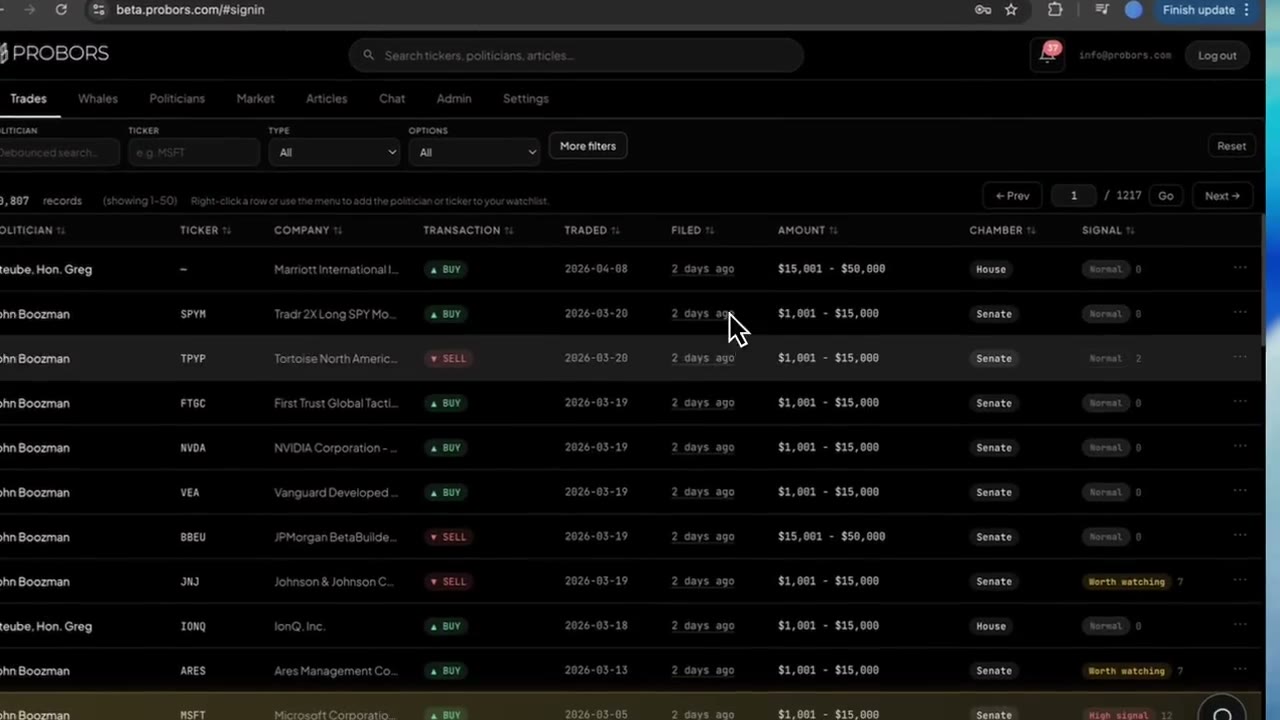
- Switch to the Trades tab with the same ticker to confirm whether any recent House or Senate PTR overlaps your insider window—TAK chamber history in ProBors is thin and mostly years old.
- Add TAK to a watchlist if you want alerts when the next executive batch arrives. See ProBors watchlist alerts for setup steps.
For broader whale triage habits, see how to triage whale transactions on ProBors.
What this does not prove
The August 2026 TAK executive sale wave does not prove:
- That Takeda management expects weaker pipeline or earnings outcomes.
- That the August 10 batch is discretionary rather than plan-driven—many officer programs follow pre-set schedules tied to vesting dates.
- That thirteen officers selling on one date share the same motive (tax, estate planning, diversification, or compensation mechanics).
- That congressional PTR history validates or contradicts current insider flow—recent chamber data on TAK is absent in ProBors.
- That signal scores alone justify a trade—the scores prioritize research attention, not outcomes.
Form 4 disclosures document what was filed and when. They do not reveal plan type, footnote language, or whether a sale was tax-driven or pre-scheduled.
FAQ
Why did so many Takeda executives file on the same trade date?
Multi-officer clusters on one trade date often reflect a shared compensation vesting event, annual sale program, or coordinated tax-related disposition. ProBors indexes each Form 4 line separately. Read footnotes on the original filing before treating the wave as discretionary selling.
Is TAK louder than CRWV on the whale board?
Not on print count. In mid-August 2026, CRWV and APPF rank higher on 14-day whale leaderboards with hundreds of prints—mostly sales and tax withholding on high-growth tech names. TAK is a narrower executive S wave on one date, not a sustained multi-week distribution program. See top whale tickers in August 2026 for leaderboard context.
How does this compare to UTHR's daily CEO sales?
UTHR in late July 2026 showed a sustained daily CEO sale rhythm across two weeks. TAK in August 2026 shows a single-day multi-officer batch. Different shapes require different triage lenses. See UTHR whale insider sales explained.
Does July disposition activity on TAK change the August story?
July TAK rows include large disposition (D) lines that can show much higher reported values than August open-market sales. Keep disposition mechanics and code S sales in separate research buckets—do not merge them into one bearish narrative.
Where do I verify a specific row?
Open the original Form 4 on SEC EDGAR — Takeda Pharmaceutical search and compare trade date, transaction code, share count, and reporting owner to the ProBors row. Check probors.com/status if rows look stale.
Track TAK insider and whale filings
Use ProBors to filter whale transactions by ticker, read signal scores, and compare insider flow with congressional disclosures on one workspace.
Get startedRelated reading
- Top whale tickers in August 2026 — where tech and healthcare names rank on the broader leaderboard
- How to triage whale transactions on ProBors — a repeatable framework for loud tickers
- UTHR whale insider sales explained — the sustained daily officer-sale pattern
- ProBors whales tab guide — filters, codes, and sorting on the whale workspace
Sources
- SEC Form 4 overview — insider transaction reporting requirements
- SEC EDGAR — Takeda Pharmaceutical Form 4 search
- SEC Rule 10b5-1 trading plans — context for pre-scheduled insider sales
- House STOCK Act disclosure information
- Rows were checked in ProBors and should be verified against the original filing. Ingestion health: probors.com/status.
Sources & methodology
Last updated:
ProBors uses public disclosure records, SEC filings, House and Senate financial disclosure portals, market data, and in-product workflow checks. Articles are written as research education, not investment advice.