Filtering congress trades by transaction type keeps purchase headlines separate from partial trims, bond sales, and option rolls. A Senate purchase and a House partial sale on the same ticker answer different research questions—and mixing them in one feed is how "Congress bought tech" stories get written from unrelated rows. ProBors labels each STOCK Act line with a transaction type so you can narrow the congressional feed to purchases only, sales only, or specific disposition categories before you check filing lag or signal scores. This seven-step workflow walks through that type-first filter on probors.com. This is research context, not investment advice.
Why transaction type belongs in your first filter pass
Congressional disclosure feeds are noisy because one filing PDF can contain many line types:
- Purchase — new or added exposure (common stock, fund, or bond)
- Sale — full exit or disposition labeled as a complete sale
- Sale (Partial) — a trim, not necessarily a thesis change
- Purchase/Sale with option language — calls, puts, or corporate actions that are not a simple share buy
- Exchange — shares swapped in a merger, spin, or corporate restructuring
Researchers filter by type first because:
- Directional narratives break when types mix. Pooling purchases with partial sales on the same ticker can look like conflicting "Congress is bullish and bearish" evidence when the rows describe different portfolio actions.
- Signal scores are row-level, not type-level. A Worth watching label on a partial sale means something different than the same label on an outright purchase—especially when lag differs by chamber.
- Non-equity lines hide inside equity searches. Bond purchases and fund interests often carry Purchase labels without a clean equity ticker; type plus asset description prevents false stock narratives.
- Options and exchanges need their own bucket. Treating a call purchase or merger exchange like a common-stock buy misstates what the politician actually did.
Type filtering is complementary to signal-score screening and filing-lag triage—not a replacement. Run type first when your question is directional; run lag or signal first when your question is timeliness.
Seven-step workflow on ProBors
-
Write the type question before opening the feed. Decide whether you care about new buying, full exits, partial trims, derivative activity, or corporate-action exchanges. "Who added exposure?" is a Purchase filter. "Who reduced a line without necessarily exiting?" is a Sale (Partial) filter. Different questions, different starting filters.
-
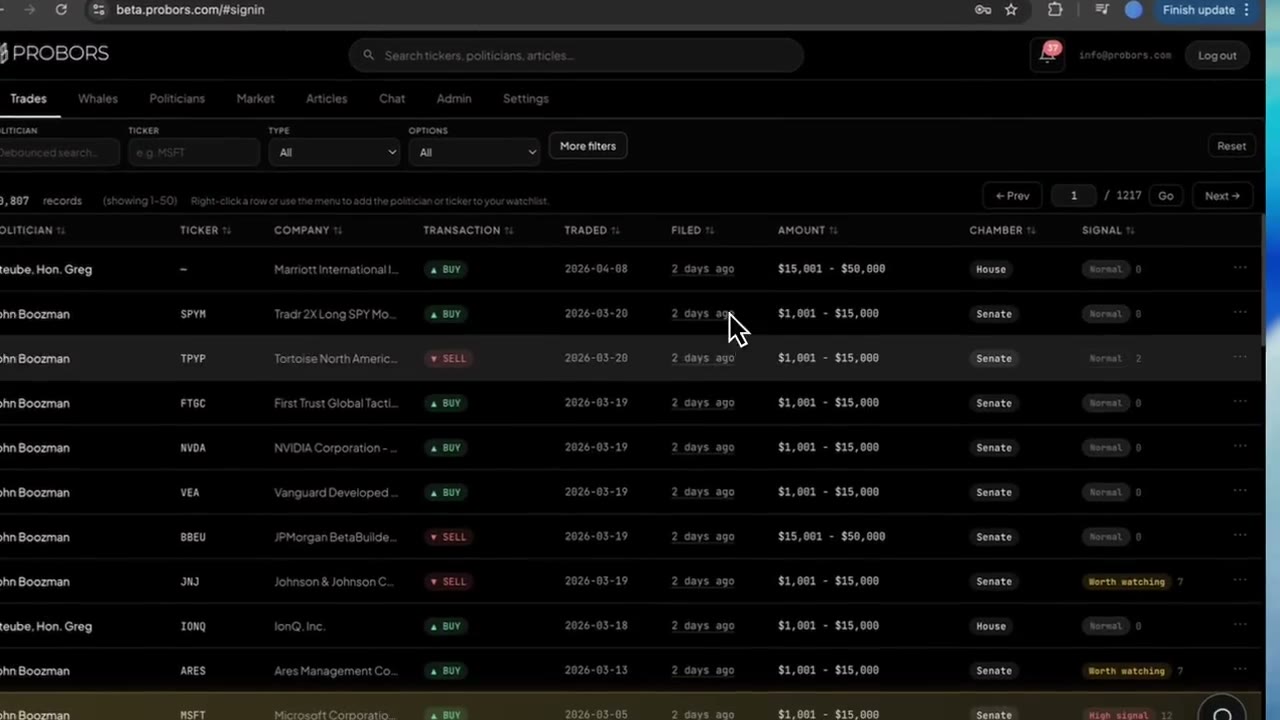
Open Congressional trades. From probors.com, go to the Trades tab (or search a ticker first if you already know the symbol). Sort by filing date descending for a morning scan, or by transaction date when you are studying a specific week.
-
Apply the transaction type filter. Use the type control on the trades table to limit rows to Purchase, Sale, Sale (Partial), or the option-related labels your feed exposes. If you are studying one politician, combine type with a name filter so you do not read their entire history when you only need recent sales.
-
Add chamber context when direction matters. House PTR rows and Senate periodic lines follow different lag patterns. After narrowing by type, split House and Senate views when you might cite a row publicly—see how to research a ticker across the House and Senate for the cross-chamber pass.
-
Read partial sales as portfolio management, not necessarily bearish bets. Sale (Partial) on a mega-cap can reflect rebalancing, tax planning, or account housekeeping. Note the amount bracket and whether the same member has outright Sale rows on the same ticker in the same window before you write "sold shares."
-
Route options and exchanges to a separate note. Purchase lines that reference calls, puts, or corporate notes belong in a derivatives bucket—not your common-stock purchase tally. Exchange rows (merger consideration, share swaps) describe corporate actions, not market-timing trades. For option-specific reading, see ProBors congress options and derivatives guide.
-
Verify type and owner in the source PDF before sharing. Click through from any row you might cite. Confirm the raw disclosure label matches the structured type, check owner code (self, spouse, joint), and confirm the asset description. Add the ticker or politician to a watchlist only after verification—alerts fire on new filings, not retroactive type sorting.
Examples from recent filings
Recent filings in ProBors as of August 15, 2026 show why a type filter should run before you build a narrative. The same August filing window includes a House purchase, a partial sale, full sales, and a Senate purchase—same calendar week, different transaction stories.
| Politician | Chamber | Type | Ticker | Traded | Filed | Lag | Amount range | Signal |
|---|---|---|---|---|---|---|---|---|
| John McGuire III | House | Purchase | AMAT | July 15, 2026 | August 7, 2026 | 23 days | $1,001 - $15,000 | Worth watching |
| John McGuire III | House | Sale (Partial) | PANW | July 31, 2026 | August 7, 2026 | 7 days | $1,001 - $15,000 | Worth watching |
| Mike Kelly | House | Sale | PEP | July 17, 2026 | August 12, 2026 | 26 days | $15,001 - $50,000 | Normal |
| Gary Peters | Senate | Purchase | O | July 23, 2026 | August 7, 2026 | 15 days | $1,001 - $15,000 | Normal |
| Michael Rulli | House | Sale | CCI | August 6, 2026 | August 6, 2026 | 0 days | $1,001 - $15,000 | Normal |
How to read this without merging types:
- McGuire (Purchase, AMAT) and McGuire (Sale Partial, PANW) are the same member in the same filing week with opposite direction labels on different tickers. Filtering to Purchase-only would surface the Applied Materials buy; filtering to partial sales would surface the Palo Alto trim—combining them into one "McGuire traded tech" line hides the type distinction.
- Kelly (Sale, PEP) is a full sale label on a consumer staple, not a partial trim. Compare amount bracket ($15,001–$50,000) and type before assuming it matches the smaller McGuire partial line.
- Peters (Purchase, O) is a Senate purchase with 15-day lag—faster than many Senate batches but still worth logging separately from House rows filed the same week.
- Rulli (Sale, CCI) filed the same day as the trade (0-day lag)—a timely House PTR example that looks "fresher" than the Senate purchase beside it in a filing-date sort.
Use this table as a template: pick your type filter → log lag per row → verify PDF → then decide what deserves follow-up.
Common mistakes when ignoring transaction type
- Counting partial sales as full exits. Sale (Partial) does not mean the politician closed the position; check for remaining holdings in the portfolio snapshot when available.
- Treating every Purchase row as common stock. Bond and fund purchases carry Purchase labels too—read the asset description or use non-equity disclosure research when tickers are missing.
- Pooling purchases and sales into a net direction score. Net "bought minus sold" tickers without type context creates false consensus readings on liquid names where multiple members trade both ways.
- Skipping exchange and option rows in equity tallies. Merger exchanges and call purchases belong in separate notes; they are not interchangeable with outright stock buys in headline counts.
- Sorting only by filing date after a type filter. Type narrows the story; lag still tells you whether the row is timely or backlog—especially on Senate periodic batches.
What this does not prove
Filtering by transaction type organizes public disclosures—it does not prove motive, material nonpublic information, or coordination between chambers. A Purchase label does not mean a politician expects the stock to rise; a Sale (Partial) does not prove a bearish view. Amount brackets are ranges, not exact trade sizes. Signal labels reflect row-level context in ProBors, not verified intent. Always verify against the original House or Senate filing before citing a row in research or journalism.
FAQ
Does ProBors separate partial sales from full sales?
Yes. Rows labeled Sale (Partial) are distinct from Sale in the transaction type field. Use that filter when you want trims without full exits, or when you need to exclude partial lines from a purchase-only scan.
Should I filter by type before or after signal score?
Filter by type first when your question is directional (who bought vs who sold). Filter by signal score first when your question is which fresh rows deserve a closer look regardless of direction. Many workflows run type, then lag, then signal on the shortened list.
How do option-related congressional rows appear?
House and Senate filings may label call or put activity with purchase or sale language plus option detail in the asset description. Route those rows to a derivatives note rather than your common-stock purchase tally. See the congress options and derivatives guide for reading those lines.
Can the same politician show multiple types on one ticker?
Yes. A member can file a Purchase on one date and a Sale (Partial) weeks later—or hold separate accounts with different transaction types. Filter by politician name plus ticker plus type to see the sequence instead of merging rows.
What if the ticker field is blank or shows "--"?
Read the asset description. Municipal bonds, fund interests, and some international listings appear with Purchase or Sale types but without a U.S. equity ticker. Do not force those into an equity-only type tally.
Filter disclosures by type on ProBors
Narrow congressional trades to purchases, sales, partial dispositions, and more—then verify each row against the original filing.
Get startedRelated reading
- How to filter congress trades by signal score
- How to research non-equity congressional disclosures
- ProBors congress options and derivatives guide
- How to read politician trade disclosures
- ProBors Trades tab guide
Sources
- House Committee on Ethics — Financial Disclosure
- Senate Select Committee on Ethics — Financial Disclosure
- STOCK Act (Pub. L. 112-105)
- Rows were checked in ProBors and should be verified against the original filing.
- Ingestion health: probors.com/status
Sources & methodology
Last updated:
ProBors uses public disclosure records, SEC filings, House and Senate financial disclosure portals, market data, and in-product workflow checks. Articles are written as research education, not investment advice.