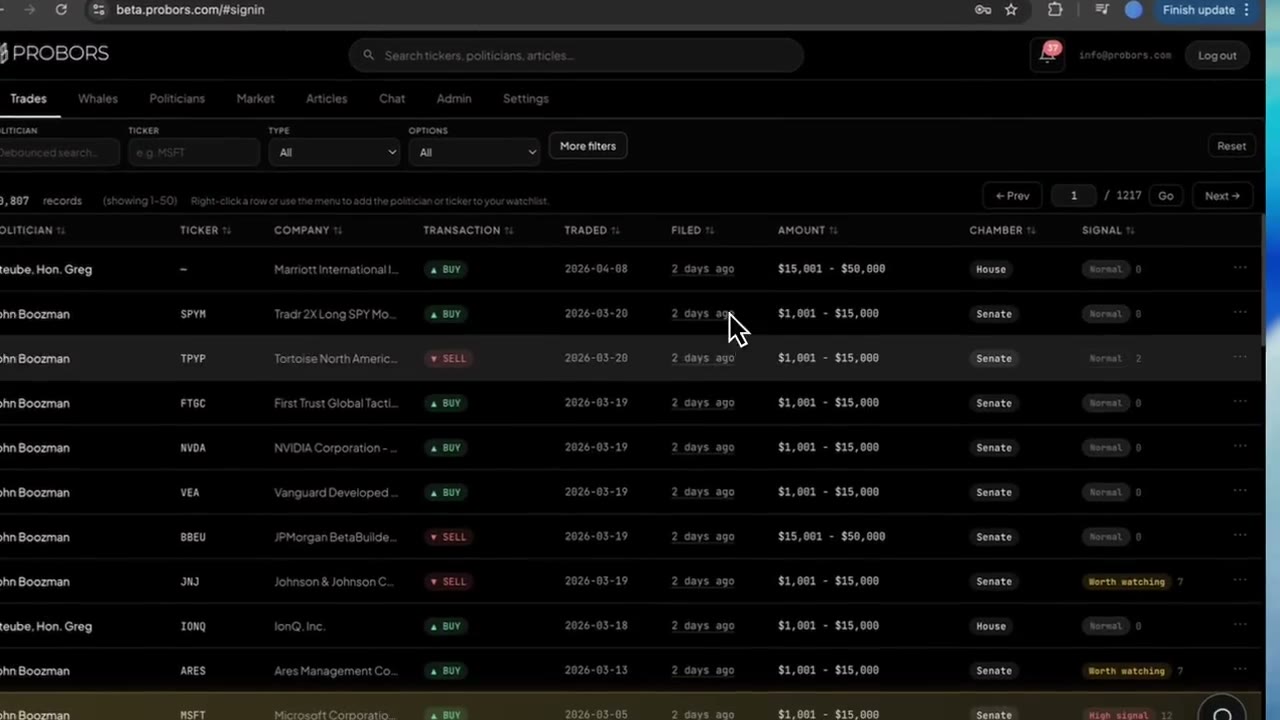
Dataroma is a long-running free site for tracking what famous investors hold through quarterly 13F filings. ProBors is a disclosure-first workspace built around timely Form 4 insider activity, whale-sized transactions, congressional STOCK Act rows, watchlists, and market context on the same ticker. If you follow Buffett-style portfolio snapshots, Dataroma may be all you need. If you triage fresh insider filings, cross-check congress on the same symbol, and want alerts when something new lands, the workflow gap shows up quickly. This is research context, not investment advice.
Quick answer
Choose Dataroma when you want a free, curated view of what well-known funds reported in their latest 13F — useful for long-horizon position tracking and idea sourcing.
Choose ProBors when your loop centers on recent Form 4 filings, large insider transactions, optional congressional overlap, signal-ranked triage, and watchlist alerts without exporting tables to other sites.
Many value investors keep Dataroma bookmarked for quarterly holdings context and use ProBors for the daily insider-and-congress pass on tickers they already watch.
Side-by-side comparison
| Capability | Dataroma | ProBors |
|---|---|---|
| Primary data source | Quarterly 13F holdings (institutional managers) | Form 4 insider filings, whale transactions, STOCK Act disclosures |
| Timeliness | Lagging — 13Fs publish up to 45 days after quarter end | Filing-date sorted insider and congress rows as they publish |
| Insider buy/sell transaction detail | Indirect — holdings change, not line-by-line Form 4 | Direct — transaction type, role, amount band, trade vs filed date |
| Congressional trade layer | No | Yes — House PTR and Senate periodic rows on same ticker |
| Watchlist + inbox alerts | No native alert inbox | Yes — ticker, politician, and disclosure-driven |
| Trade signal scores for triage | No | Yes on congress and whale rows |
| Market charts next to filings | External charting required | Built-in with optional disclosure markers |
| AI research on live disclosure data | No | Yes — table-style answers on trades and tickers |
| Price | Free | Freemium / paid tiers |
| Best fit | Quarterly superinvestor portfolio study | Daily insider + congress disclosure research |
What Dataroma does well
Dataroma built a loyal audience by making 13F holdings readable without digging through EDGAR XML. Researchers use it to:
- See what selected superinvestors reported at the last quarter end
- Compare position sizes and quarter-over-quarter changes for well-known managers
- Browse guru lists and sector tilts when screening for ideas
- Study long-hold names without paying for a terminal
For a value-oriented question — "did Fund X add to this bank last quarter?" — Dataroma remains a practical free reference. The site focuses on positions, not individual insider trades on the day they file.
13F source documents live on SEC EDGAR. Dataroma repackages that quarterly snapshot into a familiar table — similar to how many free trackers simplify one slice of public disclosure data.
Where quarterly holdings browsing stops
Dataroma is optimized for 13F portfolio archaeology, not same-week Form 4 triage. Common friction points for active disclosure researchers:
- 13F lag — a manager's Q2 filing may not appear until mid-August, while Form 4 activity on the same ticker may have published weeks earlier.
- No transaction-level insider detail — 13Fs show holdings, not whether a CEO sold on Tuesday or exercised options under a plan.
- No congressional layer — STOCK Act rows publish on House and Senate portals; they do not appear in 13F tables.
- No filing-lag tooling — you cannot sort insider rows by days between trade date and filed date for triage.
- No alert workflow — quarterly refreshes require manual checks unless you build your own reminder system.
None of that makes Dataroma wrong for its purpose. It reflects a scope choice: famous-fund holdings at quarter end, not a live insider-and-congress workspace.
Capability comparison (five features that matter)
| Feature | Dataroma | ProBors |
|---|---|---|
| Superinvestor 13F holdings by guru | Strong | Not the primary focus |
| Form 4 insider buys and sells with dates | No direct table | Strong |
| Whale / large insider notional context | No | Yes |
| Congressional trades on same ticker | No | Yes |
| Watchlist alerts + signal-ranked triage | No | Yes |
When to choose Dataroma
Choose Dataroma if you:
- Study what well-known funds held at the last quarter end, not what insiders filed this week
- Prefer a free, no-account site for guru portfolio browsing
- Do not follow Form 4 timing, filing lag, or congressional disclosures on the same symbols
- Are fine waiting for the next 13F cycle before updating your thesis
Stay on Dataroma when your entire workflow is "open the guru page, read the holdings table, note position changes, close the tab."
When to choose ProBors
Choose ProBors if you:
- Triage recent Form 4 and whale rows before the next 13F even publishes
- Cross-check insider activity and congressional disclosures on the same ticker
- Need watchlist alerts when a followed company or politician files
- Want signal scores to sort noisy filing batches by size, timing, and repeat activity
- Prefer market charts beside the disclosure row instead of alt-tabbing elsewhere
- Run a repeat research loop that combines trade date, filed date, and chamber in one workspace
ProBors does not replace SEC EDGAR for legal citation or Dataroma for a quick guru holdings snapshot. It compresses the daily insider-and-congress triage step so you open official filings only when a row survives your filters.
How to use both without duplicating work
If you already rely on Dataroma for quarterly context, this workflow keeps the tools complementary:
- Note guru-held tickers from Dataroma — your watchlist seeds from positions you already study, not every 13F line.
- Open each active ticker in ProBors — review recent Form 4 whales and any congressional rows in the same window.
- Log trade date and filed date — insider relevance decays with lag; see how to compare filing date vs transaction date.
- Read signal scores as triage hints — open row detail for reasons; scores are not buy or sell instructions.
- Set watchlist alerts — let the next insider or congress filing reach your inbox instead of manual guru-page refreshes.
- Return to Dataroma at quarter end — confirm whether the guru's reported position still matches your live-disclosure notes.
- Verify on official sources before publishing — open the Form 4 on EDGAR or the STOCK Act PDF when a row matters for a story or post.
Steps 2–5 are where ProBors saves time compared with waiting for the next 13F to hint that something changed.
What this comparison does not prove
A guru increasing a 13F position does not prove future returns. A fresh Form 4 sale on ProBors does not prove illegal trading or a durable bearish thesis. Congressional overlap on a ticker is correlation for research, not causation. Quarterly holdings and daily insider filings answer different questions — using both does not merge their timelines automatically.
FAQ
Is ProBors a Dataroma replacement?
Not for 13F guru browsing. ProBors focuses on timely insider whales, Form 4 detail, congressional disclosures, alerts, and market context. Dataroma remains useful for quarterly superinvestor holdings. Many researchers use both.
Does Dataroma show Form 4 insider trades?
No. Dataroma centers on 13F institutional holdings. Individual insider buys and sells publish on Form 4 through EDGAR, often days or weeks before the next quarterly 13F snapshot reflects a change.
Which tool is better for spotting insider selling before a 13F update?
ProBors is built for filing-date-sorted Form 4 and whale triage. Dataroma shows position changes only after managers file 13Fs, which can lag the underlying trades by weeks or months.
Can I research congress and insiders together on Dataroma?
No. Congressional STOCK Act disclosures publish through separate House and Senate systems. ProBors combines insider and congress layers when you research a ticker.
How do I verify a row before citing it?
Open the original Form 4 on SEC EDGAR for insider lines, the House Clerk or Senate eFD portal for congress rows, and the manager's 13F filing for Dataroma holdings. Cross-check dates, ticker spelling, and transaction type before treating any table row as final.
Triage insiders and congress on the same ticker
Use ProBors for Form 4 whales, STOCK Act filings, watchlists, signal scores, and market context — then keep Dataroma for quarterly guru holdings when you need both lenses.
Get startedRelated reading
- OpenInsider vs ProBors — free Form 4 table vs full disclosure workspace
- Best insider trading trackers in 2026 — broader roundup of paid and free options
- Insider and whale tracker alternatives — when to add a second tool
- How to combine congress and insider research — cross-layer workflow on one ticker
- How insider buying clusters work — triage framework for Form 4 activity
Sources
- SEC Form 13F overview — quarterly institutional holdings reporting
- SEC Form 4 overview — insider ownership and transaction reports
- SEC EDGAR search — primary source for Form 4 and 13F verification
- STOCK Act (S. 2038, 112th Congress) — congressional periodic transaction reporting
- Rows were checked in ProBors and should be verified against the original filing.
- Data ingestion health: probors.com/status
Sources & methodology
Last updated:
ProBors uses public disclosure records, SEC filings, House and Senate financial disclosure portals, market data, and in-product workflow checks. Articles are written as research education, not investment advice.