Finviz is one of the most bookmarked free stock screeners on the web. Its insider tab and heat maps help millions of users spot officer buys and sector breadth without paying for a terminal. ProBors targets a narrower loop: row-level congressional STOCK Act disclosures, insider whale tables, signal scoring, watchlists, and market context on the same ticker. If you only need a quick insider glance while screening valuation metrics, Finviz may be enough. If you verify filing lag, cross-check House and Senate PTR rows, and alert on new disclosures daily, the workflow gap shows up quickly. This is research context, not investment advice.
Quick answer
Choose Finviz when your primary job is equity screening—valuation, technicals, sector maps—and you occasionally open the insider tab on a ticker that already passed your screen.
Choose ProBors when disclosure research is the job: sorting Form 4 and PTR rows by filing date, comparing transaction date to price, stacking politician trades on the same symbol, and saving watchlists that fire on new filings—not just price moves.
Many researchers keep Finviz for broad screens and add ProBors for the verification pass. That split is common and reasonable.
Side-by-side comparison
| Capability | Finviz | ProBors |
|---|---|---|
| Primary focus | Multi-factor equity screener and market maps | Disclosure-first congress + insider whale workspace |
| Insider transaction tables | Yes — summary on ticker pages and screener filters | Yes — full whale rows with drill-down and filters |
| Congressional STOCK Act trades | No | Yes — House PTR and Senate periodic rows |
| Custom watchlists + filing alerts | Price and technical alerts (paid Elite) | Yes — ticker, politician, and disclosure-driven inbox |
| Filing date vs transaction date on every row | Limited in insider summary | Yes — core to lag screening and triage |
| Trade signal scores on disclosure rows | No | Yes on congress and whale rows |
| AI research on live disclosure data | No | Yes — table-style answers on trades and tickers |
| Market charts next to filings | Basic chart widget | Built-in workspace with optional disclosure markers |
| Best fit | Screen-first investors and chart browsers | Daily congress + insider verification loops |
What Finviz does well
Finviz earned its audience by packing screening, heat maps, and quick ticker snapshots into one free page. Typical Finviz workflows include:
- Running valuation or technical screens across thousands of U.S. stocks
- Opening the Insider Trading tab on a ticker to see recent officer activity
- Using sector and industry heat maps for breadth context
- Setting price or technical alerts on Elite for names already on a short list
- Jumping from a news headline to a one-page fundamentals snapshot
If your thesis starts with "which stocks match this P/E and RSI combo?" and insider data is a secondary check, Finviz remains a credible free starting point.
Where Finviz stops and ProBors picks up
Finviz is not built as a congressional disclosure tracker or a row-level Form 4 archive. Politician trades under the STOCK Act live on separate House and Senate portals—and Finviz insider summaries do not show filing lag buckets, amount brackets, or cross-chamber overlap on the same symbol.
Researchers who only use Finviz often still need another tool when the question becomes:
- Did any House or Senate member trade this ticker in the last 90 days?
- How many days passed between the transaction date and the filing date on this Form 4?
- Does insider whale activity overlap with a politician purchase on the same symbol?
- Can I sort disclosure rows by signal label before opening every PDF?
- Can I alert on new PTR filings without manually checking clerk portals?
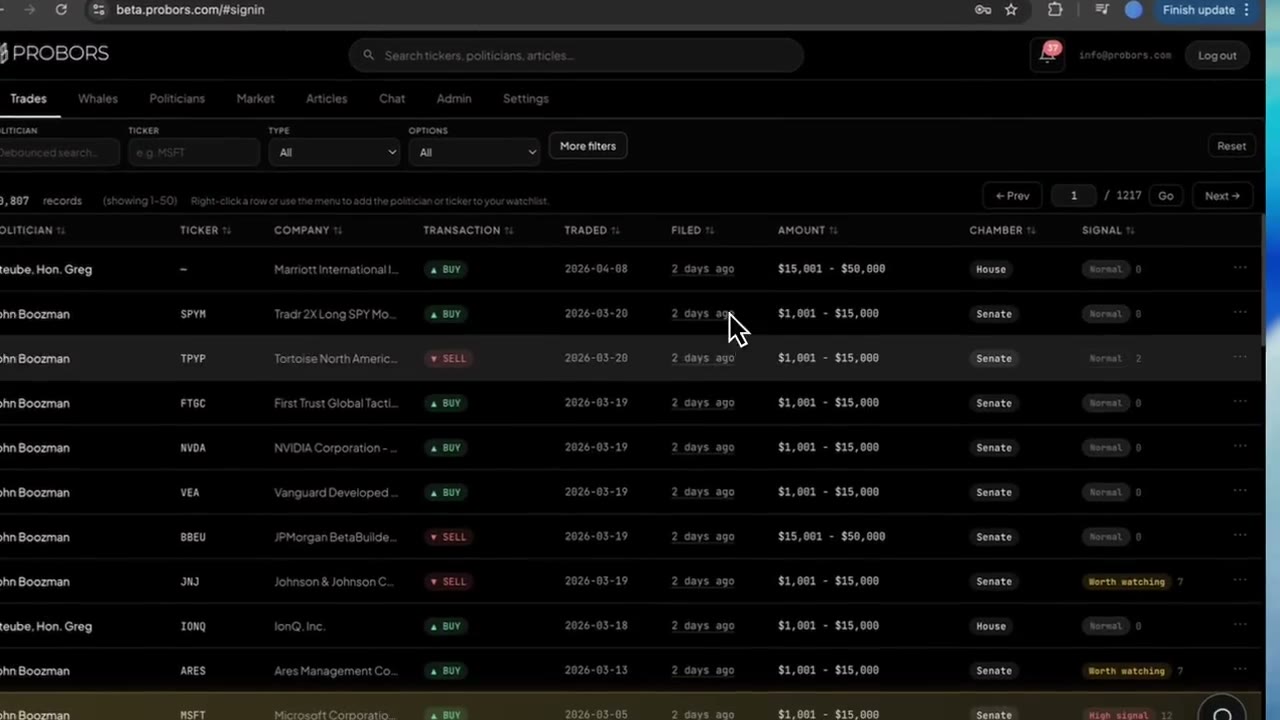
ProBors is designed for that second layer: congress rows, insider whales, signal scores, watchlists, and charts in one workspace.
How a ProBors workflow differs from a Finviz insider glance
If Finviz flags recent insider selling on a screened ticker, this six-step loop is what many ProBors users run next:
- Open the ticker in ProBors — start from the symbol Finviz surfaced, not the summary alone.
- Sort insider and whale rows by filing date — note role, transaction type, amount bracket, and lag in whole days.
- Switch to congressional disclosures on the same symbol — check whether any PTR rows landed in a similar window.
- Read signal scores as triage hints — open row detail for reasons; scores are not buy or sell instructions.
- Review the market chart — compare transaction date to price action; remember filings often arrive days or weeks later.
- Verify against the original source — open the SEC Form 4 or official House/Senate filing before citing the row.
Steps 2–6 are where a disclosure workspace saves time compared with refreshing a screener tab.
Common mistakes when comparing the two
- Treating Finviz insider summaries as a complete Form 4 history — summary tabs highlight recent events; they do not replace a searchable filing archive.
- Confusing screen date with filing date — a stock that passed your screener today may show insider activity filed weeks ago.
- Ignoring congressional overlap — insider headlines on a hot ticker deserve a STOCK Act check in the same pass.
- Skipping transaction type codes — grants, exercises, and plan-driven sales read differently from open-market purchases.
- Paying for Elite alerts without a verification loop — price alerts help; they do not replace filing-date sorting on disclosure rows.
When to choose each
Stay with Finviz (or lead with it) if you:
- Screen stocks daily on valuation, technicals, or sector themes
- Check insider activity only after a name is already on your short list
- Rarely research congressional disclosures
- Prefer free heat maps and one-page ticker snapshots over disclosure tables
Add or switch to ProBors if you:
- Stack politician trades and insider whales on the same ticker regularly
- Need filing-date sorting, lag buckets, and signal labels on every row
- Want watchlist alerts for new PTR or Form 4 filings beyond price triggers
- Prefer one dashboard for congress, whales, and price charts
What this does not prove
A Finviz insider summary or a row on ProBors does not prove insider knowledge, future returns, or illegal trading. Form 4 and STOCK Act filings are self-reported, can be amended, and often arrive after prices have already moved. Screen selection bias means Finviz surfaces names that already moved—not exhaustive disclosure datasets. Always read the original filing before acting on any table.
FAQ
Is ProBors a replacement for Finviz?
Not necessarily. Finviz excels at broad equity screening and market maps. ProBors excels at hands-on disclosure triage across insiders, whales, and congress. Many researchers use both: screens from Finviz, verification in ProBors.
Does Finviz show congressional trades?
No. Finviz focuses on mainstream market data and insider summaries tied to SEC filings. Congressional STOCK Act disclosures live on separate House and Senate systems. ProBors combines both layers when you research a ticker.
Which tool is better for insider email alerts?
Finviz Elite offers price and technical alerts on watchlists. ProBors is stronger when you need row-level filters, whale sizing, signal scores, and cross-chamber context—not just a headline that insider activity exists.
Can I use both on the same watchlist?
Yes. A common pattern is Finviz for screening and sector context, ProBors for disclosure rows and politician overlap. Keep ticker lists aligned so you are not maintaining two unrelated universes.
Do either tool replace SEC EDGAR or official STOCK Act portals?
No. Both are triage layers on public data. Before publishing or trading on a disclosure, open the original Form 4 or PTR PDF on the official source.
Verify disclosures beyond the screener
Use ProBors to cross-check insider whales, congressional filings, signal scores, and market context on tickers Finviz surfaced.
Get startedRelated reading
- OpenInsider vs ProBors insider workflow
- ProBors vs MarketBeat disclosure workflow
- Best insider trading trackers in 2026
- How to combine congress and insider research
Sources
- SEC EDGAR — Form 4 search
- House Clerk — Financial disclosure reports
- Senate eFD — Periodic transaction reports
- STOCK Act overview (Congress.gov)
- Rows were checked in ProBors and should be verified against the original filing.
- Ingestion health for ProBors data is summarized at probors.com/status.
Sources & methodology
Last updated:
ProBors uses public disclosure records, SEC filings, House and Senate financial disclosure portals, market data, and in-product workflow checks. Articles are written as research education, not investment advice.