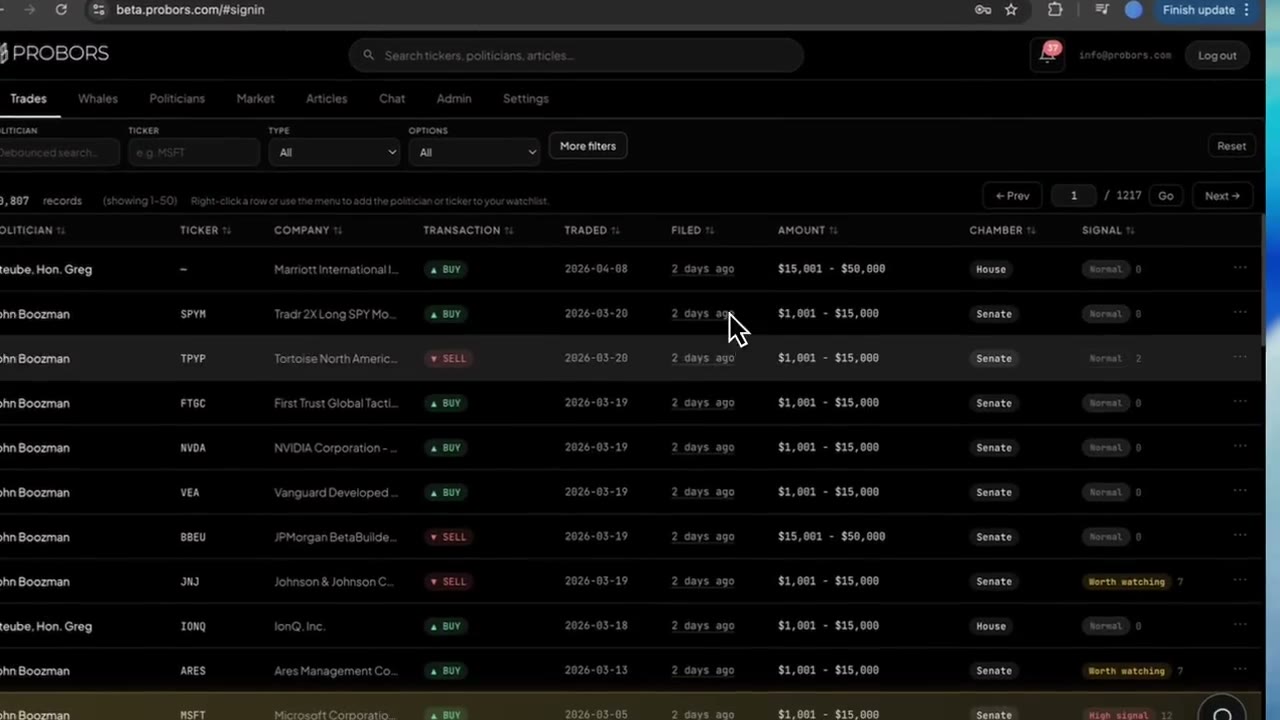
TipRanks packages analyst ratings, blogger sentiment, and a congressional trading feed for retail investors who want one dashboard for stock ideas. ProBors is disclosure-first: House PTR and Senate periodic rows, insider whale lines, signal scores, and market context on the same ticker. If you opened TipRanks for analyst conviction and stayed for politician trades, this comparison is about whether that bundle covers your STOCK Act workflow—or whether you need a dedicated disclosure workspace. This is research context, not investment advice.
Quick answer
Choose TipRanks when analyst ratings, price targets, and blogger sentiment drive your research and congressional trades are a secondary screen.
Choose ProBors when politician filings, insider whales, filing lag, and cross-chamber ticker review belong in the same daily loop—not as a sidebar to equity ratings.
Many researchers keep TipRanks for analyst context and add ProBors when PTR batches, watchlist alerts, and verification workflows matter more than a sentiment score.
Side-by-side comparison
| Capability | TipRanks | ProBors |
|---|---|---|
| Primary focus | Analyst ratings, price targets, blogger sentiment, stock ideas | Congressional STOCK Act + insider whale disclosure workspace |
| Congressional trade browsing | Yes — politician activity as a module | Yes — House PTR and Senate periodic rows with chamber filters |
| Filing date vs transaction date emphasis | Summarized trade cards | Structured fields with lag-friendly sorting |
| Insider Form 4 / whale context | Limited relative to analyst features | Core module with notional sizing and signal scores |
| Trade signal scores on disclosure rows | No dedicated disclosure scoring | Yes on congress and whale rows |
| Watchlist + alerts on politicians/tickers | Varies by plan | Yes — inbox alerts tied to disclosure events |
| AI research on live disclosure tables | No | Yes — table-style answers on trades and tickers |
| Market charts with disclosure markers | External or basic | Built-in workspace with optional congress markers |
| Analyst / blogger sentiment layer | Strong | Not the primary use case |
| Best fit | Rating-driven stock picking with congress as a filter | Daily PTR triage, member history, and insider overlap |
What TipRanks does well
TipRanks built its audience around a simple question: do Wall Street analysts agree, and how have their calls performed historically? Typical TipRanks workflows include:
- Checking consensus ratings and price targets before earnings
- Comparing blogger and analyst sentiment on a ticker
- Scanning recent congressional purchases or sales as a secondary signal
- Following smart-money narratives alongside equity research headlines
If your thesis starts with "what do analysts think?" and politician trades are an occasional filter, TipRanks remains a familiar starting point.
Where TipRanks stops and ProBors picks up
Congressional disclosures are not analyst opinions—they are self-reported STOCK Act rows with filing lag, amount brackets, and chamber-specific forms. TipRanks surfaces politician activity, but researchers who live in disclosure data often need more than a trade card.
Common gaps that push teams toward a disclosure-first tool:
- Batch filing behavior — one Senate periodic report can list trades from months earlier; member-level history matters more than the newest card alone
- Cross-chamber ticker review — the same symbol may appear in House PTRs and Senate filings on different dates
- Insider whale overlap — Form 4 lines on the same ticker as a politician purchase deserve a shared workspace, not separate tabs
- Verification before sharing — filing date, transaction date, asset type, and amount range need structured fields before you cite a row publicly
- Repeatable triage — signal scores, lag filters, and watchlist alerts reduce manual portal checks
ProBors targets that loop: congress rows, insider whales, politician profiles, and charts without exporting tables to a spreadsheet.
When the tools complement each other
A practical split many disclosure researchers use:
- TipRanks for analyst consensus, price targets, and sentiment context on a watchlist name.
- ProBors for new PTR filings, member disclosure history, whale-sized insider lines, and cross-chamber ticker passes.
- Official House and Senate disclosure sites — plus SEC EDGAR for Form 4 — for final verification before publishing or trading.
Neither platform replaces reading the original filing. Both are triage layers on public data.
When to choose each
Lead with TipRanks if you:
- Rarely open congressional disclosures beyond a quick politician scan
- Need analyst ratings and blogger sentiment as your primary filter
- Treat politician trades as one input among many equity signals
- Do not maintain watchlists tied to PTR filing events
Add or switch to ProBors if you:
- Research filing lag, Senate backlogs, or member-level clusters regularly
- Stack House and Senate rows on the same ticker in one session
- Want insider whale context and congressional rows on shared watchlists
- Need signal scores, AI tables, or alerts built for disclosure rows—not ratings
Use both if analyst conviction from TipRanks informs which tickers you then research for congressional overlap and insider activity on ProBors.
What this does not prove
A politician trade card on TipRanks or a row in ProBors does not prove insider knowledge, future returns, or illegal trading. STOCK Act disclosures are self-reported, can be amended, and often arrive weeks after the transaction. Analyst ratings reflect third-party opinions, not verified filings. Correlation between congressional activity and insider buys is a research starting point, not causation. Always verify against the original House PTR, Senate periodic report, or SEC Form 4 before acting on a headline.
FAQ
Does TipRanks replace a dedicated congressional tracker?
For occasional politician scans, TipRanks can be enough. For daily PTR triage, member history, lag analysis, and cross-chamber ticker research, a disclosure-first platform like ProBors is usually faster.
Is ProBors a TipRanks clone with analyst ratings?
No. ProBors does not center on Wall Street price targets or blogger sentiment. It is built for congressional and insider disclosure workflows with signal scores, watchlists, and market context on the same symbol.
Which tool is better for insider whale research?
TipRanks emphasizes analyst and blogger layers. ProBors treats large Form 4 whale rows as a core feed alongside congressional disclosures. Choose based on whether insider notional context belongs in the same pass as politician trades.
Can I verify a congressional row on both platforms?
Yes—but always confirm against the official source. Open the House Clerk PTR or Senate eFD filing, check transaction date, filing date, ticker spelling, and asset type before citing any row in a report or social post.
Is this investment advice?
No. Both tools surface public data and third-party opinions for research. You make your own decisions.
Research congressional and insider disclosures in one workspace
Use ProBors to triage STOCK Act filings, insider whales, watchlists, and market context on the same ticker.
Get startedRelated reading
- ProBors vs Capitol Trades
- Best congress stock trading trackers
- ProBors vs free congress trackers
- How to read politician trade disclosures
- How ProBors trade signal scores work
Sources
- House Clerk financial disclosure reports — official House PTR source
- Senate financial disclosures (eFD) — official Senate periodic transaction source
- STOCK Act (Pub. L. 112-105) — congressional financial disclosure requirements
- SEC EDGAR search — Form 4 verification for insider rows cited alongside congress research
- Rows were checked in ProBors and should be verified against the original filing.
- Data ingestion status: probors.com/status
Sources & methodology
Last updated:
ProBors uses public disclosure records, SEC filings, House and Senate financial disclosure portals, market data, and in-product workflow checks. Articles are written as research education, not investment advice.