Congressional stock trades filed in mid-August 2026 split between a fast-turn House purchase from Rep. Ed Case and two Senate backlog waves from Sen. John Boozman. As of August 21, 2026, ProBors shows 78 deduplicated disclosure rows with filing dates from August 8 through August 20—spanning 13 members across both chambers. Filing lag in this window runs from 5 days on Case's AAPL purchase to more than 490 days on Boozman's April 2025 trades still landing in August. This is research context, not investment advice.
Snapshot summary
ProBors sorts congressional disclosures by filing date. In the August 8–20 filing window:
- 78 rows after deduplication (identical politician, ticker, type, trade date, filing date, amount, and chamber removed)
- 13 politicians filed in this window: McCormick (24 rows), Boozman (20 rows), Rick Scott (6), Mike Kelly (6), Timothy Sheehy (5), Richard Allen (3), Mark Warner (3), Michael Guest (3), Steve Cohen (2), William Keating (2), John Fetterman (2), Ed Case (1), and Ron Wyden (1)
- Chamber split: 41 House rows, 37 Senate rows
- Transaction mix: 35 purchases, 42 sales, 1 exchange
- Signal tiers: 1 High signal row, 13 Worth watching, 39 Normal, 25 without a scored tier
- Filing lag: 5-day minimum (Case's August 13 AAPL purchase filed August 18), 34-day median, 552-day maximum on the oldest backlog lines
- Notable clusters: McCormick's 24-line August 12 House tech trim (23 sales, 1 purchase), Boozman's 20-row Senate backlog across August 17 and August 20 filings, and Warner's three-line Virginia municipal bond purchase batch filed August 14
The mid-August wave is smaller than early August's 221-row batch but shows broader participation—13 members versus seven in the prior window. Over the prior 14 days, Apple (AAPL) and IBM each appear once in congressional ticker activity in ProBors, reflecting the lighter equity volume this week compared with Delaney's early-August portfolio shuffle.
Recent disclosures worth a closer look
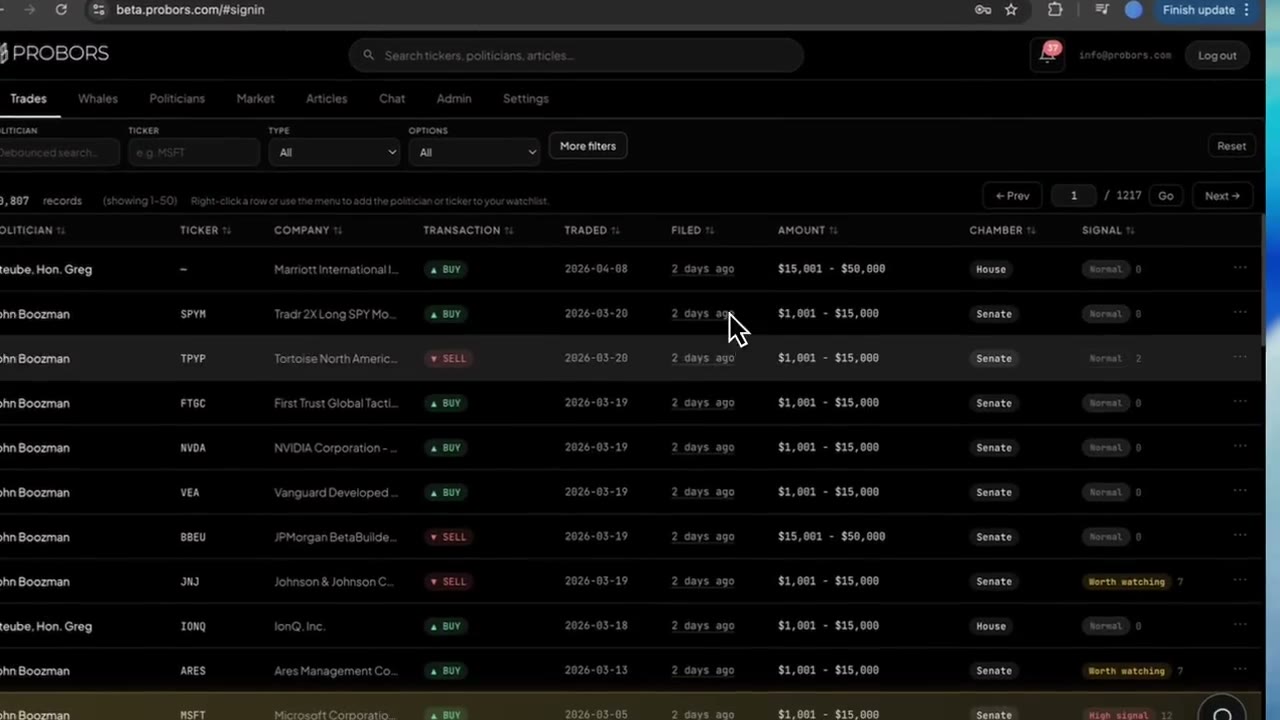
The table below shows deduplicated rows from ProBors as of August 21, 2026. Lag is calendar days between transaction date and filing date as reported in each disclosure.
| Politician | Chamber | Ticker / asset | Type | Traded | Filed | Lag | Amount range | Signal |
|---|---|---|---|---|---|---|---|---|
| Ed Case | House | AAPL | Purchase | August 13, 2026 | August 18, 2026 | 5 days | $1,001–$15,000 | Normal |
| John Boozman | Senate | APTV | Purchase | July 9, 2026 | August 17, 2026 | 39 days | $1,001–$15,000 | High signal |
| Richard W. Allen | House | AMD | Purchase | July 14, 2026 | August 17, 2026 | 34 days | $1,001–$15,000 | Worth watching |
| Mark Warner | Senate | Virginia Beach VA GO bonds (no ticker) | Purchase | July 2, 2026 | August 14, 2026 | 43 days | $100,001–$250,000 | Worth watching |
| Richard McCormick | House | BRK.B | Purchase | July 30, 2026 | August 12, 2026 | 14 days | $1,001–$15,000 | Worth watching |
| Richard McCormick | House | MDT | Sale | July 30, 2026 | August 12, 2026 | 14 days | $1,001–$15,000 | Normal |
| Mike Kelly | House | PEP | Sale | July 17, 2026 | August 12, 2026 | 26 days | $15,001–$50,000 | Normal |
| Steve Cohen | House | U.S. Treasury Bill (no ticker) | Purchase | August 6, 2026 | August 11, 2026 | 5 days | $100,001–$250,000 | Normal |
How to read this without overfitting:
- Case's AAPL purchase filed August 18 with a 5-day lag is the fastest equity turnaround in this snapshot—a small bracket purchase traded August 13 and disclosed within one business week.
- Boozman's APTV purchase is the only High signal row in the window. ProBors flagged it because of nearby insider buying activity, first-time ticker disclosure for this member, and a roughly 23% price move in the 60 days after the trade anchor. The 39-day filing lag means the market already priced APTV before the Senate row appeared.
- McCormick's August 12 batch spans 24 House rows filed on one date, with July 30 trade dates. Twenty-three are sales across large-cap tech and healthcare names (including ABT, CSCO, COST, and BLK); the lone purchase is Berkshire Hathaway Class B (BRK.B).
- Warner's August 14 filing covers three Virginia municipal bond purchases in the $50,001–$250,000 brackets—not equity trades. Treat these as fixed-income disclosures.
- Boozman's August 20 batch adds nine more Senate rows tied to April 2025 trade dates with 485- to 498-day lag. That is a separate backlog category from his fresher July trades filed August 17.
Filing lag in plain language
STOCK Act disclosures are periodic reports, not live trade feeds. In this mid-August snapshot:
- Fastest: Case's AAPL purchase and Cohen's Treasury Bill purchase at 5- to 6-day lag—trades from August 5–13 filed August 11–18
- Typical fresh trades: McCormick's July 30 tech trim at 14-day lag, filed August 12
- Moderate Senate delay: Boozman's July trades filed August 17 carry 17- to 46-day lag depending on the line
- Backlog filings: Boozman's August 20 batch ties to April 2025 trade dates with 485- to 498-day lag; Rick Scott's August 13 municipal bond rows reach back to February 2025
When a headline says a senator "just disclosed" a purchase, check both dates. An August 20 filing may cover trades from April 2025. For the rules behind that gap, see STOCK Act filing delay explained.
How to research this week's filings on ProBors
- Open Congressional trades and sort by filing date descending to mirror this snapshot.
- Filter by House when you want batches like McCormick's August 12 tech trim or Case's fast-turn AAPL line.
- Filter by Senate and search a politician name to isolate backlog waves like Boozman's August 17 and August 20 filings.
- Sort by signal score when you want to triage the one High signal row—Boozman's APTV purchase—before reading every backlog line.
- Cross-check any notable row against the original PTR or Senate eFD PDF before citing it in notes or journalism.
For chamber-specific workflows, see the House stock trading tracker and Senate stock trading tracker guides.
What this does not prove
A filing date in mid-August does not mean the politician traded that week. Boozman's August 20 batch covers April 2025 purchases—filed more than a year later. McCormick's 24-line sale batch reflects a broad portfolio trim across dozens of tickers, not a single directional call on one name. Warner's municipal bond purchases are fixed-income allocations, not stock picks. Boozman's High signal APTV row combines disclosure timing with insider activity context—it does not establish non-public information, committee conflict, or timing around pending legislation. None of these disclosures are trade signals. They are public records worth reading carefully.
FAQ
How many congressional trades were filed in mid-August 2026?
ProBors shows 78 deduplicated disclosure rows with filing dates from August 8 through August 20, 2026, across 13 politicians. The count is after removing identical politician-ticker-type-date-amount-chamber duplicates.
Why did John Boozman file trades from April 2025 in August 2026?
Boozman's August 20 Senate filing contains nine rows with trade dates from April 2025 and filing lag of 485 to 498 days. That pattern is consistent with a periodic backlog disclosure rather than same-week trading. Always compare the transaction date to the filing date before drawing conclusions.
Which tickers appeared most in congressional filings recently?
Over the prior 14 days in ProBors, Apple (AAPL) and IBM each appear once in congressional ticker activity. The mid-August window is lighter on equity volume than early August, when Life Time Group (LTH) led with five purchase lines.
How fast do House members file compared to Senate members in this batch?
Case's House AAPL row filed August 18 carries 5-day lag on an August 13 trade date. Cohen's Treasury Bill purchases filed August 11 show 5- to 6-day lag. Boozman's Senate rows filed August 17 carry 17- to 46-day lag on July trade dates—a wider spread than the fastest House lines.
Where can I verify these rows against original filings?
Each House PTR is available through the House Clerk's disclosure search. Senate reports are published through the Senate eFD system. Rows were checked in ProBors and should be verified against the original filing.
Track congressional filings as they land
Use ProBors to sort House and Senate PTR rows by filing date, signal score, and politician—then cross-check against original disclosures.
Get startedRelated reading
- Congress trades filed early August 2026
- How to read politician trade disclosures
- STOCK Act filing delay explained
- Senate stock trading tracker
- How to run a weekly congress disclosure review
Sources
- House Financial Disclosure Reports — Periodic Transaction Reports (PTRs)
- Senate Financial Disclosures (eFD) — Senate PTR search
- STOCK Act of 2012 — Congressional trading disclosure requirements
- ProBors data status — ingestion health for congressional filings
Rows were checked in ProBors and should be verified against the original filing.
Sources & methodology
Last updated:
ProBors uses public disclosure records, SEC filings, House and Senate financial disclosure portals, market data, and in-product workflow checks. Articles are written as research education, not investment advice.