Seeking Alpha is built around equity research articles, earnings coverage, and portfolio commentary—congressional trading often appears as a headline or premium screen, not as a structured disclosure workspace. ProBors is disclosure-first: House PTR and Senate periodic rows, insider whale lines, signal scores, and market context on the same ticker. If you read Seeking Alpha for stock ideas and occasionally click a politician-trade story, this comparison is about whether that feed covers your STOCK Act workflow—or whether you need a dedicated table for filing lag, chambers, and verification. This is research context, not investment advice.
Quick answer
Choose Seeking Alpha when article-driven stock research, earnings transcripts, and contributor opinions drive your process and congressional trades are a secondary curiosity.
Choose ProBors when politician filings, insider whales, filing lag, and cross-chamber ticker review belong in the same daily loop—not buried in a news feed.
Many researchers keep Seeking Alpha for equity commentary and add ProBors when PTR batches, watchlist alerts, and member-level history matter more than a summarized trade blurb.
Side-by-side comparison
| Capability | Seeking Alpha | ProBors |
|---|---|---|
| Primary focus | Equity research articles, earnings, dividends, portfolio tools | Congressional STOCK Act + insider whale disclosure workspace |
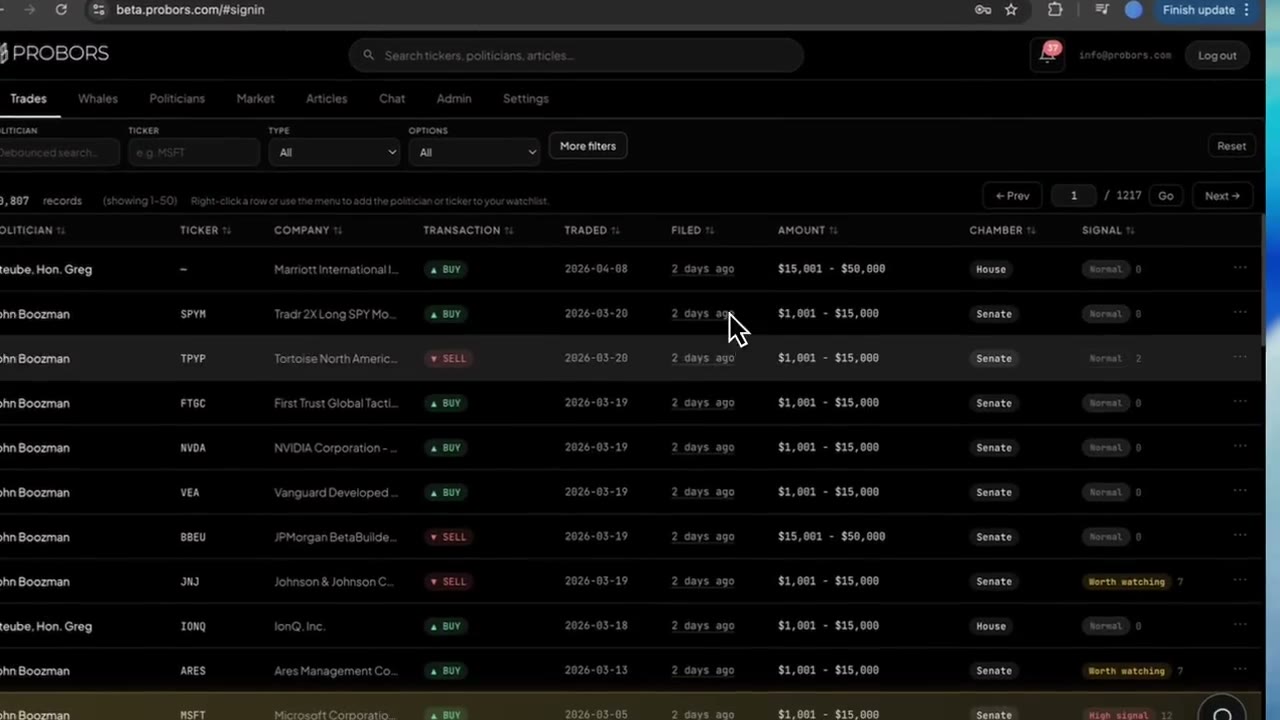
| Congressional trade browsing | Article summaries and premium screens; not a full PTR research table | House PTR and Senate periodic rows with chamber filters |
| Filing date vs transaction date emphasis | Often compressed into story headlines | Structured fields with lag-friendly sorting |
| Insider Form 4 / whale context | Limited relative to article and rating features | Core module with notional sizing and signal scores |
| Trade signal scores on disclosure rows | No dedicated disclosure scoring | Yes on congress and whale rows |
| Watchlist + alerts on politicians/tickers | Article and ticker news alerts | Inbox alerts tied to disclosure events |
| AI research on live disclosure tables | No | Yes — table-style answers on trades and tickers |
| Market charts with disclosure markers | Basic charting; congress context is external | Built-in workspace with optional congress markers |
| Best fit | Idea generation and earnings-driven research | Daily PTR triage, member history, and insider overlap |
What Seeking Alpha does well
Seeking Alpha built its audience around contributor research, earnings call transcripts, and dividend-focused screens. Typical Seeking Alpha workflows include:
- Reading bull and bear theses before earnings
- Following dividend growth and income screens
- Scanning breaking news and contributor alerts on watchlist tickers
- Catching congressional trade headlines when they surface in the feed
If your thesis starts with "what is the bull case on this name?" and politician trades are an occasional filter, Seeking Alpha remains a familiar starting point.
Where Seeking Alpha stops and ProBors picks up
Congressional disclosures are not equity articles—they are self-reported STOCK Act rows with filing lag, amount brackets, and chamber-specific forms. Seeking Alpha can surface a politician purchase as news, but researchers who live in disclosure data often need more than a one-line summary.
Common gaps that push teams toward a disclosure-first tool:
- Batch filing behavior — one Senate periodic report can list trades from months earlier; member-level history matters more than the newest headline alone
- Cross-chamber ticker review — the same symbol may appear in House PTRs and Senate filings on different dates
- Insider whale overlap — Form 4 lines on the same ticker as a politician purchase deserve a shared workspace, not a separate news tab
- Verification before sharing — filing date, transaction date, asset type, and amount range need structured fields before you cite a row publicly
- Repeatable triage — signal scores, lag filters, and watchlist alerts reduce manual portal checks
ProBors targets that loop: congress rows, insider whales, politician profiles, and charts without exporting tables to a spreadsheet.
When the tools complement each other
A practical split many disclosure researchers use:
- Seeking Alpha for earnings context, contributor theses, and dividend or valuation screens on a watchlist name.
- ProBors for new PTR filings, member disclosure history, whale-sized insider lines, and cross-chamber ticker passes.
- Official House and Senate disclosure sites — plus SEC EDGAR for Form 4 — for final verification before publishing or trading.
Neither platform replaces reading the original filing. Both are triage layers on public data.
When to choose each
Lead with Seeking Alpha if you:
- Rarely open congressional disclosures beyond a quick headline scan
- Need contributor research and earnings transcripts as your primary filter
- Treat politician trades as one input among many equity signals
- Do not maintain watchlists tied to PTR filing events
Add or switch to ProBors if you:
- Research filing lag, Senate backlogs, or member-level clusters regularly
- Stack House and Senate rows on the same ticker in one session
- Want insider whale context and congressional rows on shared watchlists
- Need signal scores, AI tables, or alerts built for disclosure rows—not article summaries
Common mistakes when mixing article feeds with PTR data
- Treating a headline date as the trade date. The story may publish when a batch is filed, not when the transaction occurred.
- Collapsing multiple politicians into one ticker narrative. Three members trading the same symbol in opposite directions is not a single "Congress bought" signal.
- Skipping amount brackets. A $1,001–$15,000 line and a $100,001–$250,000 line carry different portfolio weight.
- Ignoring chamber differences. House PTR timing and Senate periodic batches follow different rhythms; compare within chamber before drawing cross-chamber conclusions.
- Sharing before source check. Always open the original House PTR or Senate report for any row you might cite.
FAQ
Does Seeking Alpha replace a STOCK Act tracker?
No. Seeking Alpha excels at equity research and news. Congressional disclosures require structured fields—transaction date, filing date, amount range, asset type—that a dedicated tracker or official portal provides. Use Seeking Alpha for context; verify trades on official sources or a disclosure workspace.
Can I use both Seeking Alpha and ProBors on the same watchlist?
Yes. Many researchers read Seeking Alpha for earnings and thesis context, then run the same tickers through ProBors for new PTR rows, insider whales, and filing-lag checks. The tools answer different questions.
Which tool is better for alerts on politician trades?
Seeking Alpha alerts lean toward articles and ticker news. ProBors watchlists can notify you when new disclosure rows match a politician or symbol you track. If PTR filing events drive your workflow, disclosure-native alerts are usually more precise.
Is ProBors only for congressional data?
No. ProBors also covers insider whale transactions, politician portfolios, market charts, and AI-assisted research—so congress and Form 4 context can sit on the same ticker without switching sites.
Do either platform's trade summaries count as investment advice?
No. Both surface public disclosure data or third-party commentary. This is research context, not investment advice. Verify every row against the original filing before acting or publishing.
Track disclosures with ProBors
Use ProBors to review congressional, insider, whale, and market context in one workspace.
Get startedRelated reading
- TipRanks vs ProBors: Congress disclosure research compared
- ProBors vs Capitol Trades
- How to read politician trade disclosures
- Best congress stock trading trackers in 2026
Sources
- STOCK Act of 2012 — Congressional trading disclosure requirements
- House Financial Disclosure search — Official House PTR filings
- Senate eFD search — Official Senate periodic transaction reports
- SEC Form 4 overview — Insider transaction filings
- Rows were checked in ProBors and should be verified against the original filing.
- For ingestion health, see probors.com/status.
Sources & methodology
Last updated:
ProBors uses public disclosure records, SEC filings, House and Senate financial disclosure portals, market data, and in-product workflow checks. Articles are written as research education, not investment advice.