Tracing a politician's congressional disclosure history means building a timeline from STOCK Act rows—not memorizing one viral trade. ProBors groups each member's House PTRs and Senate periodic reports on a single profile, so you can see filing clusters, compare transaction dates to filing dates, and spot when a backlog lands months after the trades inside it. This seven-step workflow walks through that member-first pass for journalists, disclosure researchers, and active traders who need repeatable notes instead of a one-off screenshot. This is research context, not investment advice.
Why member history beats a single-row headline
A politician's disclosure record is a sequence of batches, not a live brokerage feed. One Senate filing date can carry a dozen ETF sales from the prior fall; a House PTR filed on a Friday can bundle stock and call-option lines from the same week. Searching only by ticker or reading the latest row misses that shape.
Member-level history answers different questions than a ticker filter:
- When does this person tend to file? House members often cluster PTRs within days of trades; senators may file periodic batches weeks later.
- What themes repeat? Tech options, municipal bonds, ETF rebalancing, and mega-cap partial sales show up as patterns across multiple filings—not isolated events.
- Which rows belong to the same form? Rows sharing a filing date usually came from one disclosure document; treat them as a cluster before you write a narrative.
- How stale is the newest public line? Long lag on a fresh filing date still means old transaction dates—critical for Senate portfolios.
Tracing history is how you avoid turning John Boozman's August 2026 ETF backlog into "Senator sold tech this week," or reading Nancy Pelosi's August 21 House cluster as seven unrelated trades instead of one filing event.
Seven-step workflow on ProBors
-
Resolve the correct name and chamber. Search the politician directory on probors.com and pick the exact disclosure name—House forms often use formal spellings like "Pelosi, Hon. Nancy" while Senate cards may show "John Boozman." If multiple matches appear, confirm chamber and photo before opening the profile. See the politician profile guide for entry points.
-
Read summary span before individual rows. On the member profile, note total trades, buys vs sells, distinct tickers, and the first-traded to last-filed date range. These chips orient you; they are not performance scores. Amount brackets are ranges, and last filed date is not the last trade date.
-
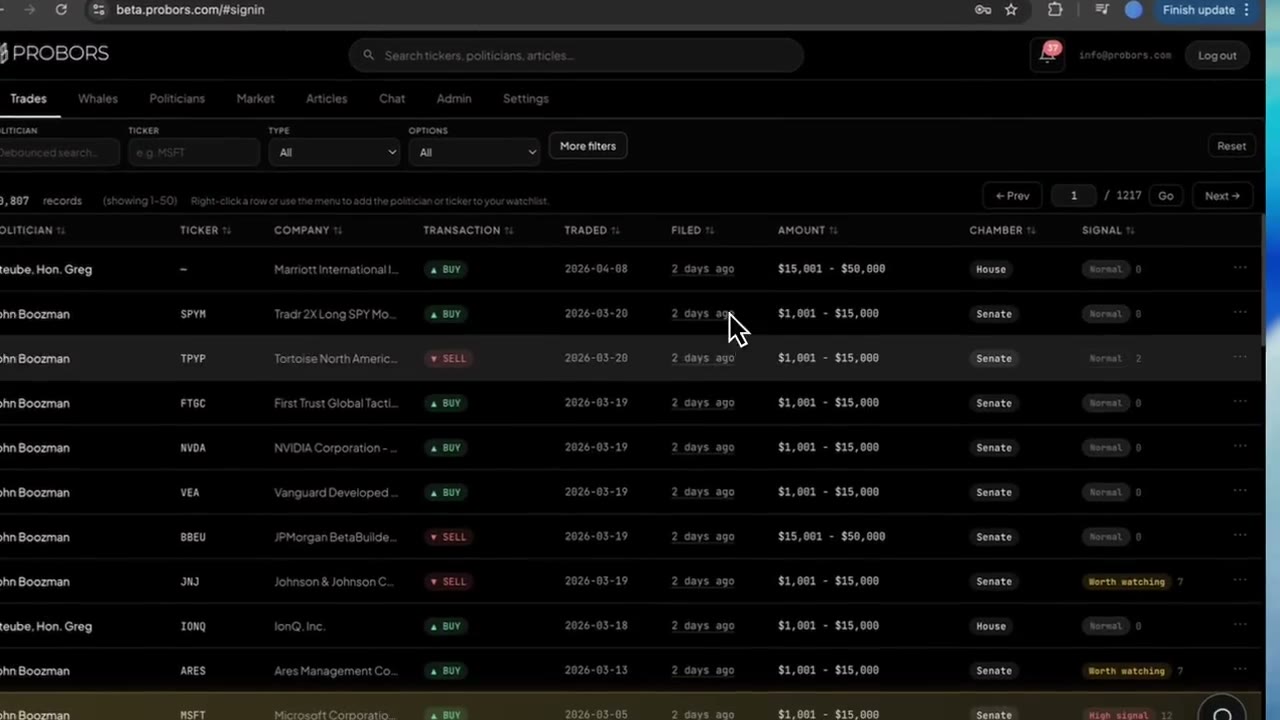
Sort by filing date to map clusters. In the Disclosures tab, sort by filing date descending. Rows sharing the same filing date usually belong to one PTR or periodic report. Circle each cluster in your notes before you interpret tickers—especially on Senate members where one August filing can list November trades.
-
Re-sort by transaction date inside each cluster. Within a filing cluster, reorder mentally (or in your spreadsheet) by transaction date. This reveals whether the member traded across several days before one disclosure landed, or whether every line shares a single trade week. Pair with how to compare filing date vs transaction date when lag looks extreme.
-
Log filing lag per cluster, not per headline. For each cluster you might cite, compute calendar days from the oldest and newest transaction dates to the filing date. Express lag plainly: "24-day lag on a July 28 trade filed August 21" or "276-day lag on November 2025 ETF sales filed in August 2026." Lag buckets help triage; see how to screen congress trades by filing lag.
-
Cross-check asset types before theme labels. Within a cluster, separate stock purchases, call-option purchases, ETF sales, Treasury lines, and fund names without tickers. A "tech buying spree" narrative fails if half the lines are structured notes or partial ETF trims. For non-equity patterns, see how to research non-equity congressional disclosures.
-
Document a timeline and set watchlist alerts last. Write a short member timeline: filing date → cluster summary → transaction window → lag note → verified source link. Add the politician to your watchlist only after you have verified any row you plan to cite. Future filings append to this history—your notes should make the next cluster easy to compare. For a weekly rhythm, pair with how to run a weekly congressional disclosure review.
Examples from recent filings
Recent filings in ProBors as of August 29, 2026 show why member history matters more than any single row. The two clusters below are real structured data from late-August disclosures—use them as templates for your own timeline notes.
House cluster: Pelosi, Hon. Nancy (filed August 21, 2026)
| Chamber | Type | Ticker | Traded | Filed | Lag | Amount range | Signal |
|---|---|---|---|---|---|---|---|
| House | Purchase | INTC | July 24, 2026 | August 21, 2026 | 28 days | $500,001–$1,000,000 | High signal |
| House | Purchase | BE | July 24, 2026 | August 21, 2026 | 28 days | $1,000,001–$5,000,000 | High signal |
| House | Purchase (call option) | BE | July 28, 2026 | August 21, 2026 | 24 days | $500,001–$1,000,000 | Worth watching |
How to read this cluster: Seven lines filed on the same House date span Intel and Bloom Energy stock plus call options from a July 24–28 transaction window—24- to 28-day lag on each line. Treat this as one August 21 disclosure event covering a short tech-and-energy week, not seven independent breaking trades. Verify owner codes and option terms in the House PTR before sharing.
Senate backlog: John Boozman (filed August 24, 2026)
| Chamber | Type | Ticker | Traded | Filed | Lag | Amount range |
|---|---|---|---|---|---|---|
| Senate | Sale | IWM | November 21, 2025 | August 24, 2026 | 276 days | $1,001–$15,000 |
| Senate | Sale | IVV | November 21, 2025 | August 24, 2026 | 276 days | $1,001–$15,000 |
| Senate | Purchase | MSFT | April 22, 2025 | August 20, 2026 | 485 days | $1,001–$15,000 |
How to read this cluster: Boozman's late-August Senate batch includes ETF partial sales tied to November 2025 trade dates—276-day lag—alongside separate April 2025 purchase lines filed days earlier with even longer delay. Member history makes the backlog visible; a ticker-only search on IWM would miss that the trade happened nine months before the filing.
Common mistakes when tracing history
- Treating the newest filing as the newest trade. Always read transaction dates inside the cluster.
- Ignoring duplicate filing dates. Multiple rows on one date usually share one source form—summarize the cluster first.
- Comparing House lag to Senate lag on the same member. Most members serve in only one chamber; compare peers within the same chamber instead.
- Skipping blank tickers. Bond, bill, and fund lines still belong in the member timeline—use the security description from the filing.
- Publishing signal labels without PDF checks. Signal tiers help triage inside ProBors; the STOCK Act PDF is still the citation anchor. Follow how to verify congressional trade disclosures before sharing before any external post.
What this does not prove
A complete disclosure timeline shows what was reported, when it was reported, and how filing lag shaped visibility. It does not prove insider information, committee foreknowledge, illegal trading, or a repeatable trading edge. Long-lag Senate batches can be fully priced in by the time they file. Amount brackets are not exact dollars. Even a carefully traced history is research context—not investment advice.
FAQ
How far back should I trace?
For a first pass, cover the last 12 months of filing dates or the member's last three to five clusters—whichever is shorter. Deep historical dives matter for pattern research, but most timely questions focus on recent batches.
Should I trace by politician or by ticker first?
Start by politician when the question is "what has this member been disclosing?" Start by ticker when the question is "who in Congress touched this symbol?" Combine both when a member repeatedly trades the same name across quarters.
What if the profile shows a portfolio snapshot?
Use the snapshot as secondary context. Holdings caches can lag filings; the disclosure table is the authoritative STOCK Act record. See politician portfolio tracking for how snapshots relate to PTR rows.
How do I handle amended filings in a timeline?
When two rows share similar dates and amounts, open the source PDF and check for amended or superseded forms. Note the amendment in your timeline and retire superseded lines from shareable summaries.
Can I automate timeline notes?
Spreadsheet exports from your verification pass work well: filing date, transaction date, lag, ticker, type, amount bracket, source URL. ProBors watchlists handle future filings; your timeline spreadsheet handles past clusters.
Build politician timelines in one workspace
Open member profiles, sort disclosure clusters, and verify source links on ProBors before you write the narrative.
Get startedRelated reading
- ProBors politician profile guide
- How to verify congressional trade disclosures before sharing
- How to run a weekly congressional disclosure review
- STOCK Act filing delay explained
- Congress trades filed late August 2026
Sources
- House Clerk Financial Disclosure (PTR) search
- Senate Financial Disclosures (eFD)
- STOCK Act (Pub. L. 112-105)
- Senate STOCK Act guidance
- Rows were checked in ProBors and should be verified against the original filing.
- For ingestion health, see ProBors data status.
Sources & methodology
Last updated:
ProBors uses public disclosure records, SEC filings, House and Senate financial disclosure portals, market data, and in-product workflow checks. Articles are written as research education, not investment advice.