Filtering congress trades by amount bracket helps you separate a routine $1,001–$15,000 trim from a $100,001–$250,000 municipal bond purchase before you build a narrative. STOCK Act forms report gross transaction value in dollar ranges—not exact share counts—so amount is a magnitude filter, not a position-sizing tool. ProBors displays the bracket text from each House PTR or Senate periodic line; this seven-step workflow shows how to use those ranges in a repeatable scan on probors.com without treating every row as equally sized. This is research context, not investment advice.
Why amount bracket belongs in your first filter pass
Congressional disclosure feeds mix small housekeeping trades with larger bond and equity lines in the same filing batch. Without an amount filter, a 24-line House PTR can look like 24 equally important signals when most rows sit in the smallest bracket.
Researchers filter by amount because:
- Bracket width varies by orders of magnitude. The gap between $1,001–$15,000 and $100,001–$250,000 is not a 10× difference in reported precision—it is a different research tier entirely.
- Larger brackets often flag non-equity assets. Municipal bonds, fund interests, and corporate note purchases frequently land in $50,001+ bands while common-stock trims cluster in the smallest range.
- Headline counts inflate without a floor. "Congress traded tech this week" stories often pool dozens of sub-$15,000 lines with one mid-bracket sale—amount filtering prevents false scale.
- Signal scores are row-level, not size-level. A Worth watching label on a $1,001–$15,000 Senate sale means something different than the same label on a $250,001–$500,000 bond purchase filed 18 months late.
Amount filtering complements transaction-type sorting and signal-score screening. Run amount when your question is magnitude; run type when your question is direction; run lag when your question is timeliness.
Seven-step workflow on ProBors
-
Write the bracket question before opening the feed. Decide whether you need a floor (only $50,001+), a ceiling (exclude multi-million bands), or a single band (mid-tier $15,001–$50,000 only). "Which filings moved more than $50,000?" is a different scan than "show me every sub-$15,000 House sale this month."
-
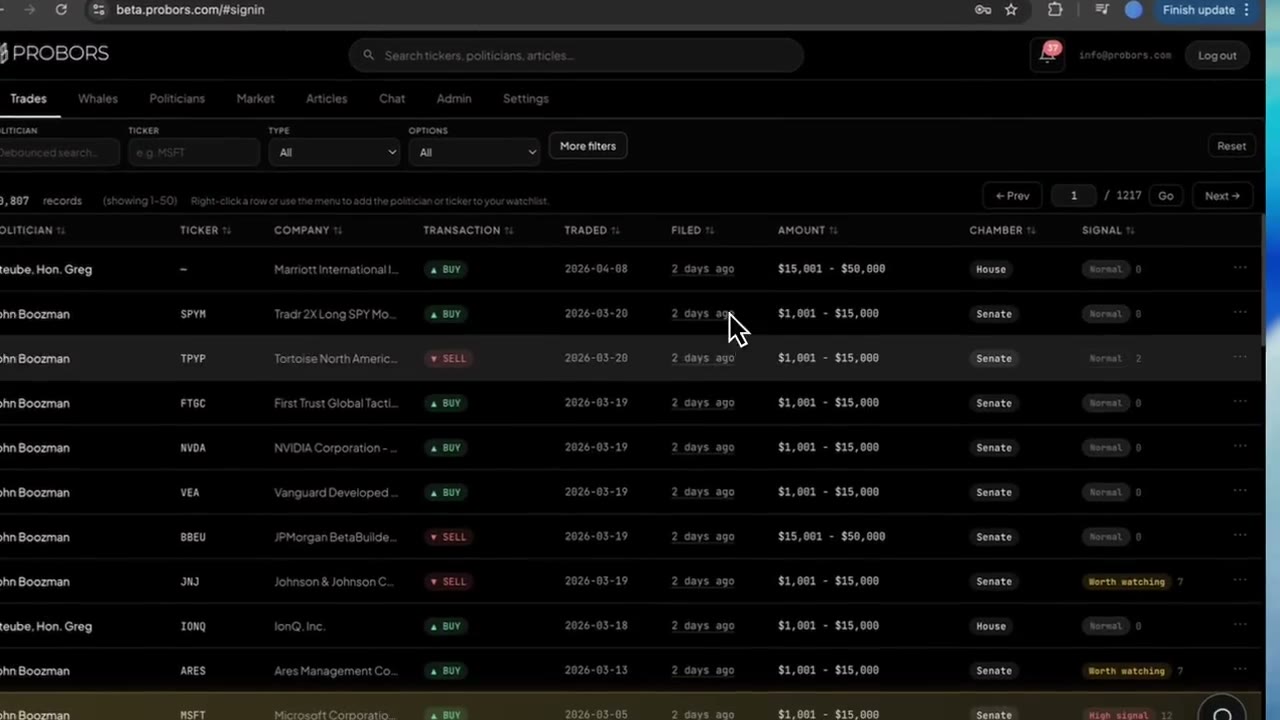
Open Congressional trades. From probors.com, go to the Trades tab. Sort by filing date descending for a morning scan, or by transaction date when you are studying a specific week. If you already know the ticker, search it first and then apply amount context row by row.
-
Scan the amount column before building a table. ProBors shows the bracket text from the source filing (for example
$1,001 - $15,000or$100,001 - $250,000). Read it as a band, not an exact dollar figure—see why congressional amount ranges are not exact dollars for the official House PTR brackets. -
Set a practical floor for your research lane. Most daily scans use one of three tiers:
- Broad scan: all brackets (useful for politician-specific follow-ups)
- Mid-tier floor: $15,001+ (drops routine small trims)
- Large-line focus: $50,001+ or $100,001+ (bond batches, bigger equity moves)
There is no universal "right" floor—journalists covering a single member may read every line; sector researchers often start at $15,001+.
-
Split equity tickers from no-ticker bond lines. Rows with
--in the ticker field often carry larger brackets on municipal or revenue bonds. Route those to a non-equity research pass instead of mixing them into an equity amount tally. -
Log bracket + lag together. A $250,001–$500,000 purchase filed 552 days after the trade date is a backlog disclosure, not a fresh large bet. Note filing lag beside every amount bracket you might cite—especially on Senate periodic batches.
-
Verify gross amount in the source PDF before sharing. House guidance requires filers to report gross transaction value, not gain or loss. Open the linked disclosure, confirm the checkbox bracket matches the structured amount field, and check owner code (self, spouse, trust). Add the politician or ticker to a watchlist only after verification.
Examples from recent filings
Recent filings in ProBors as of August 22, 2026 show why amount bracket should run before you rank rows by signal or ticker. The same August filing window includes a same-day House sale in the $50,001 band, a mid-bracket Microsoft trim, small-cap purchases in the lowest bracket, and Senate bond lines in the six-figure range.
| Politician | Chamber | Type | Ticker / asset | Traded | Filed | Lag | Amount range | Signal |
|---|---|---|---|---|---|---|---|---|
| Mark Warner | Senate | Purchase | Virginia Beach VA GO bonds (no ticker) | July 2, 2026 | August 14, 2026 | 43 days | $100,001–$250,000 | Worth watching |
| Tim Moore | House | Sale | T | August 14, 2026 | August 14, 2026 | 0 days | $50,001–$100,000 | Normal |
| David J. Taylor | House | Sale | MSFT | August 11, 2026 | August 20, 2026 | 9 days | $15,001–$50,000 | Normal |
| David J. Taylor | House | Purchase | IBP | August 14, 2026 | August 20, 2026 | 6 days | $1,001–$15,000 | Normal |
| Rick Scott | Senate | Purchase | Charlotte NC Water & Sewer bonds (no ticker) | February 7, 2025 | August 13, 2026 | 552 days | $250,001–$500,000 | — |
How to read this without mis-sizing rows:
- Warner (bond, $100,001–$250,000): A six-figure municipal bond purchase belongs in a fixed-income note, not an equity watchlist. The Worth watching signal reflects row context—not proof of a market-timing equity trade.
- Moore (Sale, T, $50,001–$100,000): Mid-bracket sale with 0-day House lag. Compare to Taylor's MSFT sale in the next bracket down—same filing week, different magnitude band.
- Taylor (MSFT sale vs IBP purchase): Same member, same August 20 filing batch, opposite directions, different brackets. Filtering to $15,001+ surfaces the Microsoft trim; filtering to the smallest bracket surfaces the Installed Building Products buy.
- Scott (bond, $250,001–$500,000, 552-day lag): Large bracket plus extreme lag signals a Senate backlog dump—not a fresh half-million-dollar position change. Amount alone would overstate timeliness without the lag column.
Use examples like these as admission tests: verified source, clear bracket tier, and lag logged before you cite a row.
Common mistakes when filtering by amount
- Treating bracket midpoints as exact trade size. ProBors may show estimated midpoint values internally, but public PTR forms only require a range checkbox. Never size a position from
$15,001 - $50,000alone. - Ranking politicians by summing brackets. Adding the low ends of 20 small-bracket rows does not produce a portfolio total—ranges overlap, accounts differ, and partial sales repeat across filings.
- Ignoring gross-amount rules on sales at a loss. A sale that returned $8,000 on a $12,000 cost basis still reports in the bracket covering $8,000 gross proceeds—not the $4,000 loss.
- Pooling bond and equity lines because both say Purchase. A $250,001 bond purchase and a $1,001 equity buy are both Purchase type but belong in separate research buckets.
- Applying an amount floor without a lag check. Large brackets on stale Senate rows are common in August backlog waves—see mid-August 2026 filings for the pattern.
What this does not prove
Filtering by amount bracket organizes public disclosures—it does not prove motive, material nonpublic information, or that a member "bet big" on a ticker. A $100,001–$250,000 label covers any gross value in that band; it does not tell you share count, entry price, or remaining holdings. Signal labels reflect row-level context in ProBors, not verified intent or position size. Always verify against the original House or Senate filing before citing a row in research or journalism.
FAQ
What are the standard House PTR amount brackets?
The smallest reportable band above the $1,000 threshold is $1,001–$15,000, stepping up through $15,001–$50,000, $50,001–$100,000, $100,001–$250,000, and higher bands to Over $50,000,000. Senate periodic reports follow the same STOCK Act framework. Full bracket tables and gross-amount rules are in why congressional amount ranges are not exact dollars.
Should I filter by amount before or after transaction type?
Filter by type first when your question is directional (purchases vs sales). Filter by amount first when your question is magnitude (which lines cleared $50,000). Many workflows run type, then amount, then lag on the shortened list.
Why do municipal bond rows often show larger brackets?
Bond purchases report gross transaction value in the same checkbox brackets as equities. A single muni line can land in $100,001–$250,000 while a stock trim on the same filing sits in $1,001–$15,000. Read the asset description when the ticker field is blank.
Can the same politician file multiple brackets on one day?
Yes. House PTR batches routinely mix small rebalancing lines with mid-bracket sales. Filter by politician name, then sort by amount descending to see which lines cleared your floor—without assuming one bracket represents the whole filing.
Does a larger bracket mean a higher signal score?
Not automatically. Signal scores reflect row-level context (lag, asset type, transaction pattern)—not bracket size alone. A Normal label on a $50,001–$100,000 same-day sale and a Worth watching label on a $1,001–$15,000 Senate row can coexist in the same week.
Filter disclosures by amount on ProBors
Scan congressional trades by dollar bracket, log filing lag, and verify each row against the original STOCK Act filing.
Get startedRelated reading
- Why congressional amount ranges are not exact dollars
- How to filter congress trades by transaction type
- How to filter congress trades by signal score
- How to research non-equity congressional disclosures
- Congress trades filed mid-August 2026
Sources
- House Committee on Ethics — Financial Disclosure
- House PTR form instructions (2025)
- Senate Select Committee on Ethics — Financial Disclosure
- STOCK Act (Pub. L. 112-105)
- Rows were checked in ProBors and should be verified against the original filing.
- Ingestion health: probors.com/status
Sources & methodology
Last updated:
ProBors uses public disclosure records, SEC filings, House and Senate financial disclosure portals, market data, and in-product workflow checks. Articles are written as research education, not investment advice.