House and Senate members face the same core PTR deadline under the STOCK Act—report securities transactions within 30 days of awareness or 45 days from the trade—but the two chambers publish filings on different portals, with different search habits and batch-filing patterns. Researchers who treat "Congress trades" as one uniform feed often misread Senate rows as unusually late or House rows as suspiciously fast. This guide explains the shared rule, where the chambers diverge in practice, and how to compare deadlines without overfitting. It is educational context, not investment advice.
The shared STOCK Act clock
The STOCK Act requires Periodic Transaction Reports (PTRs) when a covered official (or certain spouse or dependent accounts) trades reportable securities above the statutory threshold.
Both chambers follow the same timing framework described in House ethics guidance: a PTR is due by the earlier of:
- 30 days from when the filer becomes aware of the transaction, or
- 45 days from the transaction date.
The House Committee on Ethics instruction guide and Senate ethics disclosure materials describe the same outer bound. A filing on day 40 is timely even when the market moved weeks earlier—that is a feature of the law, not a data error.
What changes between chambers is not usually the legal deadline. It is where filings appear, how offices batch submissions, and when public portals make rows searchable.
Three dates every chamber shares
Whether you research House or Senate rows, log these dates separately:
| Date | What it means | Research use |
|---|---|---|
| Transaction date | When the trade occurred | Price context usually lives here |
| Filed date | When the PTR was submitted to the chamber ethics system | Measures compliance with the 30/45-day rule |
| Public posting date | When the disclosure appears on the official search portal | What trackers ingest—often after filing |
ProBors and other trackers add a fourth timestamp: when the row was first indexed. Always note which clock you are citing in notes or headlines.
Where House and Senate filings actually live
Official sources remain the citation layer. Chamber-specific portals are the reason "PTR deadline" research splits into two workflows:
| Chamber | Official PTR search portal | Typical researcher friction |
|---|---|---|
| House | House Clerk Financial Disclosure | PDF-heavy rows; representative name search; batch uploads after month-end review |
| Senate | Senate eFD search | Separate login and search UX; periodic batch drops that can make several senators appear on the same posting day |
Neither portal is designed for ticker-level screening. That is why researchers use structured trackers—but the underlying deadline rule is the same.
Practical differences researchers notice
Even with identical statutory timing, day-to-day patterns often diverge:
House PTR habits
- Representatives file through the Clerk of the House system. Filings can show up in tight clusters when an office reviews accounts after a holiday or month-end.
- Fast one- to three-day lags appear when a member files promptly after a personal trade.
- Spouse or dependent account trades may ride closer to the 45-day outer window if the member did not learn about the trade immediately—still compliant under ethics guidance that recommends regular account checks.
Senate PTR habits
- Senators file through the Senate Select Committee on Ethics eFD workflow. Public search results can lag filing submission by additional processing time.
- Batch posting is common: several PTR lines from different senators may become searchable on the same calendar day even when transaction dates span weeks.
- Long 30–45 day gaps attract headlines but often reflect permitted timing, not necessarily an ethics violation—verify against the filed date before calling a row "late."
Portal processing lag (both chambers)
A PTR can be filed on time but posted later. Trackers ingest after posting. Comparing "alert time" to "transaction date" without checking filed date mixes compliance timing with ingestion delay.
How to compare House vs Senate rows on ProBors
Use chamber context when you screen congressional disclosures:
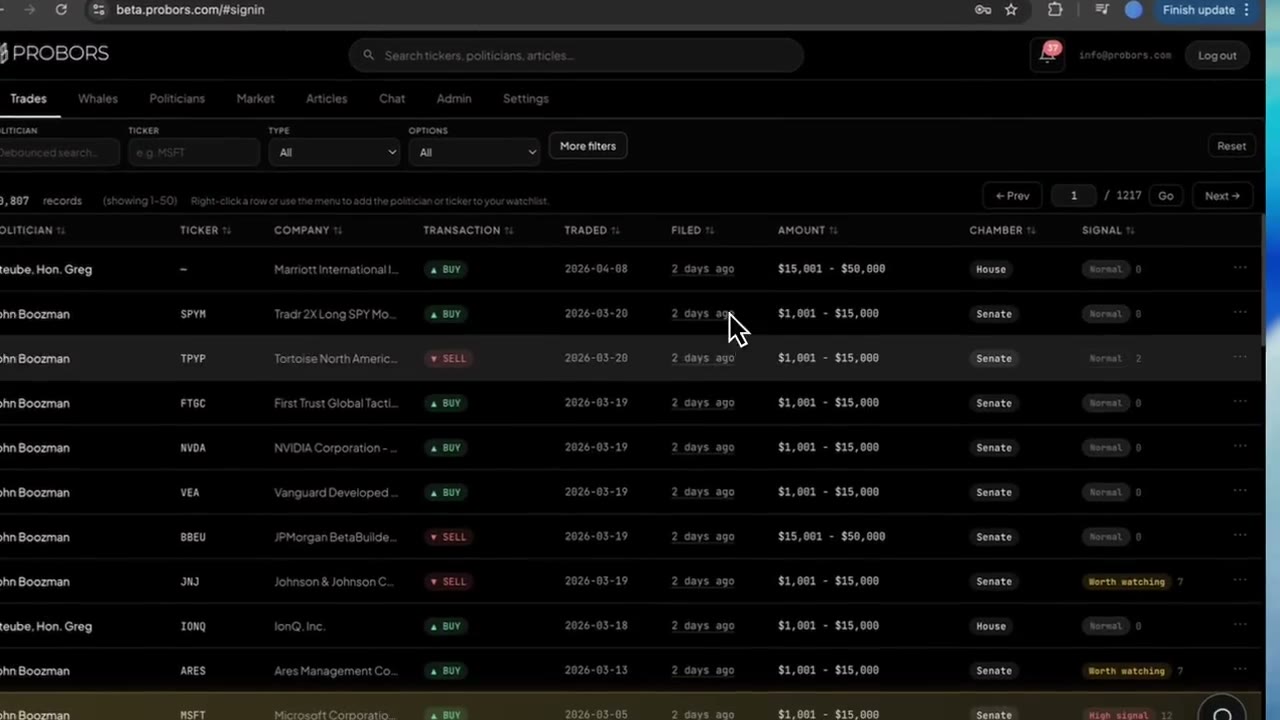
- Open Trades and filter by House or Senate when your question is chamber-specific (committee jurisdiction, state delegation, etc.).
- On every row, compare transaction date and filed date before inferring urgency.
- For the same ticker, toggle chamber filters to see whether activity is isolated to one side of the Capitol or spread across both.
- Cross-check the original filing link when a row will be cited publicly—amount brackets and owner fields are easier to misread in summaries.
- Note posting batches: multiple Senate rows with the same filed date may reflect office workflow, not coordinated trading.
For broader filing-lag math, see STOCK Act filing delay explained. For chamber-specific browse workflows, see the House stock trading tracker and Senate stock trading tracker guides.
Common mistakes when comparing chambers
- Assuming Senate rows are "later" because they batch-post. Filed date matters; posting clusters do not by themselves imply slower compliance.
- Treating House fast filings as inside information. Next-day PTRs usually mean prompt office filing, not that the trade was public in real time.
- Ignoring owner or account context. Spouse and dependent lines follow the same deadline framework but different awareness clocks.
- Using filing date as trade date in charts. Market markers belong on transaction dates; filing dates explain disclosure lag.
- Citing tracker rows without the official PDF. Portals remain the authoritative text for amount ranges and amendments.
What this does not prove
Matching PTR deadlines across chambers does not prove:
- That a trade was timely relative to non-public information (that requires an ethics or enforcement investigation, not a disclosure row).
- That late-posted rows were filed late—posting lag and filing date must be read separately.
- That House and Senate members face different legal standards today under the STOCK Act core PTR rule (proposed reforms may change this in the future; verify current law when publishing).
- That either chamber's disclosure is precise enough for exact position sizing—amount brackets are ranges, not dollars.
This is research context, not investment advice.
FAQ
Do House and Senate PTR deadlines differ?
Under the current STOCK Act framework, both chambers use the same 30-day awareness / 45-day transaction outer rule for PTR timing. Differences researchers see are usually about portals, batch habits, and posting lag—not a separate Senate statutory clock.
Why do Senate disclosures sometimes appear in big batches?
Senate offices often file multiple lines together, and the eFD portal may publish several PTRs on one day. That can make unrelated senators look synchronized in a tracker sort by filed date even when transaction dates differ.
How do I know if a PTR was filed late?
Compare filed date minus transaction date against the 45-day outer bound (and awareness rules described in chamber ethics guidance). A 35-day gap can still be compliant. Alleged violations require official ethics findings, not tracker math alone.
Should I filter by chamber on ProBors?
Filter to House or Senate when your question is chamber-specific—state delegation research, committee context, or comparing portal posting habits. For ticker-level questions, start with the ticker and then split by chamber.
Where can I check ingestion health for congressional rows?
ProBors publishes refresh notes on the data status page. Use it when filings look missing after you have confirmed the official portal already posted them.
Compare House and Senate PTR rows in one workspace
Filter by chamber, review transaction vs filed dates, and cross-check tickers on ProBors.
Get startedRelated reading
- STOCK Act filing delay explained
- How to read politician trade disclosures
- House stock trading tracker
- Senate stock trading tracker
- How to compare filing date vs transaction date
Sources
- STOCK Act (S. 2038, 112th Congress)
- House Committee on Ethics — Financial Disclosure instruction guide
- House Clerk — Financial Disclosure search
- U.S. Senate — eFD financial disclosure search
- Rows were checked in ProBors and should be verified against the original filing.
Sources & methodology
Last updated:
ProBors uses public disclosure records, SEC filings, House and Senate financial disclosure portals, market data, and in-product workflow checks. Articles are written as research education, not investment advice.