Koyfin is a financial data terminal built for fundamentals, charting, and macro dashboards—many analysts use it for earnings, valuation, and sector screens. ProBors is disclosure-first: House PTR and Senate periodic rows, insider whale lines, signal scores, and market context on the same ticker. If you already pay for Koyfin and wonder whether it replaces a congressional disclosure tracker, the short answer is no—Koyfin excels at company financials, while ProBors excels at STOCK Act triage. This comparison maps where each tool fits so you do not duplicate subscriptions or miss filing lag on a politician row buried in a news headline. This is research context, not investment advice.
Quick answer
Choose Koyfin when fundamentals, charting, macro dashboards, and equity screening drive your research and congressional trades are a rare afterthought.
Choose ProBors when politician filings, insider whales, filing lag, and cross-chamber ticker review belong in the same daily loop—not as a side note on a stock chart.
Many researchers keep Koyfin for financial statements and valuation work, then add ProBors when PTR batches, watchlist alerts, and member-level history matter more than a summarized trade card.
Side-by-side comparison
| Capability | Koyfin | ProBors |
|---|---|---|
| Primary focus | Fundamentals, charting, macro, equity screener | Congressional STOCK Act + insider whale disclosure workspace |
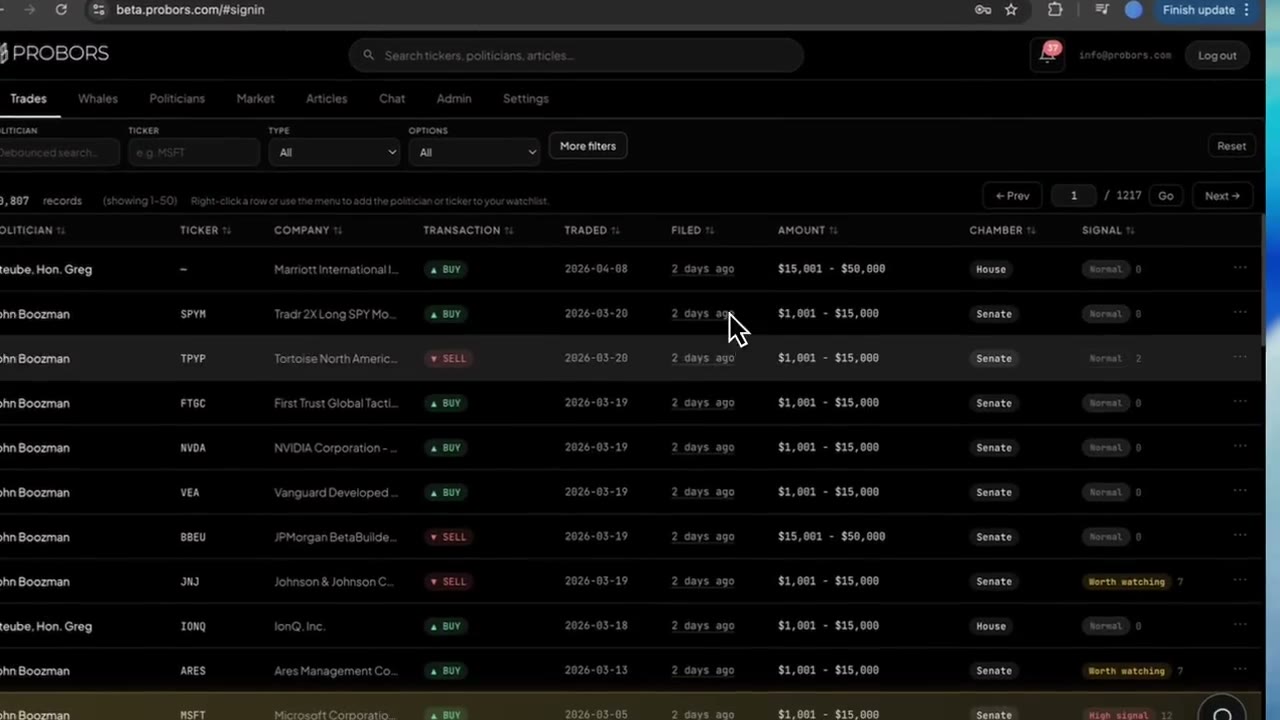
| Congressional trade browsing | Limited or none as a core module | House PTR and Senate periodic rows with chamber filters |
| Filing date vs transaction date emphasis | Not designed for PTR lag analysis | Structured fields with lag-friendly sorting |
| Insider Form 4 / whale context | Not a primary feature | Core module with notional sizing and signal scores |
| Trade signal scores on disclosure rows | No | Yes on congress and whale rows |
| Watchlist + alerts on politicians/tickers | Equity and macro watchlists | Inbox alerts tied to disclosure events |
| AI research on live disclosure tables | No | Yes — table-style answers on trades and tickers |
| Market charts with disclosure markers | Strong charting; congress context is external | Built-in workspace with optional congress markers |
| Financial statements and valuation tools | Strong | Not the primary use case |
| Best fit | Fundamental and macro research on public companies | Daily PTR triage, member history, and insider overlap |
What Koyfin does well
Koyfin built its audience around a clean alternative to legacy terminals: multi-year financials, customizable dashboards, sector heatmaps, and macro overlays in one browser tab. Typical Koyfin workflows include:
- Pulling income statements, cash flow, and valuation ratios before earnings
- Building watchlists around sector themes or geographic exposure
- Comparing peer multiples on a single chart
- Tracking macro indicators alongside equity positions
If your thesis starts with "what are the fundamentals on this name?" and politician trades are an occasional curiosity, Koyfin remains a strong research hub.
Where Koyfin stops and ProBors picks up
Congressional disclosures are not financial statement rows—they are self-reported STOCK Act filings with filing lag, amount brackets, and chamber-specific forms. Koyfin does not center that workflow. Researchers who live in disclosure data often need capabilities Koyfin was never built to provide:
- Batch filing behavior — one Senate periodic report can list trades from months earlier; member-level history matters more than a headline alone
- Cross-chamber ticker review — the same symbol may appear in House PTRs and Senate filings on different dates
- Insider whale overlap — Form 4 lines on the same ticker as a politician purchase deserve a shared workspace, not a separate fundamentals tab
- Verification before sharing — filing date, transaction date, asset type, and amount range need structured fields before you cite a row publicly
- Repeatable triage — signal scores, lag filters, and watchlist alerts reduce manual portal checks
ProBors targets that loop: congress rows, insider whales, politician profiles, and charts without exporting tables to a spreadsheet.
When the tools complement each other
A practical split many disclosure researchers use:
- Koyfin for financial statements, valuation ratios, and macro context on a watchlist name.
- ProBors for new PTR filings, member disclosure history, whale-sized insider lines, and cross-chamber ticker passes.
- Official House and Senate disclosure sites — plus SEC EDGAR for Form 4 — for final verification before publishing or trading.
Neither platform replaces reading the original filing. Both are triage layers on public data.
When to choose each
Lead with Koyfin if you:
- Rarely open congressional disclosures beyond an occasional headline
- Need fundamentals, charting, and macro dashboards as your primary screen
- Treat politician trades as one input among many equity signals
- Do not maintain watchlists tied to PTR filing events
Add or switch to ProBors if you:
- Research filing lag, Senate backlogs, or member-level clusters regularly
- Stack House and Senate rows on the same ticker in one session
- Want insider whale context and congressional rows on shared watchlists
- Need signal scores, AI tables, or alerts built for disclosure rows—not financial ratios
Use both if you run a hybrid workflow: Koyfin for the balance sheet, ProBors for the disclosure table, and official .gov sources for the final check.
How to test overlap without overpaying
Before adding a second subscription, run a one-week trial on the disclosure side:
- List five politicians and five tickers you already track in Koyfin.
- Search each name in ProBors and note whether recent PTR rows appear with filing and transaction dates.
- Open one politician profile and scan for spouse, trust, or joint-account lines.
- Pull insider whale rows on a ticker where you saw a congressional purchase.
- Compare whether Koyfin alone would have surfaced the same filing lag or chamber context.
If ProBors only duplicates what you already see elsewhere, stay with Koyfin. If PTR batches, lag, or cross-chamber gaps show up, a disclosure-first tool earns its place.
FAQ
Does Koyfin track congressional stock trades?
Koyfin is optimized for fundamentals, charting, and macro data—not STOCK Act periodic transaction reports. For structured House and Senate PTR rows, use a dedicated disclosure tracker or official government portals.
Can ProBors replace Koyfin for financial analysis?
No. ProBors focuses on congressional disclosures, insider whales, signal scores, and market context around those filings. It is not a full fundamentals terminal with multi-year financial statements and macro dashboards.
Do I need both tools?
Not always. Fundamental-only researchers can stay on Koyfin. Disclosure-heavy researchers who already use Koyfin for valuation often add ProBors for PTR triage without dropping their charting workflow.
Which tool is better for journalists covering politician trades?
Journalists who verify every row against original filings benefit from ProBors' structured dates, chambers, and member history. Koyfin helps with company context after you confirm the disclosure—not as the primary PTR source.
Is this investment advice?
No. Both platforms surface public data for research; you make your own decisions.
Add disclosure depth to your research stack
Congress trades, insider whales, watchlists, and signal scores—on ProBors.
Get startedRelated reading
- TipRanks vs ProBors: Congress disclosure research
- Seeking Alpha vs ProBors: Congress disclosure research
- Best congress stock trading trackers
- How to read politician trade disclosures
- ProBors vs Capitol Trades
Sources
- House Clerk — Financial Disclosure Reports
- Senate Office of Public Records — Financial Disclosures
- STOCK Act (Pub. L. 112-105)
- SEC — EDGAR Form 4 overview
- Rows were checked in ProBors and should be verified against the original filing.
- Ingestion health: probors.com/status
Sources & methodology
Last updated:
ProBors uses public disclosure records, SEC filings, House and Senate financial disclosure portals, market data, and in-product workflow checks. Articles are written as research education, not investment advice.