Spouse, trust, and joint-account congressional disclosures are still public STOCK Act rows—but the owner field changes how you read them. A House PTR line may show the member's spouse, a family revocable trust, a SEP IRA, or a joint brokerage account. ProBors surfaces the same structured dates, amount brackets, and signal labels; your job is to confirm who held the asset before you attribute conviction to the politician. This six-step workflow walks through owner codes, filing-lag nuance, and verification so "Senator bought X" does not become a mislabeled spouse trade. This is research context, not investment advice.
Why owner context belongs in your first pass
Congressional disclosure rules cover the member and certain spouse and dependent accounts. House periodic transaction reports encode owner information in each line—often as a short code or account description in the filing text. Senate periodic reports follow the same principle with slightly different formatting.
Owner context matters because:
- Attribution — A spouse-owned call option purchase is a different story from a member's direct equity sale, even on the same ticker.
- Filing lag — House ethics guidance allows more time when a member learns about a spouse or dependent trade later. Long lag on a spouse line is not automatically suspicious—it may reflect notification timing.
- Signal interpretation — ProBors signal labels summarize research context across the row. A Worth watching label on a trust-account partial sale still requires owner verification in the PDF.
- Headline accuracy — "Pelosi bought Intel calls" without "spouse-owned" misstates a common disclosure pattern. See Pelosi Intel and Uber call options explained for a worked example.
Official portals remain the citation layer. ProBors is where you triage rows, compare chambers, and open source links faster.
Six-step owner-account workflow on ProBors
-
Open the row and read the security description before the ticker. In ProBors trade detail, scan the full asset line—not just the ticker column. House PTR text often includes owner hints after codes like
S O:(owner). Trust names, IRA labels, and spouse codes appear there even when the headline ticker is familiar. -
Map the owner code in the source PDF. Follow the disclosure link to the House Clerk financial disclosure portal or Senate eFD. Confirm whether the owner field is self, spouse (often
SP), joint, dependent child, or a named trust or retirement account. If the structured row and PDF disagree on owner, trust the PDF. -
Log transaction date, filing date, and lag—with owner noted. Write both dates and compute calendar lag in whole days. Add one phrase of owner context: "spouse-owned," "family revocable trust," or "SEP IRA." A 14-day lag on a spouse line and a 14-day lag on a self trade both deserve the same lag discipline; see how to compare filing date vs transaction date.
-
Separate account types before you compare tickers. Do not merge a member's direct MSFT sale with a spouse's MSFT call purchase into one narrative. Group rows by owner bucket first, then by ticker. Trust and IRA lines may rebalance on different calendars than a member's personal account.
-
Cross-check the politician's recent history on the same owner bucket. Open the politician profile and filter mentally to the same account type. A first-time spouse option line deserves different context than a routine trust partial sale that appears every quarter.
-
Verify before you share or watchlist. Only after steps 1–5, draft your summary with owner, chamber, asset type, trade date, filing date, lag, and amount bracket. Use how to verify congressional trade disclosures before sharing as a pre-flight checklist. Add politicians or tickers to a watchlist only after the PDF confirms owner context.
Examples: same ticker, different owner stories
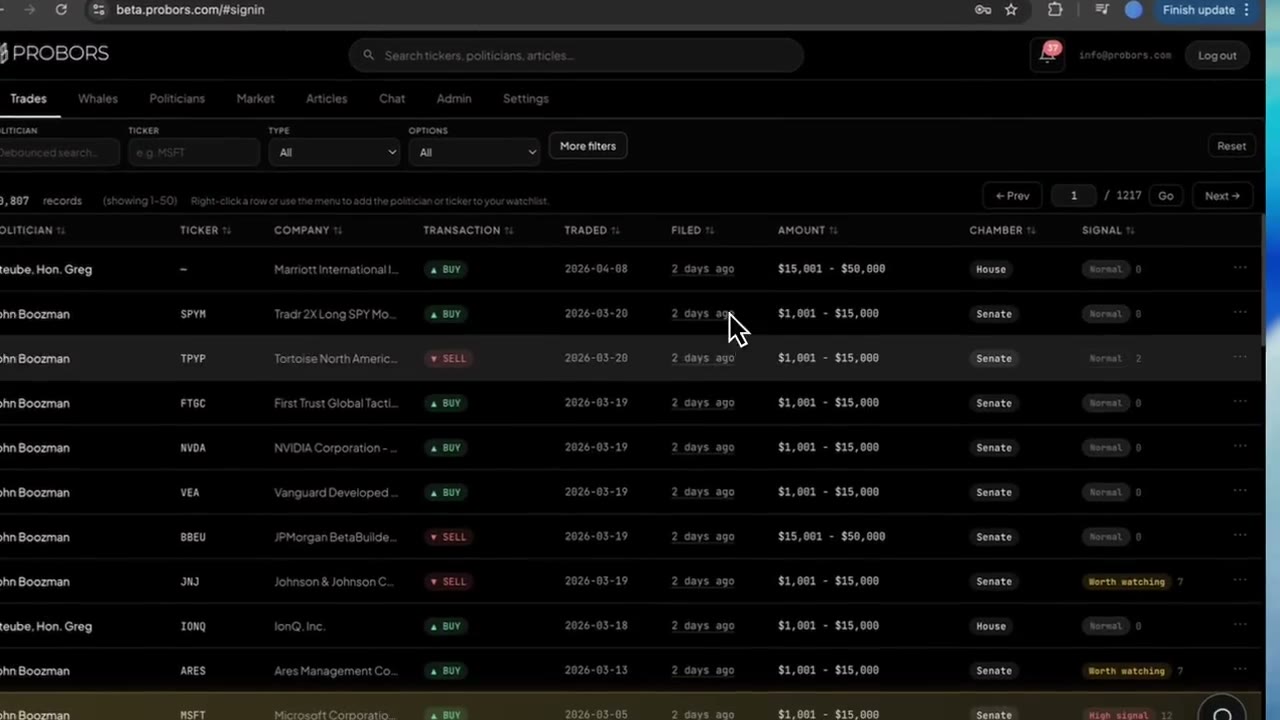
Recent filings in ProBors as of September 8, 2026 show why owner codes come before signal labels. The table below is deduplicated—identical politician, ticker, type, trade date, filing date, amount, and chamber appear once. Owner summaries come from the filing description text visible in ProBors.
| Politician | Chamber | Ticker | Type | Traded | Filed | Lag | Amount range | Owner context | Signal |
|---|---|---|---|---|---|---|---|---|---|
| John McGuire | House | AAPL | Sale (Partial) | August 18, 2026 | September 1, 2026 | 14 days | $1,001–$15,000 | Merrill Lynch SEP IRA | Worth watching |
| Kevin Hern | House | PG | Sale | August 24, 2026 | August 27, 2026 | 3 days | $50,001–$100,000 | Hern Family Revocable | Normal |
| David Taylor | House | VRTX | Sale | August 26, 2026 | September 3, 2026 | 8 days | $1,001–$15,000 | David Taylor Trust | Normal |
| Jonathan Jackson | House | VSAT | Sale (Partial) | August 28, 2026 | September 2, 2026 | 5 days | $1,001–$15,000 | Morgan Stanley Trust | Normal |
How to read these without overfitting:
- McGuire / AAPL: A partial sale inside a SEP IRA, not necessarily the member's personal brokerage. ProBors flagged Worth watching on context—not a reason to skip owner verification. Confirm the IRA owner field in the House PTR before calling it "McGuire dumped Apple."
- Hern / PG: A larger bracket sale through a family revocable trust with only 3-day lag. Trust lines are reportable and public, but the narrative is estate or family-account management—not always a personal directional bet on Procter & Gamble.
- Taylor / VRTX: A trust-account sale filed September 3 with 8-day lag alongside other trust and IRA lines in the same batch. Read the cluster as portfolio maintenance across accounts, not a single-account conviction trade.
- Jackson / VSAT: A partial sale through a Morgan Stanley trust account with 5-day lag—the fastest equity turnaround in this sample. Timely filing does not prove the member personally initiated the trade; check the owner field first.
Use rows like these to practice step 1 before you expand a shortlist across chambers.
Common owner-context mistakes
- Dropping spouse or trust labels in headlines. "Congress member bought calls" without owner context misattributes the trade.
- Treating IRA and trust lines as personal conviction. Retirement and family-trust accounts follow disclosure rules but often reflect different decision-makers.
- Ignoring longer lag on spouse trades. Ethics guidance explicitly contemplates delayed notice on spouse activity; see STOCK Act filing delay explained.
- Merging all accounts into one politician chart. Portfolio views are useful only after you label owner buckets.
- Skipping the PDF because the ticker is familiar. Owner codes live in the source form, not in a screenshot.
What this does not prove
Owner-aware research clarifies who held the asset and when the public record updated. It does not prove the member had non-public information, directed a spouse's trade, or timed the market correctly. Amount fields remain ranges. A verified spouse-owned purchase is still a lagging public data point—not investment advice.
FAQ
Where do I find spouse or joint owner codes?
In the original House PTR or Senate periodic report PDF. ProBors exposes owner hints in the security description and links to the source filing. Always confirm the code in the .gov document before publishing.
Are spouse trades less important than member trades?
They are equally reportable under the STOCK Act. Importance depends on your research question—policy overlap, portfolio pattern, or headline accuracy—not on whether the owner field says self or spouse.
Does ProBors show owner codes on every row?
Where the source filing includes owner or account text, ProBors carries it in the security description. Some bond, bill, or fund lines use text labels instead of tickers; owner verification matters there too.
Can filing lag differ for spouse accounts?
Yes. House ethics guidance notes that members may learn about spouse or dependent trades later, which can push filings toward the outer deadline even when the filer is diligent. Lag alone is not evidence of wrongdoing.
Should I filter out trust and IRA rows?
Only if your question requires member-direct trades only. For complete disclosure research, keep them—but label owner context in your notes and headlines.
Research owner context with structured disclosures
Open congressional rows on ProBors, confirm owner codes in the source PDF, and track politicians across accounts.
Get startedRelated reading
- How to read politician trade disclosures
- How to verify congressional trade disclosures before sharing
- STOCK Act filing delay explained
- Pelosi Intel and Uber call options explained
- House stock trading tracker
Sources
- STOCK Act (S. 2038, 112th Congress)
- House Ethics — PTR due date calculator and guidance
- House Clerk financial disclosure portal
- Senate eFD search
- Rows were checked in ProBors and should be verified against the original filing.
- ProBors data status for ingestion health.
Sources & methodology
Last updated:
ProBors uses public disclosure records, SEC filings, House and Senate financial disclosure portals, market data, and in-product workflow checks. Articles are written as research education, not investment advice.