Large congressional disclosure batches—20, 50, or even 75 rows on a single filing date—are routine in STOCK Act data, not breaking-news events. ProBors shows every line with transaction date, filing date, amount bracket, and signal label, but a batch dump still demands a different workflow than reading one timely House PTR. This six-step process helps you size the batch, separate rebalancing noise from Worth watching rows, verify owner codes in the PDF, and decide what deserves follow-up without treating every ticker as a conviction trade. This is research context, not investment advice.
Why batch size changes your research order
A single politician can file dozens of lines at once when a brokerage statement closes, a trust account rebalances, or a Senate periodic report catches up on months of activity. The filing date is shared across every row, but trade dates, amount brackets, and signal labels vary line by line.
Batch research fails when you:
- Lead with tickers instead of batch metadata (row count, chamber, trade-date span, lag range)
- Treat row count as conviction — 57 purchases does not mean 57 high-conviction bets
- Ignore owner codes — trust and spouse lines in the same batch need separate attribution
- Skip signal triage — most rows in a large batch are often Normal rebalancing lines
The goal is a short verified shortlist, not a headline for every ticker in the PDF.
Six-step batch workflow on ProBors
-
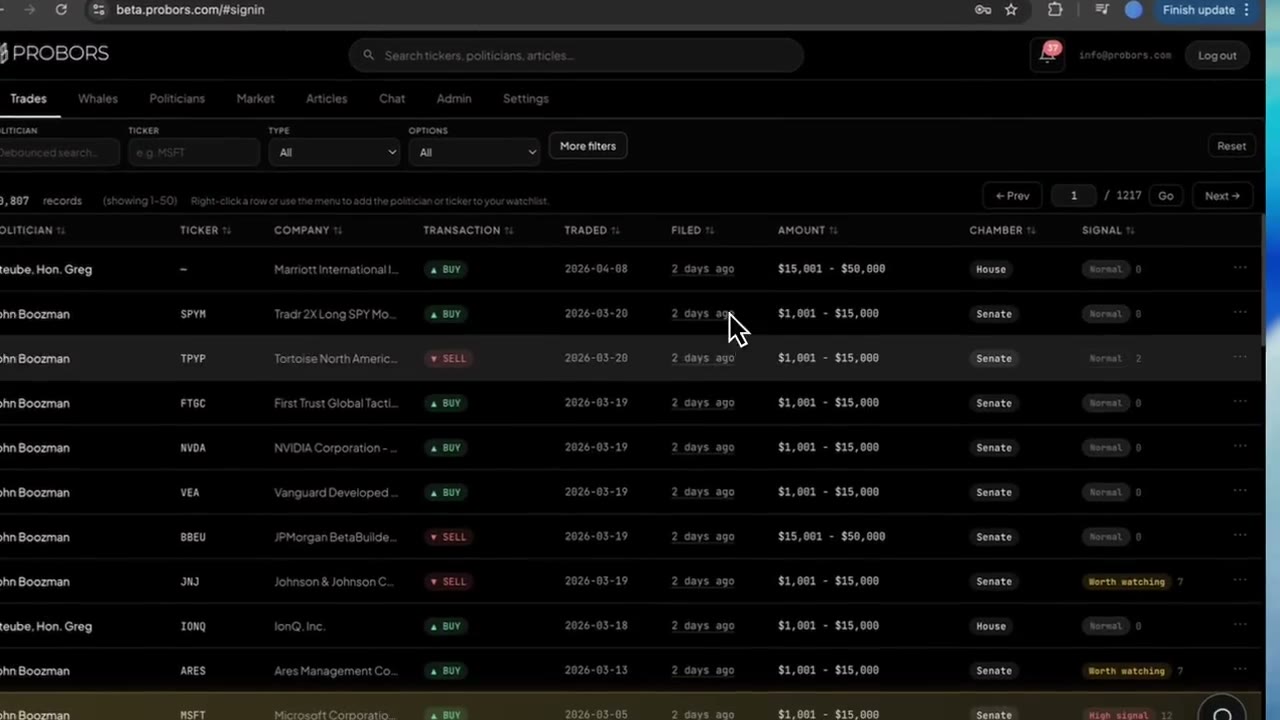
Identify the batch before you read tickers. Sort Congressional trades by filing date descending on probors.com. When one politician name repeats across many rows with the same filed date, you have a batch. Note the chamber (House PTR vs Senate periodic report), total row count, and the filing date in your notes header.
-
Map the trade-date window and lag range. Open the politician's profile or filter by that member. Scan the earliest and latest transaction dates inside the batch. Compute lag in whole days for a few edge rows—the shortest-lag line and the longest-lag line. A House batch filed September 4 with trades from August 7 through August 28 is a normal monthly catch-up; a Senate batch with 2024 trade dates filed in 2026 needs the stale Senate batch workflow.
-
Bucket by signal label before opening PDFs. Filter or sort by signal tier inside the batch. In recent data, large House batches often show a heavy Normal majority with a handful of Worth watching and one or two High signal rows. Start with High signal and Worth watching lines; defer Normal partial sales until you need portfolio context. See how to filter congress trades by signal score for floor settings.
-
Separate transaction types and owner accounts. Group purchases, full sales, and partial sales independently. A batch mixing 33 purchases with 16 partial sales is often a rebalance, not a directional bet. Read owner hints in each row's security description—trust names, IRA labels, and spouse codes appear before the ticker. Do not merge a trust-account purchase with a personal-account sale into one narrative.
-
Verify shortlisted rows in the source PDF. For any line you might cite, follow the disclosure link to the House Clerk financial disclosure portal or Senate eFD. Confirm ticker, owner, amount bracket, and transaction type against the original form. Check for duplicate lines and amendments. Use how to verify congressional trade disclosures before sharing as a pre-flight checklist.
-
Cross-check survivors against chamber and insider context. For the two or three rows that survived steps 3–5, filter the same ticker across House and Senate views. Open insider and whale tabs only when the congressional line is already verified—overlap is context, not confirmation. Add tickers or politicians to a watchlist for the next filing, not retroactive alerts on rows you already read.
Examples: two September batches, different triage outcomes
Recent filings in ProBors as of September 15, 2026 show why batch size alone is not the story. Rep. Gilbert Cisneros filed a 57-row House batch on September 4 covering August trades. Rep. April McClain Delaney filed a 75-row House batch on September 1. The row counts look similar; the signal distribution does not.
| Politician | Chamber | Ticker / asset | Type | Traded | Filed | Lag | Amount range | Signal |
|---|---|---|---|---|---|---|---|---|
| Gilbert Cisneros | House | CSGP | Purchase | August 19, 2026 | September 4, 2026 | 16 days | $1,001–$15,000 | High signal |
| Gilbert Cisneros | House | BSX | Purchase | August 18, 2026 | September 4, 2026 | 17 days | $1,001–$15,000 | High signal |
| Gilbert Cisneros | House | SKHY | Purchase | August 7, 2026 | September 4, 2026 | 28 days | $1,001–$15,000 | Worth watching |
| Gilbert Cisneros | House | GMED | Purchase | August 19, 2026 | September 4, 2026 | 16 days | $15,001–$50,000 | Worth watching |
| Gilbert Cisneros | House | PWR | Purchase | August 27, 2026 | September 4, 2026 | 8 days | $15,001–$50,000 | Normal |
How to read these without overfitting:
- Cisneros's CSGP and BSX purchases are the only High signal rows in the 57-line batch. ProBors flagged both partly because insider Form 4 buying appeared in the same tickers within the scoring window—not because the dollar brackets are large.
- SKHY (SK hynix ADR) is Worth watching on a first-time ticker disclosure with meaningful price movement after the anchor date, despite a 28-day filing lag.
- GMED carries a larger bracket ($15,001–$50,000) but only a Worth watching label—bracket size and signal tier are independent fields.
- PWR is a timely Normal purchase (8-day lag) buried in a loud batch—exactly the kind of row step 3 helps you defer until you need portfolio context.
By contrast, Delaney's 75-row September 1 batch shows 71 Normal and 4 Worth watching lines—mostly routine rebalancing where signal filtering saves the most time. The workflow is identical; the shortlist length is not.
For a full snapshot of the mid-September filing wave that includes Cisneros's batch, see Congress trades filed mid-September 2026.
Common mistakes when reading large batches
- Publishing "Congress bought 57 stocks" when one member rebalanced a trust account across a month of trades.
- Ignoring the trade-date span inside a single filed date—August 7 and August 28 trades are not the same decision window.
- Elevating partial sales to full exits without reading the transaction type column and PDF line.
- Skipping owner verification on trust-labeled rows (Cisneros's High signal CSGP line references a named trust in the security description).
- Confusing batch filing with Senate backlog—timely House batches and multi-year Senate dumps both look like "many rows at once" but need different lag expectations.
FAQ
How many rows count as a "large" batch?
There is no official threshold. In practice, 20 or more rows on one filing date from one politician is where ticker-by-ticker reading stops being efficient and batch metadata (lag range, signal distribution, transaction mix) should lead.
Should I read every line in a 50-row batch?
No. Sort by signal label, verify only the rows you might cite or watchlist, and treat the rest as portfolio context. Most large batches are dominated by Normal rebalancing lines.
Do large batches mean the politician traded more than usual?
Not necessarily. One filing date often reflects a statement close or periodic catch-up, not a burst of same-day trading. Compare trade dates inside the batch, not just the filing date.
How is this different from investigating stale Senate batches?
Stale Senate workflows focus on multi-month or multi-year lag inside periodic reports. This workflow applies to any large dump—including timely House PTR batches—where row count, not lag alone, is the triage problem.
Can I rely on signal scores inside a batch?
Signal labels rank which rows to open first inside a noisy filing. They do not replace PDF verification, owner checks, or filing-lag context. See how to filter congress trades by signal score.
Triage disclosure batches faster
Filter congressional trades by signal score, filing date, and politician on ProBors—then verify shortlisted rows against the original STOCK Act PDF.
Get startedRelated reading
- Congress trades filed mid-September 2026 — a recent batch-heavy filing window
- How to filter congress trades by signal score — rank rows before you open PDFs
- How to investigate stale Senate disclosure batches — when trade dates span months or years
- How to verify congressional trade disclosures before sharing — source-check steps before you publish
- Gilbert Cisneros's stock buying spree and BABA — prior context on this member's disclosure patterns
Sources
- House Clerk financial disclosure — Periodic Transaction Reports
- Senate Select Committee on Ethics — eFD search
- STOCK Act — Pub. L. 112-105
- House Committee on Ethics — PTR filing guidance
- Rows were checked in ProBors and should be verified against the original filing.
- Ingestion health: probors.com/status
Sources & methodology
Last updated:
ProBors uses public disclosure records, SEC filings, House and Senate financial disclosure portals, market data, and in-product workflow checks. Articles are written as research education, not investment advice.