Congressional trading disclosure follows two calendars, not one. Periodic Transaction Reports (PTRs) are filed after individual trades on a rolling 30/45-day clock, while annual financial disclosure reports land on a fixed May deadline with extensions. Researchers who expect a steady drip of PTRs every week—or who confuse an annual holdings snapshot with a fresh trade—often misread timing and overreact to batch uploads. This guide maps both calendars, explains when filing waves tend to cluster, and shows how to fold the schedule into a ProBors workflow. It is research context, not investment advice.
Two disclosure types, two clocks
Congressional stock research usually involves two distinct public filings:
| Filing type | Trigger | Typical timing | What it shows |
|---|---|---|---|
| Periodic Transaction Report (PTR) | A reportable purchase, sale, exchange, or similar transaction above the statutory threshold | Due within 30 days of awareness or 45 days from the trade, whichever is earlier | Individual transaction lines with dates, amount brackets, and asset descriptions |
| Annual financial disclosure report | Calendar-year reporting obligation for covered officials | May 15 filing deadline (extensions common) | Broad holdings snapshot, income sources, and positions as of year-end—not a trade-by-trade log |
The STOCK Act created the PTR requirement for transaction-level transparency. Annual reports predate the STOCK Act and answer a different question: what did the member hold at year-end, and what outside income did they report?
PTRs are event-driven. Annual reports are calendar-driven. Mixing the two is one of the most common timing mistakes in congressional stock research.
The PTR rolling deadline (transaction calendar)
Every reportable trade starts its own clock. House ethics guidance—summarized in the House PTR instruction materials—states that a PTR is due by the earlier of:
- 30 days from when the filer becomes aware of the transaction, or
- 45 days from the transaction date.
Senate filers follow the same core framework under Senate ethics rules. Published rows appear on the House Clerk Financial Disclosure portal or the Senate eFD search after submission—often with additional posting lag.
There is no fixed "PTR day of the month." A trade on September 1 can legally appear anytime through mid-October. That is why trackers sort by filed date for recency and by transaction date for market context—they measure different things.
For chamber-specific portal habits and deadline nuance, see House vs Senate PTR deadlines explained.
The annual disclosure calendar (fixed deadline)
Annual financial disclosure reports cover the prior calendar year. The House Committee on Ethics annual filing page and Senate ethics materials describe a May 15 submission deadline for most covered officials.
Practical calendar notes for researchers:
- May filing season — Annual reports for the prior year typically publish between mid-May and late June, depending on extensions and portal processing.
- Extensions — Members routinely receive filing extensions. A report labeled for calendar year 2025 may not appear until summer 2026. Absence in May does not mean no report is coming.
- Holdings vs trades — An annual report lists positions and ranges as of December 31. It does not replace PTRs for trades that happened during the year. Use annual reports for portfolio context; use PTRs for transaction timing.
- Amendments — Corrected annual forms can appear months after the original. Always check whether a filing is marked amended before citing holdings.
Annual reports help you understand what a member held at a point in time. PTRs tell you when they traded.
When PTR batches tend to cluster (informal patterns)
PTRs have no official monthly schedule, but researchers often notice informal waves:
| Period | Common pattern | Why it matters |
|---|---|---|
| First week of a month | House offices sometimes batch-review spouse and brokerage accounts after month-end | A quiet tracker week can flip into a 20-row batch overnight |
| Late summer / early fall | Post-recess catch-up filings after August district work periods | September filing windows can look unusually large even when trades happened weeks earlier |
| Year-end (November–December) | Portfolio rebalancing, tax-loss harvesting, and fund distributions | January and February PTR uploads may reference Q4 transaction dates |
| After major market moves | Headline-driven scrutiny—not a legal trigger, but offices may accelerate review | Do not assume faster filing means better information quality |
| New member orientation | First-year filers learning PTR workflows | Early-session rows may show longer lags as staff processes new accounts |
These patterns are observational, not statutory. A member can file next-day or on day 44. ProBors indexes rows as they publish; the data status page shows ingestion health when you wonder whether a portal delay or a tracker gap explains missing rows.
How to use the calendar in a ProBors workflow
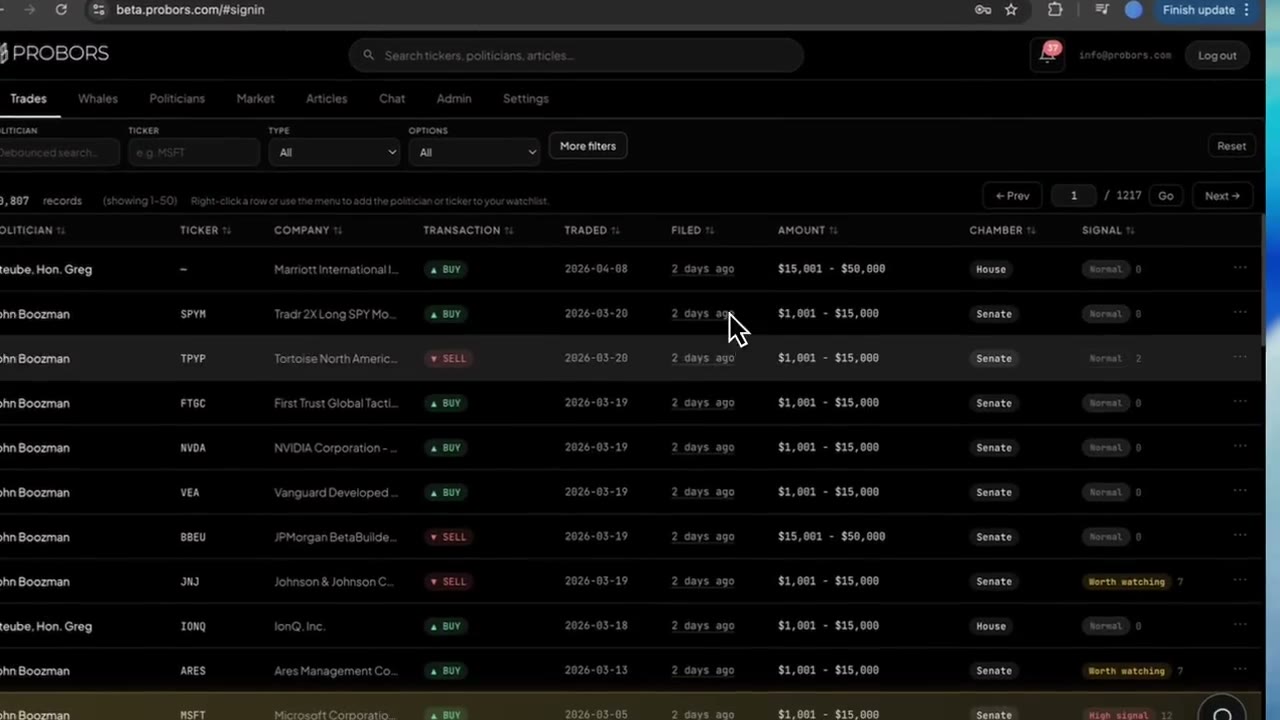
- Separate PTR monitoring from annual-report season. During May and June, expect holdings snapshots—not a surge of new trade signals. PTR sorting by filed date remains your live feed year-round.
- Log three dates on every row — transaction date, filed date, and the day you first saw the row in ProBors. See how to compare filing date vs transaction date.
- Run a weekly PTR review — A fixed Monday pass catches batch uploads without treating any single day as "disclosure day." The weekly congress disclosure review workflow fits this cadence.
- Flag long-lag rows for context, not alarm — A 38-day lag can still be timely under the STOCK Act. Compare against the filing delay guide before calling a row "late."
- Cross-check annual holdings once per year — When a member's May annual report publishes, compare year-end positions to recent PTR lines for the same ticker. Discrepancies often reflect timing, not fraud.
- Watch Senate batch drops separately — Senate eFD sometimes publishes several senators on the same posting day. Chamber filters in ProBors prevent mixing House batch habits with Senate timing.
Common mistakes when reading the disclosure calendar
-
Treating PTRs like Form 4 insider filings. Congressional PTRs allow up to 45 days. Insider Form 4s generally require two business days. Comparing lag between the two systems produces false "Congress is slower" narratives without acknowledging different laws.
-
Expecting same-day disclosure. The STOCK Act never promised real-time congressional trade feeds. A trade from three weeks ago can be the newest row you see today—and still be compliant.
-
Using annual reports as trade alerts. A May 2026 annual report describes December 2025 holdings. It is stale for intraday research the day it publishes.
-
Ignoring amended filings. Both PTRs and annual reports can be corrected. A headline based on the first PDF may not match the amended version posted a week later.
-
Assuming quiet weeks mean no trading. Quiet tracker weeks often mean quiet filing weeks. Trades may have happened; PTRs may arrive in the next batch.
-
Forgetting spouse and dependent account lag. Spouse trades can legally file toward the 45-day outer bound when the member learns of the transaction later. Calendar math differs from member-direct trades.
What this does not prove
A disclosure calendar explains when filings are due and when waves tend to appear—not whether a trade was informed, ethical, or profitable. A timely PTR does not prove insider knowledge. A batch filed on September 4 does not prove coordinated trading across members. An annual report does not reveal trades that happened after December 31.
Congressional disclosure is a transparency tool for conflict-of-interest monitoring, not a real-time signal feed. Use calendars to set research expectations, not to time entries.
FAQ
Is there an official monthly PTR filing date for Congress?
No. PTRs are due on a rolling basis after each reportable transaction. The 30/45-day rule is the only statutory schedule. Informal batch habits vary by office.
When are annual congressional financial disclosures due?
The standard deadline is May 15 for the prior calendar year, though extensions are common. Check the House ethics annual disclosure page and Senate ethics resources for the current cycle.
Why do so many congressional trades appear in the same week?
Offices often batch-review accounts and upload multiple PTR lines in one submission—especially after month-end or congressional recess. The trades may span several transaction dates even when filing dates cluster.
Should I research Congress differently in May vs September?
In May, prioritize annual holdings reports for portfolio context. From September through year-end, expect more PTR volume referencing summer and early-fall transaction dates. Your PTR monitoring workflow stays the same; your interpretation of "new" changes.
Does ProBors show annual reports and PTRs together?
ProBors focuses on transaction-level PTR rows for congressional trade screening. Annual holdings context appears in politician profile and portfolio views where available. Always open the original filing for holdings detail.
Track PTRs on a rolling calendar
Filter House and Senate disclosures by filed date, transaction date, and signal score on ProBors.
Get startedRelated reading
- STOCK Act filing delay explained
- House vs Senate PTR deadlines explained
- How to read politician trade disclosures
- How to run a weekly congress disclosure review
- How to compare filing date vs transaction date
Sources
- STOCK Act (S. 2038, 112th Congress)
- House Committee on Ethics — Periodic Transaction Report (PTR)
- House Committee on Ethics — Annual Financial Disclosure
- House Clerk Financial Disclosure search
- Senate eFD search portal
- Rows were checked in ProBors and should be verified against the original filing.
- Ingestion health: probors.com/status
Sources & methodology
Last updated:
ProBors uses public disclosure records, SEC filings, House and Senate financial disclosure portals, market data, and in-product workflow checks. Articles are written as research education, not investment advice.