Researching amended congressional disclosures means finding when a House PTR or Senate periodic report was corrected—and deciding which row in your notes is still valid. Members can amend filings to fix transaction dates, amount brackets, asset descriptions, or owner codes. A tracker row from the original PDF may no longer match the amended version posted days or weeks later. ProBors surfaces structured rows with source links; the workflow below shows how to spot likely superseded lines, compare official documents, and retire outdated entries before you share or watchlist them. This is research context, not investment advice.
Why amendments break naive tracker reads
STOCK Act disclosures are self-reported. Clerks publish an initial PTR or periodic transaction report, then sometimes post an amended version when a member corrects an error. Aggregators—including ProBors—ingest each published document. Until you reconcile versions, you may see:
- Two rows for the same politician and ticker with different trade dates
- The same filing window with conflicting amount brackets
- A headline based on a line that the official filing later retracted or corrected
Amendments are not evidence of wrongdoing by themselves. They are a routine reason to re-verify before citing. Treat every shareable summary as provisional until you confirm you are reading the latest published form.
Seven-step amendment research workflow on ProBors
-
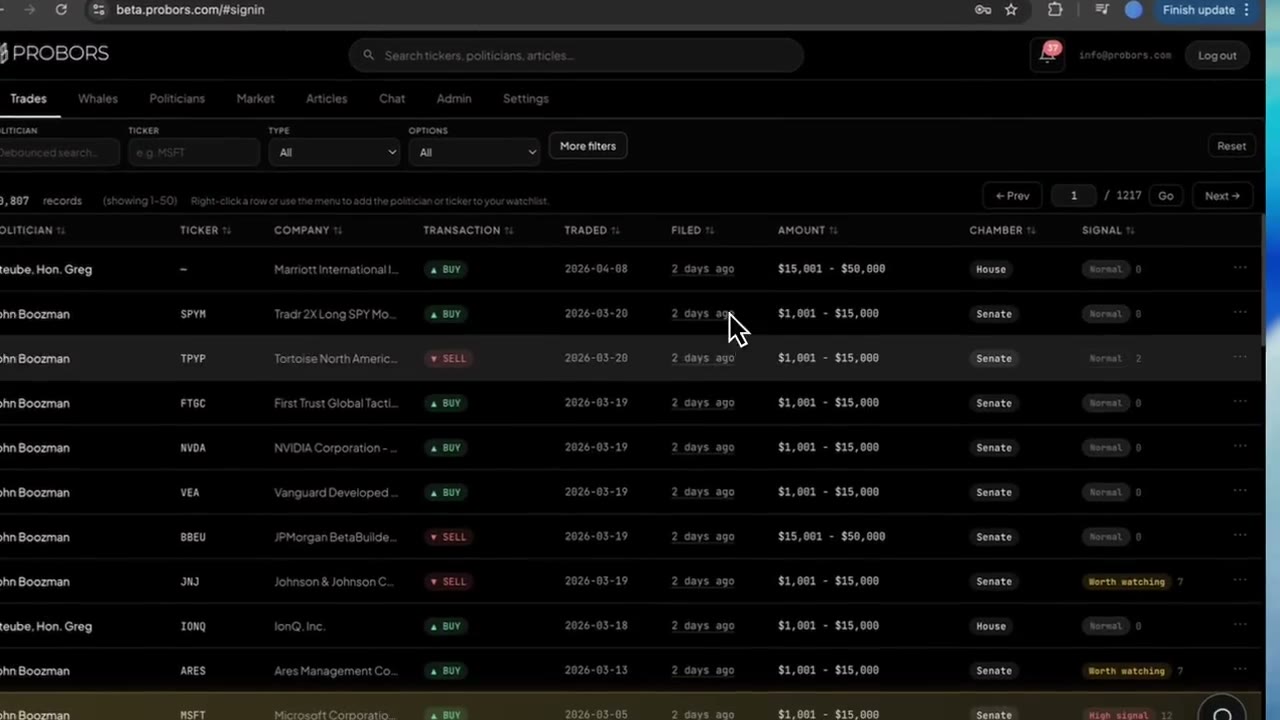
Trigger a check when duplicates look suspicious. Start from Congressional trades on probors.com. Sort by filing date descending. Flag rows where the same politician shows the same or similar ticker within a 30-day filing window, or where transaction date and filing date look unusually far apart for that chamber. Duplicates are not always amendments—Senate batches list many lines on one form—but they are your cue to open source PDFs.
-
Open the politician profile for filing-date clusters. From trade detail, jump to the member's profile (see how to trace a politician's disclosure history). Scan filing dates before tickers. If two filings land within a week for overlapping assets, assume you need a side-by-side read even when structured fields look similar.
-
Pull both source disclosures. Follow the source link on each candidate row to the House Clerk Financial Disclosure PTR or Senate eFD document. Note whether the form header or footer marks Amended or references a prior report ID. House and Senate portals label corrections differently; read the cover page before the transaction table.
-
Compare six fields line by line. For each asset row you plan to cite, match politician name, owner code (self, spouse, joint), transaction type, transaction date, amount bracket, and asset description. If any field differs between two filings for what looks like the same trade, the later published document usually supersedes the earlier one—unless the member filed a separate new transaction.
-
Record which version you trust. In your notes, keep one row: politician, chamber, ticker or asset text, transaction type, trade date, filing date, amount bracket, and a note like "amended filing dated September 14 replaced September 7 line." Retire the superseded row from watchlists and drafts. Do not delete your audit trail—mark it superseded.
-
Re-run verification before sharing. Walk the surviving row through the seven-step verification pass: chamber, both dates, lag in plain language, asset class, and PDF match. Amendments often fix dates or brackets—the exact fields people misquote in headlines.
-
Check ingestion freshness if rows still conflict. When the PDF is clear but structured rows disagree, open ProBors data status to see whether House PTR or Senate ingest recently processed new filings. Lag between official publication and structured rows is usually short, but amendment waves can arrive in bursts after a batch correction.
Examples: when to pause for an amendment check
Recent filings in ProBors as of September 22, 2026 illustrate duplicate-detection triggers—not confirmed amendments. Use them as admission tests for steps 1–2; always confirm on the official PDF before calling any row amended or superseded.
| Politician | Chamber | Ticker | Type | Traded | Filed | Lag | Amount range | Signal |
|---|---|---|---|---|---|---|---|---|
| Sessions, Hon. Pete | House | GOOGL | Sale | September 14, 2026 | September 18, 2026 | 4 days | $15,001–$50,000 | Normal |
| Sessions, Hon. Pete | House | ABBV | Sale | September 14, 2026 | September 18, 2026 | 4 days | $15,001–$50,000 | Normal |
| A. McConnell | Senate | WFC | Purchase | September 1, 2026 | September 21, 2026 | 20 days | $15,001–$50,000 | Normal |
| Taylor, Hon. David J. | House | PG | Purchase | September 8, 2026 | September 17, 2026 | 9 days | $1,001–$15,000 | Normal |
How to read these as amendment-check triggers:
- Sessions GOOGL and ABBV (same trade date, same filing date): A two-line House batch filed September 18 for September 14 sales. Not an amendment by itself—but if a third GOOGL row for Sessions appears with a nearby filing date and a different amount bracket, compare PDFs before citing either GOOGL line.
- McConnell WFC (20-day Senate lag): Routine periodic timing. Amendment suspicion rises if a second WFC row for the same member shows the same trade date with a revised bracket or a different transaction date—open the Senate filing header for an amended stamp.
- Taylor PG (9-day House lag): Fast House turnaround relative to Senate batches in the same week (see late September filings). If a follow-up PTR arrives within days for the same ticker, treat the newer filing as the candidate corrected version until the PDF proves otherwise.
None of the rows above are labeled amended in ProBors. They show why researchers batch-check politician history before publishing—not because every duplicate is a correction, but because uncorrected citations are how amended forms create silent errors.
Common mistakes when handling amendments
- Assuming the first filing you saw is still current. Newsletters and screenshots freeze one version; clerks may publish corrections later.
- Treating same-day batch lines as amendments. Multiple tickers on one House PTR are normal; amendments usually reference a prior report or carry an amended label on the form.
- Ignoring owner-code fixes. A correction from spouse to self changes attribution, not just numbers.
- Deleting the old row from your audit trail. Mark it superseded with the amended filing date instead—you may need the timeline for lag or pattern research.
- Skipping chamber-specific portals. House PTR amendments and Senate periodic corrections follow different publication paths; see House vs Senate PTR deadlines.
What this does not prove
Finding an amended filing confirms which public document is latest, not whether a trade was illegal, timed to legislation, or investable. Corrections fix disclosure errors; they do not validate trading intent. Even a perfectly reconciled row remains a self-reported amount bracket with filing lag—research context, not investment advice.
FAQ
How do I know if a filing is amended?
Read the official House or Senate PDF header and cover text. Look for "Amended," "Amendment," or language referencing a prior report. Structured tracker rows may not surface that flag prominently—source PDFs are decisive.
Should I research amendments differently for House and Senate?
The workflow is the same; the portals differ. House PTRs publish through the Clerk's site; Senate reports through eFD. Labeling and amendment timing vary by chamber—compare within the same member and portal before merging rows.
What if ProBors shows two rows but I only find one PDF?
Expand the filing-date window on the politician profile, search the clerk portal by member name, and check whether a second PDF published on a later date. If only one official document exists, the duplicate may be a parsing or batch artifact—note the discrepancy and avoid sharing until resolved.
Do amendments change signal scores?
Signal tiers summarize research context on structured fields. If an amendment changes dates, brackets, or asset type, the score may change on re-ingest. Re-read the row after corrections; do not treat an old tier as authoritative.
How often should I re-check rows on my watchlist?
After any known amendment wave in your coverage universe— or when a politician profile shows a new filing date for a ticker you already logged—re-run steps 3–6. A weekly pass is enough for most retail researchers; journalists should check before every publish.
Track disclosures with version discipline
Use ProBors politician profiles, source links, and chamber filters to reconcile amended STOCK Act filings before you cite them.
Get startedRelated reading
- How to verify congressional trade disclosures before sharing
- How to trace a politician's disclosure history on ProBors
- How to read politician trade disclosures
- STOCK Act filing delay explained
- Congress trades filed late September 2026
- Congressional trading disclosure calendar
Sources
- STOCK Act (S. 2038, 112th Congress) — statutory basis for periodic transaction reports and corrections
- House Clerk Financial Disclosure — Periodic Transaction Reports — official House PTR publication
- Senate Financial Disclosures (eFD search) — official Senate periodic and annual reports
- Ethics in Government Act disclosure requirements — covered official reporting framework
- Rows were checked in ProBors and should be verified against the original filing.
- ProBors data status — ingestion health for House and Senate sources
Sources & methodology
Last updated:
ProBors uses public disclosure records, SEC filings, House and Senate financial disclosure portals, market data, and in-product workflow checks. Articles are written as research education, not investment advice.