Congressional stock trades filed in late September 2026 are a smaller, more options-heavy wave than the mid-September Cisneros batch. As of September 21, 2026, ProBors shows 13 deduplicated disclosure rows with filing dates between September 14 and September 17—spanning four members across House and Senate. Rep. Josh Gottheimer filed a seven-row House batch on September 14 centered on Microsoft (MSFT), mixing equity sales and purchases with two call-option lines in the $500,001–$1,000,000 bracket. Sen. Alan Armstrong's September 17 Senate filing includes Electronic Arts (EA) sales and Williams Companies (WMB) call purchases. Rep. David Taylor's September 17 House line is the fastest turnaround in this window at 9-day lag. This is research context, not investment advice.
Snapshot summary
ProBors sorts congressional disclosures by filing date. In the September 14–17 filing window:
- 13 rows after deduplication (identical politician, ticker or asset, type, trade date, filing date, amount, and chamber removed)
- 4 politicians filed in this window: Josh Gottheimer (7 rows), Alan Armstrong (4 rows), David Taylor (1 row), and Angus King (1 row)
- Chamber split: 8 House rows, 5 Senate rows
- Transaction mix: 7 purchases, 3 sales, 1 exchange, 1 call-option purchase, 1 call-option sale
- Signal tiers: 3 High signal rows, 5 Worth watching, 5 Normal
- Filing lag: 9-day minimum (Taylor's September 8 PG purchase filed September 17), 31-day median, 44-day maximum on Armstrong's early-August EA sale
- Notable clusters: Gottheimer's September 14 MSFT options-and-equity batch (7 rows); Armstrong's September 17 Senate EA and WMB lines; King's September 14 EA sale
Late September is quieter than mid-September's 83-row batch, but the MSFT concentration stands out—five politicians traded Microsoft in August within ProBors's scoring window, and Gottheimer's four MSFT lines alone carry three High signal scores.
Recent disclosures worth a closer look
The table below shows deduplicated rows from ProBors as of September 21, 2026. Lag is calendar days between transaction date and filing date as reported in each disclosure.
| Politician | Chamber | Ticker / asset | Type | Traded | Filed | Lag | Amount range | Signal |
|---|---|---|---|---|---|---|---|---|
| Josh Gottheimer | House | MSFT | Sale (call option) | August 14, 2026 | September 14, 2026 | 31 days | $500,001–$1,000,000 | High signal |
| Josh Gottheimer | House | MSFT | Purchase (call option) | August 14, 2026 | September 14, 2026 | 31 days | $500,001–$1,000,000 | High signal |
| Josh Gottheimer | House | MSFT | Sale | August 14, 2026 | September 14, 2026 | 31 days | $250,001–$500,000 | High signal |
| Josh Gottheimer | House | MSFT | Purchase | August 14, 2026 | September 14, 2026 | 31 days | $250,001–$500,000 | Worth watching |
| Alan Armstrong | Senate | EA (Electronic Arts) | Sale | August 4, 2026 | September 17, 2026 | 44 days | $1,001–$15,000 | Worth watching |
| Angus King | Senate | EA (Electronic Arts) | Sale | August 5, 2026 | September 14, 2026 | 40 days | $15,001–$50,000 | Worth watching |
| Alan Armstrong | Senate | WMB | Purchase (call option) | August 19, 2026 | September 17, 2026 | 29 days | $1,001–$15,000 | Normal |
| David Taylor | House | PG | Purchase | September 8, 2026 | September 17, 2026 | 9 days | $1,001–$15,000 | Normal |
How to read this without overfitting:
- Gottheimer's MSFT cluster is the headline of this window. Four MSFT lines filed September 14 on the same August 14 trade date include two call-option rows in the largest bracket ProBors tracks. All four carry elevated signal scores partly because five politicians traded MSFT in August.
- The call-option sale and purchase on the same date may reflect a roll, spread adjustment, or trust-account rebalancing—not a simple directional bet. Read the original House PTR for strike and expiration detail before inferring intent.
- Armstrong's EA sale and King's EA sale are separate Senate disclosures in the same ticker with different trade dates and brackets. Both are Worth watching on politician-consensus scoring, not on size alone.
- Taylor's PG purchase is the only row with a September trade date and the shortest lag in this batch at 9 days—useful as a contrast to Gottheimer's 31-day MSFT lines.
- Armstrong's WMB call purchase is a derivative line with a stated strike and expiration in the underlying filing. Treat it separately from the EA sale on the same September 17 batch.
Filing lag in plain language
STOCK Act disclosures are periodic reports, not live trade feeds. In this late-September snapshot:
- Fastest line: Taylor's September 8 PG purchase filed September 17 at 9-day lag
- Gottheimer's MSFT batch: August 14 trade dates filed September 14 at 31-day lag
- Senate EA lines: King's August 5 sale filed September 14 at 40-day lag; Armstrong's August 4 sale filed September 17 at 44-day lag
- Armstrong's WMB calls: August 19–20 trade dates filed September 17 at 28- to 29-day lag
When a headline says a member "just disclosed" Microsoft options, check both dates. A September 14 filing may cover trades from mid-August. For the rules behind that gap, see STOCK Act filing delay explained.
How to research this week's filings on ProBors
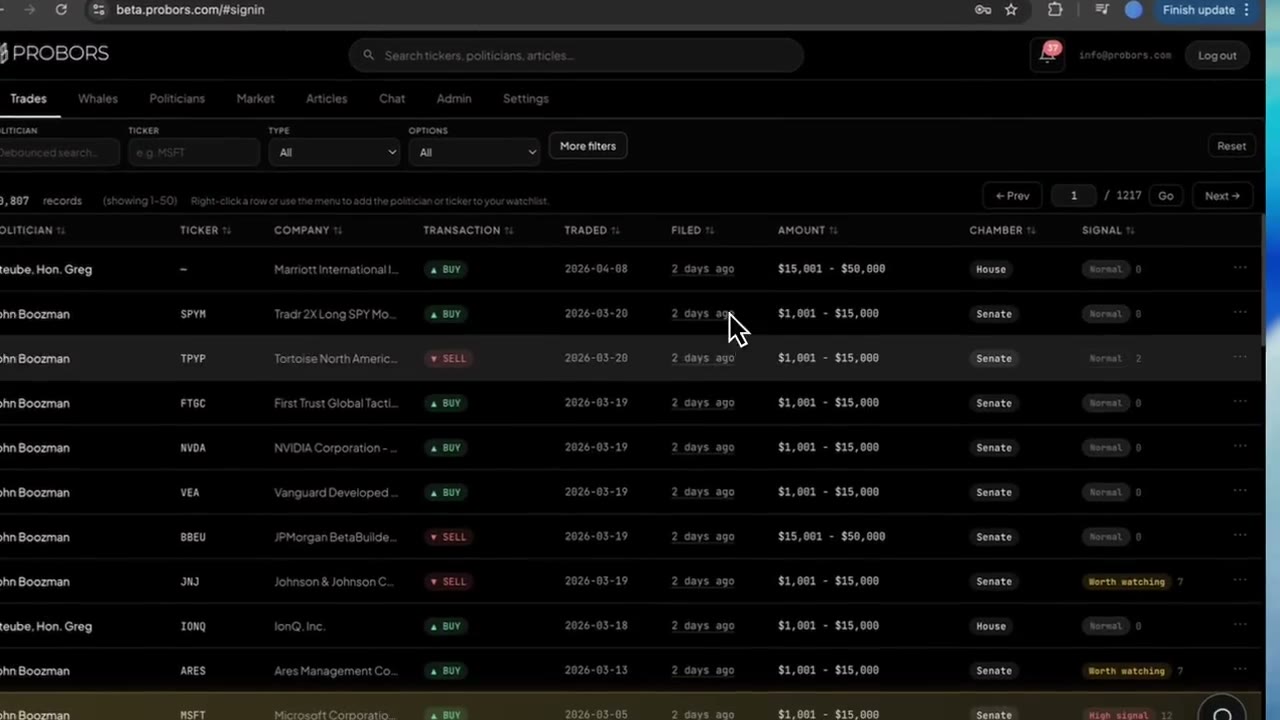
- Open Congressional trades and sort by filing date descending to mirror this snapshot.
- Filter by House when you want Gottheimer's September 14 MSFT cluster or Taylor's September 17 PG line.
- Filter by Senate for Armstrong's September 17 EA and WMB batch or King's September 14 EA sale.
- Sort by signal score when you want to triage the three High signal and five Worth watching rows before reading every Normal line.
- Cross-check any notable row against the original PTR or Senate eFD PDF before citing it in notes or journalism.
For chamber-specific workflows, see the House stock trading tracker and Senate stock trading tracker guides.
What this does not prove
A filing date in late September does not mean the politician traded that week. Gottheimer's September 14 House batch covers August 14 trade dates filed three weeks later. MSFT call-option rows on the same date could reflect portfolio hedging or trust-account management, not a directional call on Microsoft. Armstrong's and King's EA sales are small-bracket Senate lines with consensus scoring—not evidence of coordinated activity or non-public information. Taylor's 9-day PG purchase is timely by congressional standards but still a $1,001–$15,000 bracket that reveals little about conviction. High signal tiers flag overlap with other disclosures and derivatives—they are triage flags, not proof of insider knowledge. None of these disclosures are trade signals. They are public records worth reading carefully.
FAQ
How many congressional trades were filed in late September 2026?
ProBors shows 13 deduplicated disclosure rows with filing dates between September 14 and September 17, 2026, across four politicians. The count is after removing identical politician-ticker-type-date-amount-chamber duplicates.
Why is Gottheimer's MSFT batch flagged as High signal?
ProBors scored three of Gottheimer's four MSFT lines as High signal because five politicians traded MSFT in August within the scoring window, the rows include derivative instruments, and several lines are large relative to this member's typical disclosure size. That combination is a research flag—not a prediction about MSFT.
Which filing had the shortest lag in this window?
Rep. David Taylor's Procter & Gamble (PG) purchase traded September 8 and filed September 17—a 9-day gap. Most other rows in this batch carry 28- to 44-day lag.
How does late September compare to mid-September 2026?
Mid-September carried 83 deduplicated rows across seven members, dominated by Cisneros's 57-row House batch. Late September has 13 rows from four members, with options and MSFT concentration rather than broad multi-sector buying.
Where can I verify these rows against original filings?
Each House PTR is available through the House Clerk's disclosure search. Senate reports are published through the Senate eFD system. Rows were checked in ProBors and should be verified against the original filing.
Track congressional filings as they land
Use ProBors to sort House and Senate PTR rows by filing date, signal score, and politician—then cross-check against original disclosures.
Get startedRelated reading
- Congress trades filed mid-September 2026
- MSFT congressional disclosures explained
- How to read politician trade disclosures
- STOCK Act filing delay explained
- How to filter congress trades by signal score
Sources
- House Financial Disclosure Reports — Periodic Transaction Reports (PTRs)
- Senate Financial Disclosures (eFD) — Senate PTR search
- STOCK Act of 2012 — Congressional trading disclosure requirements
- ProBors data status — ingestion health for congressional filings
Rows were checked in ProBors and should be verified against the original filing.
Sources & methodology
Last updated:
ProBors uses public disclosure records, SEC filings, House and Senate financial disclosure portals, market data, and in-product workflow checks. Articles are written as research education, not investment advice.