STOCK Act disclosure limits mean a Periodic Transaction Report (PTR) is a narrow slice of a member's financial life—not a live portfolio feed or a complete trading history. PTRs capture many reportable securities trades above the statutory threshold, but they omit small transactions, most holdings that never traded during the period, and activity held inside certain trust structures. Researchers who treat every congressional tracker row as "everything the politician did in the market" overstate what public filings can prove. This guide maps what PTRs are designed to show, what they routinely leave out, and how to avoid common misreads when you work on probors.com. It is research context, not investment advice.
What a PTR is supposed to do
The STOCK Act added Periodic Transaction Reports so the public can see individual securities transactions by covered officials and certain family accounts within the Act's timing rules—not so outsiders can reconstruct exact net worth or real-time positioning.
House filers submit PTRs through the House Clerk financial disclosure system; Senate filers use the Senate eFD portal. Ethics guidance, including the House Committee on Ethics instruction materials, ties each PTR line to a transaction (purchase, sale, exchange, and similar reportable events), not to a full balance sheet.
Think of PTRs as event logs. Annual financial disclosure reports are inventory snapshots. Confusing the two is one of the fastest ways to misread congressional trading data—a topic the congressional trading disclosure calendar covers in more detail.
Coverage limits researchers should expect
Sub-threshold trades
PTRs generally cover securities transactions over $1,000 in gross terms. Trades at or below that threshold typically do not appear on periodic transaction reports, even when they would matter to a personal portfolio narrative.
Trackers that only ingest PTRs therefore cannot show a pattern built from many small trades. Absence from a feed is not proof the politician avoided a ticker—it may mean each line fell under the reporting floor.
Holdings without a reportable transaction
If a member held shares, funds, or bonds but did not execute a reportable transaction during the window you are studying, that position may never appear on a PTR for that period.
You may still see the asset on an annual financial disclosure schedule, but that filing answers "what was held around the reporting date," not "they bought on Tuesday." For reading transaction vs filing dates on rows you do see, start with how to read politician trade disclosures.
Amount brackets, not exact dollars
Even when a trade is reportable, PTRs usually show ranges (for example $1,001–$15,000), not precise share counts or dollar proceeds. That design limit applies across chambers; see why congressional amount ranges are not exact dollars for bracket tables and gross-amount rules.
A tracker column labeled with a range is faithfully reflecting the form—not hiding precision that exists in the PDF.
Qualified blind trusts and manager-directed accounts
Members may hold assets in qualified blind trusts or other arrangements where they do not control day-to-day trading decisions. Ethics rules still require disclosure, but the researcher-visible detail on any single trade can be thinner than a self-directed brokerage line.
When a filing describes trust or manager activity, avoid attributing trade timing to personal market views without reading the owner and account fields in the source PDF. Spouse, joint, and trust context matters; see how to research spouse and joint congressional disclosures for owner-code workflow.
Asset classes and labels that resist simple tickers
PTR lines can describe municipal bonds, fund names, structured products, or corporate actions where a clean equity ticker is missing or misleading. Trackers may show a placeholder or a parsed label that still needs PDF confirmation.
Non-equity and derivative rows deserve a separate reading frame—how to research non-equity congressional disclosures walks through that split.
Publication lag on top of legal deadlines
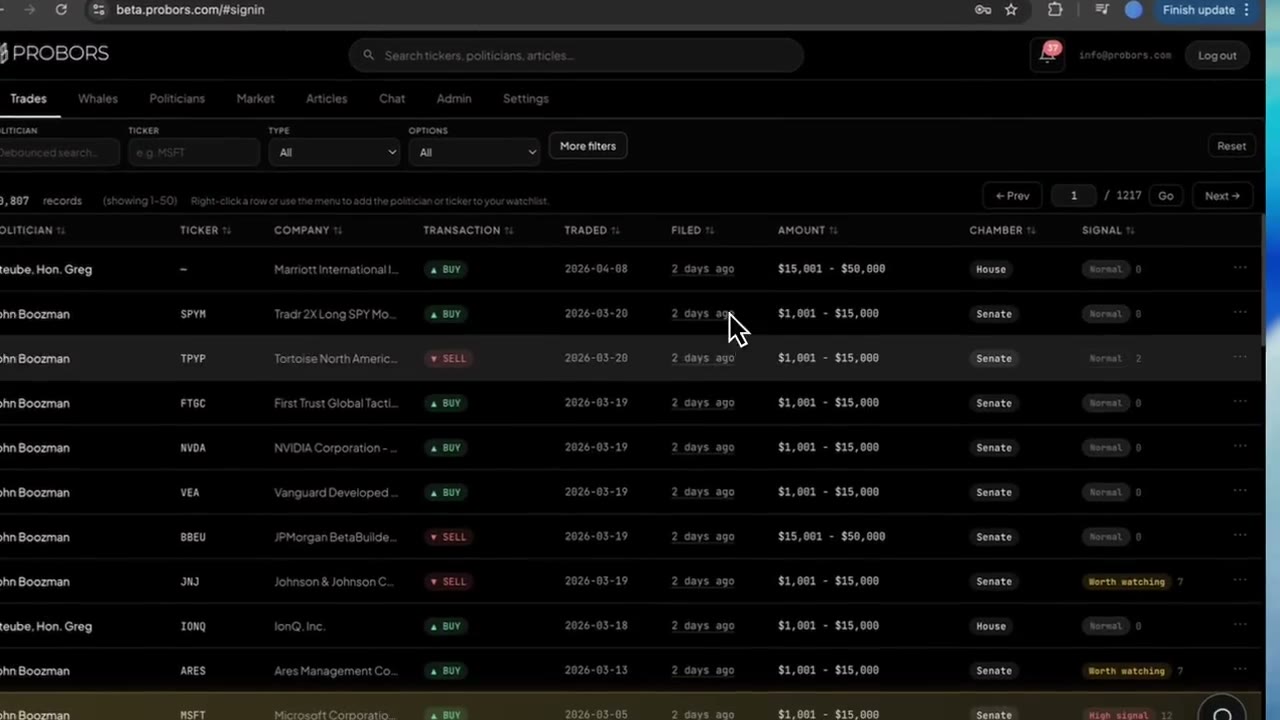
Even a timely PTR under the 30/45-day rule appears to the public only after chamber processing. Trackers add another indexing step. A "new" row in ProBors is a publication event, not the trade date. For deadline math and lag examples, see STOCK Act filing delay explained.
PTR vs annual disclosure: quick reference
| Question | Periodic Transaction Report (PTR) | Annual financial disclosure |
|---|---|---|
| Primary focus | Individual reportable transactions | Broad holdings and income picture for the year |
| Typical trigger | A purchase, sale, exchange, or similar reportable event | Fixed annual deadline (with extensions) |
| Shows exact trade size? | Usually ranges only | Often ranges on schedules; not a trade blotter |
| Good for "what did they buy this month?" | Yes, when a reportable trade occurred | No—holdings may be stale vs transaction date |
| Good for "what sectors do they hold?" | Partial—only if recent trades touched those names | Better starting point for static exposure |
Use both calendars when you build a research narrative. Use PTR-first tools when you monitor new activity.
Common mistakes when PTR limits are ignored
-
Treating missing ticker activity as "no exposure." Small trades and untraded holdings can leave no PTR footprint while annual schedules still list the asset class.
-
Summing amount brackets across rows. PTR ranges are not additive dollar totals; summing them implies precision the forms never provide.
-
Assuming every sale is a thesis change. Partial sales, rebalancing, tax planning, and trust distributions can share the same "Sale" label with very different intent.
-
Ignoring amendments and corrections. A first-pass PTR can be superseded. A tracker row without a follow-up check can embed stale dates or brackets—see how to research amended congressional disclosures.
-
Equating signal scores with legal completeness. ProBors signal tiers summarize structured disclosure context on ingested rows. They do not expand STOCK Act coverage to trades the law never required on a PTR.
-
Expecting committee or bill timing on the PTR itself. Periodic reports identify the transaction and owner context; they do not embed legislative calendars. Policy overlap research still requires separate sources.
How to research within STOCK Act limits on ProBors
-
Start on Trades when your question is "what filed recently?" Filter by chamber, ticker, or transaction type before you interpret direction.
-
Open the source link on any row that will leave your private notes. Confirm transaction date, filing date, amount bracket, owner field, and asset description against the House or Senate PDF.
-
Check filing lag in plain language (for example "filed about three weeks after the trade") so you do not confuse legal deadlines with portal posting delays.
-
Pivot to Politicians when you need member-level history or portfolio-style context beyond a single PTR line.
-
Cross-check annual disclosures on the official portals when your question is holdings breadth, not a specific trade.
-
Note ingestion health on probors.com/status if a filing you expect is missing—delay may be chamber publication, parser lag, or an amendment still processing.
What this does not prove
Understanding PTR limits does not prove a member traded on non-public information, avoided disclosure, or holds any specific position size today. It also does not mean every row in a tracker is trivial—many reportable trades are material within their brackets. The point is narrower: public PTR data is bounded by statute and form design, and good research states those bounds before drawing conclusions.
FAQ
Are all family account trades on PTRs?
The STOCK Act covers reportable transactions by covered officials and certain spouse, dependent, and joint accounts above the threshold. Not every financial movement in a family office or small account triggers a PTR line. Read the owner field in the source filing before attributing a trade.
Why do some rows show no ticker symbol?
The underlying disclosure may describe a bond, fund, or corporate instrument without a single equity ticker. Treat the asset description in the PDF as authoritative and avoid forcing a ticker narrative.
Do PTRs include cryptocurrency?
Reportable treatment depends on how the filer and ethics guidance classify the asset and whether a reportable transaction occurred above the threshold. Do not assume all digital-asset activity appears in congressional feeds without verifying the official filing category.
Can a politician legally have no PTRs for months?
Yes, if they had no reportable transactions above the threshold during that period, or if activity occurred in structures reported on different forms or schedules. Quiet PTR months are not proof of no market exposure.
Where should I verify a suspicious gap?
Use the House Clerk disclosure search and Senate eFD for the member's PTR history and annual reports. Compare filing dates to your tracker row before assuming data loss.
Research disclosures within clear limits
Track new congressional PTRs, open source filings, and add politicians to your watchlist on ProBors.
Get startedRelated reading
- STOCK Act filing delay explained
- Congressional trading disclosure calendar
- Why congressional amount ranges are not exact dollars
- How to verify congressional trade disclosures before sharing
Sources
- STOCK Act (S. 2038, 112th Congress)
- House Committee on Ethics — Periodic Transaction Report (PTR)
- U.S. House Clerk — Financial Disclosure
- U.S. Senate eFD search
- Rows were checked in ProBors and should be verified against the original filing.
- Ingestion health: probors.com/status
Sources & methodology
Last updated:
ProBors uses public disclosure records, SEC filings, House and Senate financial disclosure portals, market data, and in-product workflow checks. Articles are written as research education, not investment advice.