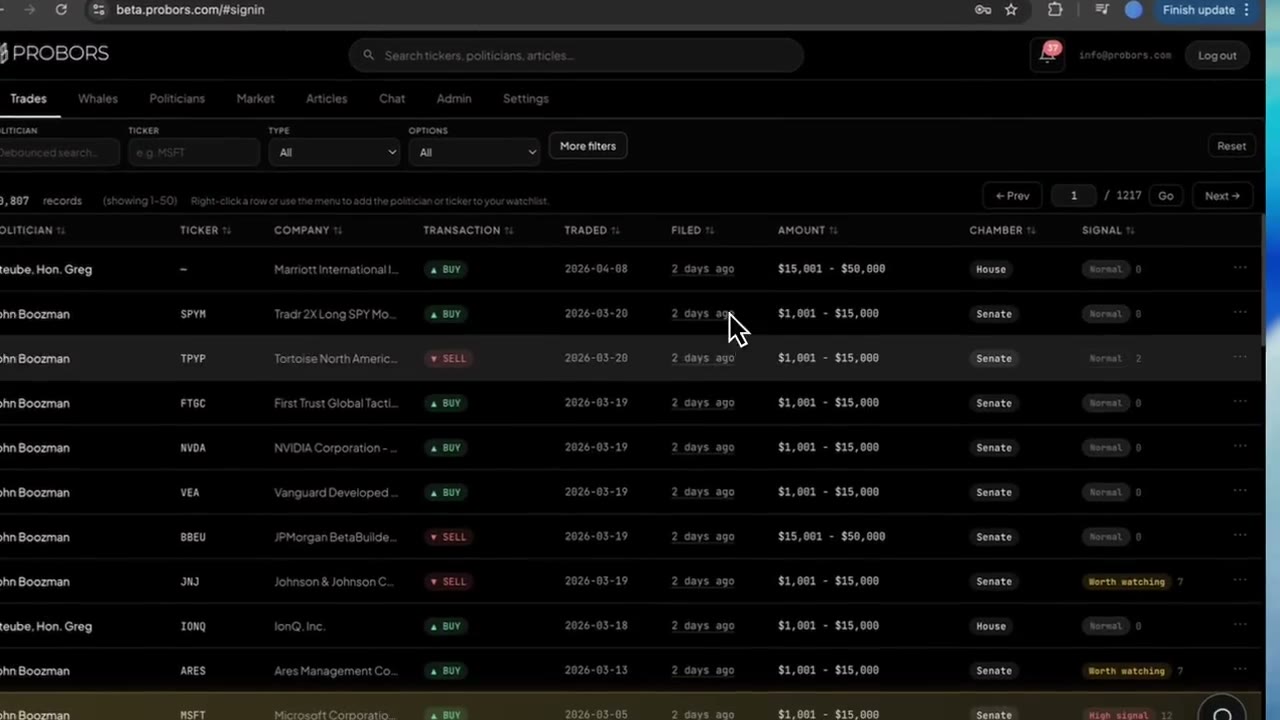
Family LLC and private-entity congressional disclosures show up without a stock ticker: the asset line names the LLC, sometimes labels the interest as a hedge fund, and may repeat across several amount brackets on one filing date. That pattern is easy to misread as “16 separate stock trades” when it is one Senate batch describing alternative investments. ProBors lists each bracket line with transaction date, filing date, and signal labels—the workflow below helps you group those rows, verify the Senate PDF, and decide what belongs in an equity watchlist versus a private-entity note. This is research context, not investment advice.
Why LLC rows need a different pass than ticker trades
STOCK Act periodic reports cover more than listed common stock. Senators and representatives also disclose interests in family LLCs, private funds, and operating entities where no exchange symbol applies. In ProBors the ticker field may show as missing while the security description carries the entity name (for example “MH Built to Last LLC” or “Not Fade Away LLC”).
Researchers stumble when they:
- Count bracket splits as separate investment themes — one hedge-fund purchase can appear as four adjacent lines with different dollar ranges on the same trade date.
- Map LLC activity to a public equity — a family LLC sale is not a short on a mega-cap unless the filing ties the entity to that company.
- Skip signal labels on non-ticker rows — High signal and Worth watching tiers still reflect size, batch context, and lag; they are triage flags, not trade recommendations.
- Ignore filing lag on private entities — August trade dates filed in late September are normal in Senate batches; lag discipline still applies.
Treat LLC lines as a sibling workflow to non-equity congressional disclosures and large batch triage, with extra emphasis on entity names and bracket splitting.
Six-step workflow on ProBors
-
Sort by filing date, then open the politician profile. Start from the congressional trades feed sorted by filing date descending so a single Senate dump (for example a September 28 batch) stays together. Open the member’s profile before you export notes—LLC clusters are member-specific, not ticker-specific.
-
Read the first line of the security description, not the ticker column. When the ticker is blank, the LLC name is the identifier. Copy the exact entity string into your memo; do not substitute a guessed public symbol.
-
Group rows by entity + transaction type + trade date. Lines that share the same LLC, purchase or sale label, and transaction date but differ only by amount bracket are usually one economic event split across PTR brackets. Collapse them for narrative counts; keep each bracket in your table if you are auditing against the PDF line by line.
-
Compute filing lag per grouped event. Use calendar days between transaction date and filing date. LLC rows often carry longer lag than a timely House equity PTR—note that in prose (“filed about five weeks after the trade”) without treating delay as proof of wrongdoing. See STOCK Act filing delay explained.
-
Prioritize signal tier inside the batch, then open the Senate PDF. Start with High signal and Worth watching LLC lines. Follow the source link on any row you might cite. Confirm entity name, transaction type, amount bracket, and whether the description says hedge fund, operating company, or other asset class. Use how to verify congressional trade disclosures before sharing before publishing.
-
Route outcomes to the right research bucket. Equity watchlists get tickers with symbols. LLC notes stay in a private-entity appendix with entity name, direction, trade date, filing date, lag, and bracket text. Cross-link to congress trades filed early October 2026 when you want a recent example of a Senate-heavy, LLC-heavy filing week.
Examples: one filing date, many LLC lines
Recent filings in ProBors as of October 8, 2026 illustrate bracket splitting after deduplication—identical politician, entity (first line of description), type, trade date, filing date, amount, and chamber appear once.
| Politician | Chamber | Entity (from description) | Type | Traded | Filed | Lag | Amount range | Signal |
|---|---|---|---|---|---|---|---|---|
| Richard Blumenthal | Senate | MH Built to Last LLC | Sale | August 19, 2026 | September 28, 2026 | 40 days | $100,001–$250,000 | High signal |
| Richard Blumenthal | Senate | Not Fade Away LLC | Purchase | September 11, 2026 | September 28, 2026 | 17 days | $250,001–$500,000 | Worth watching |
| Richard Blumenthal | Senate | Days Between LLC | Purchase | August 27, 2026 | September 28, 2026 | 32 days | $100,001–$250,000 | Worth watching |
How to read this without overfitting:
- MH Built to Last LLC sale is a private-entity disposition with a 40-day lag and a High signal label in ProBors—verify the Senate PDF before citing the bracket; it is not a listed equity sale.
- Not Fade Away LLC shows as a hedge-fund-style purchase with a 17-day lag; additional bracket lines on the same trade date may exist in the raw feed—group before you count “how many trades.”
- Days Between LLC shares the same September 28 filing date as the other rows but a different August trade date—batch filing date does not mean all trades happened the same week.
Common LLC disclosure mistakes
- Headlining “Senator bought four stocks” from four brackets on one LLC purchase.
- Adding LLC names to a ticker alert feed — they will never match a symbol filter.
- Dropping entity type language — when the filing says hedge fund or operating LLC, keep that phrase in your summary.
- Treating High signal on an LLC row as equity momentum — signal scores summarize disclosure context, not market direction.
- Skipping deduplication when comparing week-over-week row counts across congressional filing snapshots.
What this does not prove
LLC-aware research clarifies what entity changed hands, when it was reported, and how brackets split in the public record. It does not prove the member controlled day-to-day investment decisions, had non-public information, or traded through the LLC to obscure a listed stock. Amount fields remain ranges, not exact dollars. Even a verified hedge-fund purchase line is a lagging disclosure—not investment advice.
FAQ
Are family LLC disclosures limited to the Senate?
No. House PTRs can include LLCs, trusts, and fund interests too. Recent high-row-count LLC clusters in ProBors have been Senate-heavy, but the same grouping and PDF rules apply in both chambers. See House vs Senate PTR deadlines explained.
Should I dedupe LLC rows with the same trade date?
For narrative counts, yes—group by entity, type, and trade date. For audit work, keep each bracket line until the PDF confirms whether the form reported one transaction or multiple.
Why does ProBors show several Not Fade Away LLC lines on one date?
Periodic reports often repeat amount brackets as separate lines. That inflates raw row counts in a weekly review unless you group first.
Can LLC disclosures relate to a stock I follow?
Only when the filing text or an underlying fund document names a public issuer—and even then the disclosed asset is usually the fund or LLC interest, not a direct share count. Do not infer a ticker trade without reading the source.
Where do I check whether LLC data is current?
Use the ProBors data status page for ingestion health, then confirm any cited row in the original Senate or House filing.
Triage LLC rows with structured congressional data
Sort by filing date, open politician profiles, and verify private-entity lines on ProBors before they hit your watchlist.
Get startedRelated reading
- Congress trades filed early October 2026
- How to research non-equity congressional disclosures
- How to research large congressional disclosure batches
- Senate stock trading tracker
- How to write a congress disclosure research memo
Sources
- STOCK Act (S. 2038, 112th Congress)
- Senate Select Committee on Ethics — Financial Disclosure
- Senate eFD search
- House Clerk financial disclosure portal
- Rows were checked in ProBors and should be verified against the original filing.
- ProBors data status for ingestion health.
Sources & methodology
Last updated:
ProBors uses public disclosure records, SEC filings, House and Senate financial disclosure portals, market data, and in-product workflow checks. Articles are written as research education, not investment advice.