Congressional crypto disclosures show up in the same Periodic Transaction Report (PTR) feeds as Apple or Microsoft—but the asset line might describe direct Bitcoin, an Ethereum purchase, a crypto-linked ETF, or shares of an exchange operator. Treating every BTC or COIN row as the same bet is one of the fastest ways to misread STOCK Act data. ProBors indexes those lines with transaction dates, filing dates, amount brackets, and chamber tags; your job is to separate the asset type, confirm the owner field in the source PDF, and note filing lag before you attribute a “crypto trade” to a member. This is research context, not investment advice.
Three ways “crypto” appears on a PTR
Congressional ethics rules focus on reportable securities transactions, not on how researchers bucket narratives. In practice, digital-asset exposure in public PTRs usually falls into three buckets:
| What you see | What it usually means | Research note |
|---|---|---|
| Asset described as Bitcoin, Ethereum, or similar | Direct digital-asset transaction line on the PTR | Ticker fields may show BTC or ETH, but the PDF description is authoritative |
| Listed equity tied to crypto markets (for example exchange operators) | Common-stock purchase or sale like any other equity | This is equity exposure to the business, not a wallet transfer |
| ETF or fund with crypto exposure | Fund share purchase or sale | Read the fund name; do not assume spot-coin ownership |
The STOCK Act did not create a separate “crypto form.” Filers use the same House and Senate periodic transaction workflows as for other reportable securities. House ethics PTR guidance and Senate eFD instructions still turn on transaction type, amount, and timing—not on whether the headline ticker is trendy.
Examples from recent filings in ProBors
Recent filings in ProBors as of October 11, 2026 illustrate how differently these lines can look. Amounts are statutory ranges, not exact dollars.
| Politician | Chamber | Ticker / asset | Type | Trade date | Filed | Amount bracket |
|---|---|---|---|---|---|---|
| Rep. Byron Donalds | House | BTC (Bitcoin) | Buy | Jan 8, 2026 | Jan 13, 2026 | $1,001–$15,000 |
| Rep. Gilbert Cisneros | House | COIN (Coinbase Global) | Sale | Aug 18, 2026 | Sep 4, 2026 | $1,001–$15,000 |
| Sen. Alan Armstrong | Senate | COIN (Coinbase Global) | Purchase | Mar 27, 2026 | Jul 21, 2026 | $1,001–$15,000 |
| Rep. Michael Collins Jr. | House | ETH (Ethereum) | Buy | May 1, 2025 | May 1, 2025 | $1,001–$15,000 |
Filing lag varies sharply: Rep. Donalds’s January Bitcoin line was filed five days after the trade date, while Sen. Armstrong’s Coinbase purchase was filed about four months later—still a question for the official Senate PDF and ethics timing rules, not proof of wrongdoing by itself. Rep. Cisneros’s August Coinbase sale carried a 17-day gap between trade and filing.
None of these rows tell you wallet addresses, coin quantity, or whether the member still holds the asset today.
Common mistakes when reading crypto PTR lines
-
Equating COIN with self-custodied Bitcoin. Coinbase Global is a listed company; a COIN sale is a stock disposition unless the filing text says otherwise.
-
Ignoring the asset description when the ticker is generic.
BTCandETHrows still need a PDF check—some filers describe the instrument in prose that clarifies custody or account type. -
Skipping owner codes. Spouse, joint, or dependent-account lines change attribution and can shift filing-lag expectations; see spouse and joint account disclosures.
-
Treating amount brackets as position size. A $1,001–$15,000 purchase bracket does not map cleanly to coins purchased at spot; use brackets for magnitude only.
-
Assuming complete coverage. Sub-threshold trades, certain trust structures, and holdings without a reportable transaction may never appear on PTRs—see STOCK Act disclosure limits.
-
Confusing ETF tickers with direct coin. Bitcoin-strategy ETFs and spot-ETF products belong in the fund bucket until the filing text proves otherwise.
How to research crypto-related congressional rows on ProBors
-
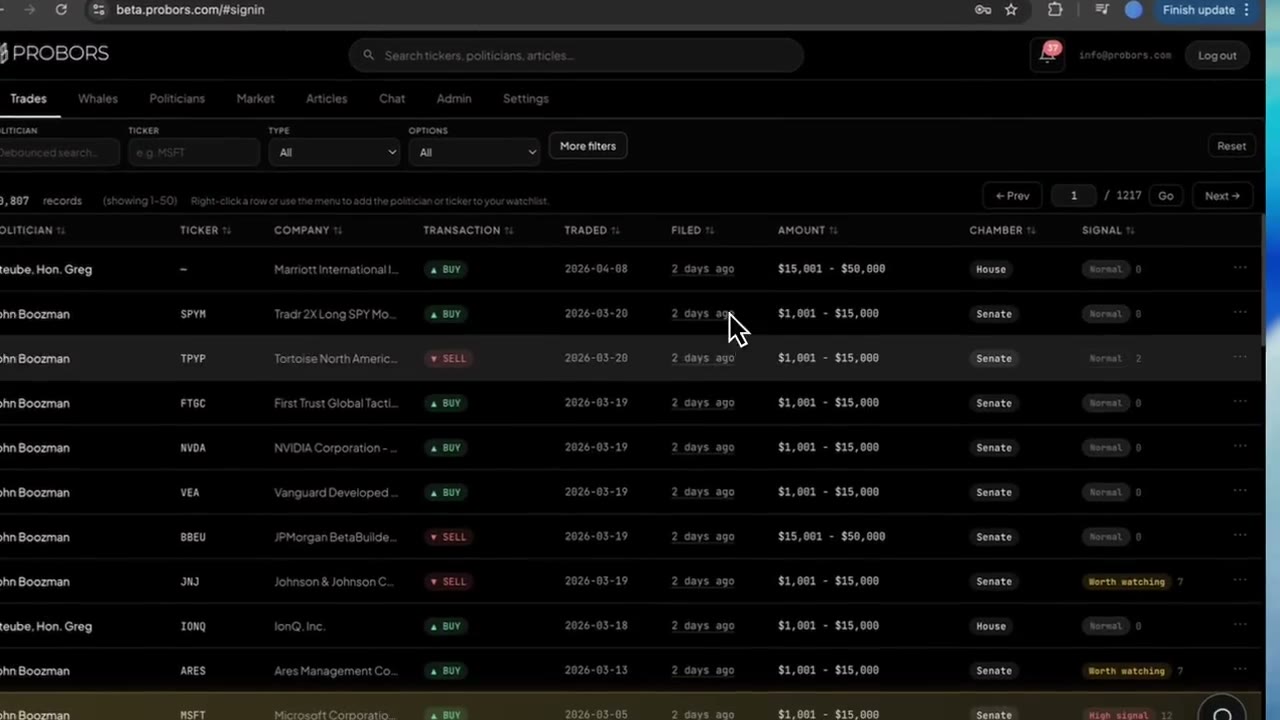
Start from Congressional trades on probors.com and search the ticker you care about (
BTC,ETH,COIN,MSTR, or an ETF symbol)—or open a politician profile if the story is member-specific. -
Read the security description column, not only the ticker. If the line looks like a bond, fund, or structured product, switch to the non-equity disclosure workflow.
-
Log trade date and filing date separately and write lag in plain language (for example “filed about two weeks after the trade”).
-
Open the official source link from the row and confirm transaction type, amount checkbox, and owner field against the House Clerk or Senate eFD document.
-
Compare chambers when the same ticker appears in both—House PTRs often arrive on a different cadence than Senate periodic batches.
-
Cross-check for amendments before sharing; corrected crypto lines have the same supersession risk as any other PTR.
-
Note data freshness on probors.com/status if you expect a filing that has not landed yet.
What this does not prove
A congressional crypto or crypto-adjacent PTR line does not prove the member traded on non-public information, timed a policy vote, or holds a specific coin balance now. It also does not prove that every digital-asset position is visible in public data—PTRs are event logs with statutory floors and form limits. Use these rows to ask better questions, not to justify trades.
FAQ
Does Congress file a separate form for cryptocurrency?
No separate public “crypto PTR” exists. Members report qualifying transactions on the same periodic transaction reports used for other securities, following House and Senate ethics instructions.
Why do some Bitcoin rows show a BTC ticker while others do not?
Parsing and filer practice vary. When ProBors shows -- or a sparse description, treat the linked PDF as the source of truth rather than forcing a ticker narrative.
Are crypto ETF purchases the same as buying Bitcoin on a PTR?
Not necessarily. An ETF line is usually a fund share transaction. Read the fund name in the filing before describing the trade as “buying Bitcoin.”
Can filing lag be longer for crypto trades?
Lag follows STOCK Act timing and office workflow, not the asset class. Senate batches in particular can list older trade dates on a newer filing date—use lag screening like any other row.
Where should I verify a row before publishing?
Use the official House Clerk and Senate eFD portals linked from the disclosure, compare dates and brackets line by line, and follow how to verify congressional trade disclosures before sharing.
Track crypto-related PTR lines with context
Filter congressional trades by ticker, open source filings, and watch politicians on ProBors.
Get startedRelated reading
- STOCK Act disclosure limits explained
- How to read politician trade disclosures
- How to research non-equity congressional disclosures
- Track Congress stock trades by ticker
Sources
- STOCK Act (S. 2038, 112th Congress)
- House Committee on Ethics — Periodic Transaction Report (PTR)
- U.S. House Clerk — Financial Disclosure
- U.S. Senate eFD search
- Rows were checked in ProBors and should be verified against the original filing.
- Ingestion health: probors.com/status
Sources & methodology
Last updated:
ProBors uses public disclosure records, SEC filings, House and Senate financial disclosure portals, market data, and in-product workflow checks. Articles are written as research education, not investment advice.