CRWD whale insider sales remain one of the clearest sell-heavy patterns on ProBors as of October 13, 2026. In the last 14 days, CrowdStrike shows 79 whale-class Form 4 prints, 77 open-market sales, zero purchases, and about $103.9 million in net reported selling. CEO George Kurtz filed code S sales on every business day from September 24 through October 7, 2026, with daily totals near $2.5 million to $2.8 million split across multiple lines. President Michael Sentonas added a separate $16.4 million sale cluster on September 30. This guide explains how to read that officer mix, triage Kurtz’s daily tranches versus one-off executive sales, and what the whale board does not prove. It is research context, not investment advice.
Why CRWD still dominates cybersecurity whale flow
CrowdStrike sits in a different bucket than fund-distribution waves on DELL or biotech disposition clusters on NUVL. Three patterns explain why CRWD stays near the top of the 14-day leaderboard even as buy-side names like KOD break into the mix:
- Sustained CEO open-market sales. Kurtz filed code S sales across ten consecutive trade dates in late September and early October, with each day totaling roughly $2.5 million to $2.8 million across up to eleven Form 4 lines.
- A large president sale on one date. Sentonas filed a $16,421,179 open-market sale on September 30, 2026 (filed October 2)—a separate research bucket from Kurtz’s daily rhythm.
- Other officers joined on October 1. Sameer K. Gandhi and chief accounting officer Anurag Saha filed multi-million-dollar code S lines the same trade date, filed October 5 with a four-day lag.
Whale leaderboards rank by print frequency and reported value. CRWD is loud because several C-suite officers filed large open-market sales in the same two-week window—not because a single headline exit explains the whole board.
Recent CRWD whale filings in ProBors
The table below shows deduplicated whale rows from ProBors as of October 13, 2026. Each row is a distinct open-market sale (code S) chosen to illustrate officer role and trade-date clustering. Dollar amounts are shown as positive values for readability; they match reported values indexed in ProBors.
| Insider | Role | Type | Traded | Filed | Lag | Reported value | Signal |
|---|---|---|---|---|---|---|---|
| Michael Sentonas | President | Sale | September 30, 2026 | October 2, 2026 | 2 days | $16,421,179 | 5 |
| Sameer K. Gandhi | — | Sale | October 1, 2026 | October 5, 2026 | 4 days | $4,609,880 | 5 |
| Anurag Saha | Chief Accounting Officer | Sale | October 1, 2026 | October 5, 2026 | 4 days | $2,376,335 | 5 |
| George Kurtz | President and CEO | Sale | October 6, 2026 | October 8, 2026 | 2 days | $1,060,580 | 5 |
| George Kurtz | President and CEO | Sale | October 5, 2026 | October 6, 2026 | 1 day | $1,381,719 | 5 |
| George Kurtz | President and CEO | Sale | October 2, 2026 | October 6, 2026 | 4 days | $1,347,000 | 5 |
| George Kurtz | President and CEO | Sale | September 30, 2026 | October 2, 2026 | 2 days | $1,078,343 | 5 |
| George Kurtz | President and CEO | Sale | September 28, 2026 | September 30, 2026 | 2 days | $915,187 | 5 |
Filing lag on Kurtz’s October 5 trade is one calendar day—routine for officer sales. October 1 officer sales from Gandhi and Saha filed October 5 show a four-day gap; worth a footnote read on the original Form 4, but still within a normal reporting window for multi-line batches.
A five-step triage framework for CRWD officer waves
Use the same checklist when a liquid cybersecurity name stays on the whale board through sustained code S flow.
1. Read the SEC transaction code first
Open-market sales use code S. Option exercises (M), tax withholding (F), and grants (A) are different economic events. The October window on CRWD is overwhelmingly code S on officer rows—filter here before you treat every whale print as discretionary selling.
2. Measure daily tranches, not individual lines
Eleven code S lines on October 7, 2026 totaling about $2.7 million are one distribution event split across tranches. Kurtz’s daily clusters from September 24 through October 7 each land near $2.5 million to $2.8 million when you sum lines by trade date—a shape that often reflects a pre-scheduled plan rather than ad-hoc selling.
3. Separate CEO rhythm from one-off executive sales
Sentonas’s $16.4 million September 30 cluster is a separate bucket from Kurtz’s multi-week daily cadence. Gandhi and Saha sales on October 1 add a third officer layer on one date—they do not automatically confirm the same thesis as the CEO program. Tag holder role before you merge narratives.
4. Compare to the 14-day whale leaderboard
CRWD at 79 prints and zero buys ranks among the loudest sell-heavy names in mid-October 2026, behind high print-count names like UTHR and PKOH but still carrying tens of millions in net reported selling. CACI in the same window is driven by grants and tax withholding—not open-market code S flow—so leaderboard rank alone does not make every defense contractor comparable to CrowdStrike. For broader board context, see top whale tickers in early October 2026.
5. Cross-check congressional and chart context
Congressional PTR rows on CRWD in ProBors are sparse relative to insider volume and mostly dated earlier in 2026—for example modest House purchases filed in summer 2026, not in the current officer sale window. No recent House or Senate overlap confirms or contradicts the whale wave. Open the CRWD workspace on ProBors to compare price action, insider flow, and any politician markers on one chart.
How to research CRWD whale flow on ProBors
- Open the Whales tab and filter by ticker CRWD.
- Sort by filing date (newest first) to catch Kurtz’s latest daily tranche.
- Read transaction codes and insider names before sorting by reported value—exercise-and-sell mechanics can inflate the queue on the same trade dates.
- Group rows by trade date and sum reported value to see whether daily totals follow a repeating pattern.
- Note signal scores as a second sort. Scores of 5 flag attention on multi-million-dollar officer sales but do not prove bearish intent—read footnotes for 10b5-1 plan references on the original filing.
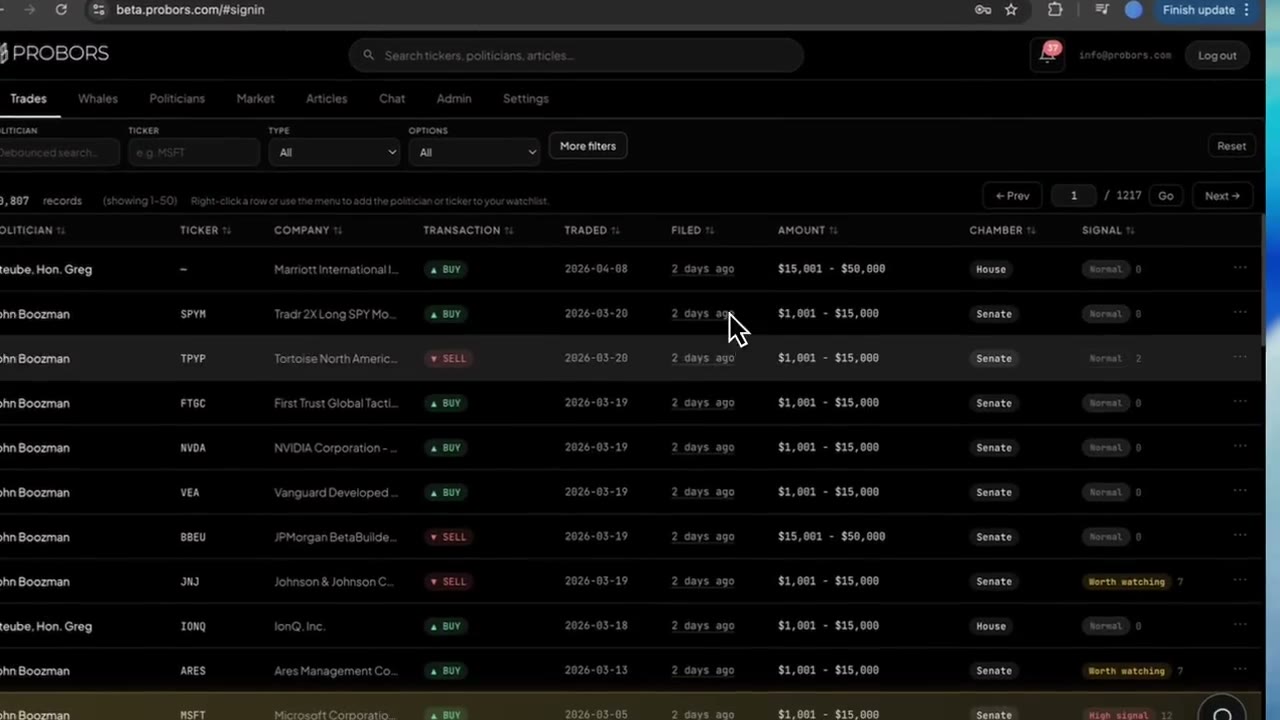
- Switch to the Trades tab with the same ticker to see whether any House or Senate PTRs overlap your insider window.
- Add CRWD to a watchlist if you want alerts when the next officer batch arrives. See ProBors watchlist alerts for setup steps.
For broader whale triage habits, see how to triage whale transactions on ProBors.
What this does not prove
Sustained CRWD whale selling in early October 2026 does not prove:
- That CrowdStrike management expects weaker product demand or security incident outcomes.
- That Kurtz’s daily $2.5 million to $2.8 million cadence is discretionary rather than plan-driven—many officer sale programs follow pre-set schedules.
- That Sentonas’s $16.4 million September 30 cluster confirms the same thesis as the CEO’s multi-week rhythm.
- That summer 2026 congressional purchases validate or contradict current insider flow.
- That signal scores alone justify a trade—the scores prioritize research attention, not outcomes.
Form 4 disclosures document what was filed and when. They do not reveal motive, plan type, or whether a sale was tax-driven, estate planning, or pre-scheduled.
FAQ
Why does Kurtz file roughly $2.5 million in sales many days in a row?
Multi-line daily clusters near the same dollar total often reflect a Rule 10b5-1 trading plan or similar pre-scheduled program. ProBors indexes each Form 4 line separately, which inflates print count. Read the footnotes on the original filing before treating the rhythm as discretionary selling.
How is Sentonas’s September 30 sale different from Kurtz’s daily flow?
Sentonas’s $16,421,179 sale on one trade date is a single large officer event. Kurtz’s program spans ten business days with smaller tranches per line. Keep president and CEO buckets separate in your notes.
Does CRWD still show zero open-market buys on the whale board?
In the 14 days through October 13, 2026, ProBors shows zero whale-class purchases on CRWD against 77 sales. That sell-heavy split is the backdrop for interpreting any individual officer row.
Is there recent congressional activity on CRWD?
ProBors shows modest House PTR purchases on CRWD filed in mid-2026—not in the late-September insider window covered here. Congressional brackets are wide; they do not confirm officer sale motives. See how to combine congress and insider research for a dual-feed workflow.
Where do I verify a specific row?
Open the filing link on SEC EDGAR and compare transaction codes, share counts, and footnotes to the ProBors row. Check ProBors data status if a filing looks missing or delayed.
Track CRWD insider and whale flow in one workspace
Filter CrowdStrike Form 4 rows, signal scores, and congressional markers on ProBors—without juggling separate tools.
Get startedRelated reading
- Top whale tickers in early October 2026
- How to triage whale transactions on ProBors
- ProBors Whales tab guide
- How ProBors trade signal scores work
Sources
- SEC Form 4 overview
- STOCK Act and congressional disclosure context (for comparing PTR timing, not insider Form 4 rules)
- SEC EDGAR search
- Rows were checked in ProBors and should be verified against the original filing.
- Ingestion health: probors.com/status
Sources & methodology
Last updated:
ProBors uses public disclosure records, SEC filings, House and Senate financial disclosure portals, market data, and in-product workflow checks. Articles are written as research education, not investment advice.