Congressional ETF disclosures sit in the same Periodic Transaction Report feeds as single-stock lines, but they answer a different research question. A Senate sale of a commodity-strategy fund is usually portfolio allocation—not a bet against one company—and a House trim of an S&P 500 index fund is not the same story as selling an individual mega-cap name. ProBors indexes ETF tickers with transaction dates, filing dates, amount brackets, and chamber tags so you can separate fund flows from stock picks before you open the source PDF. This seven-step workflow walks through that ETF-first habit on probors.com. This is research context, not investment advice.
Why ETF rows need their own pass
Index and sector funds show up constantly in STOCK Act data:
- Broad market exposure (for example S&P 500 or total-market ETFs) often reflects rebalancing, not a directional call on one issuer.
- Sector or thematic funds bundle dozens of names; a headline that says "Senator sold tech" may be a single ETF line.
- Senate periodic batches can file many ETF sales from months earlier in one PDF—lag and clustering matter more than for a same-week House PTR.
Skipping an ETF filter is how commodity-fund sales become "dumped commodities stocks" or how a small Russell 2000 ETF trim turns into a small-cap bearish narrative.
Seven-step ETF workflow on ProBors
-
State the question in fund terms. Before you search, decide whether you care about a specific ETF ticker (VOO, IWM, FTGC), a politician's allocation pattern, or "any fund line this week." ETF research is usually about exposure and timing, not earnings catalysts on one symbol.
-
Check freshness on the status page. Open probors.com/status so you know House PTR, Senate periodic, and related feeds are current. A quiet House week with a heavy Senate backlog changes which chamber will dominate your ETF table.
-
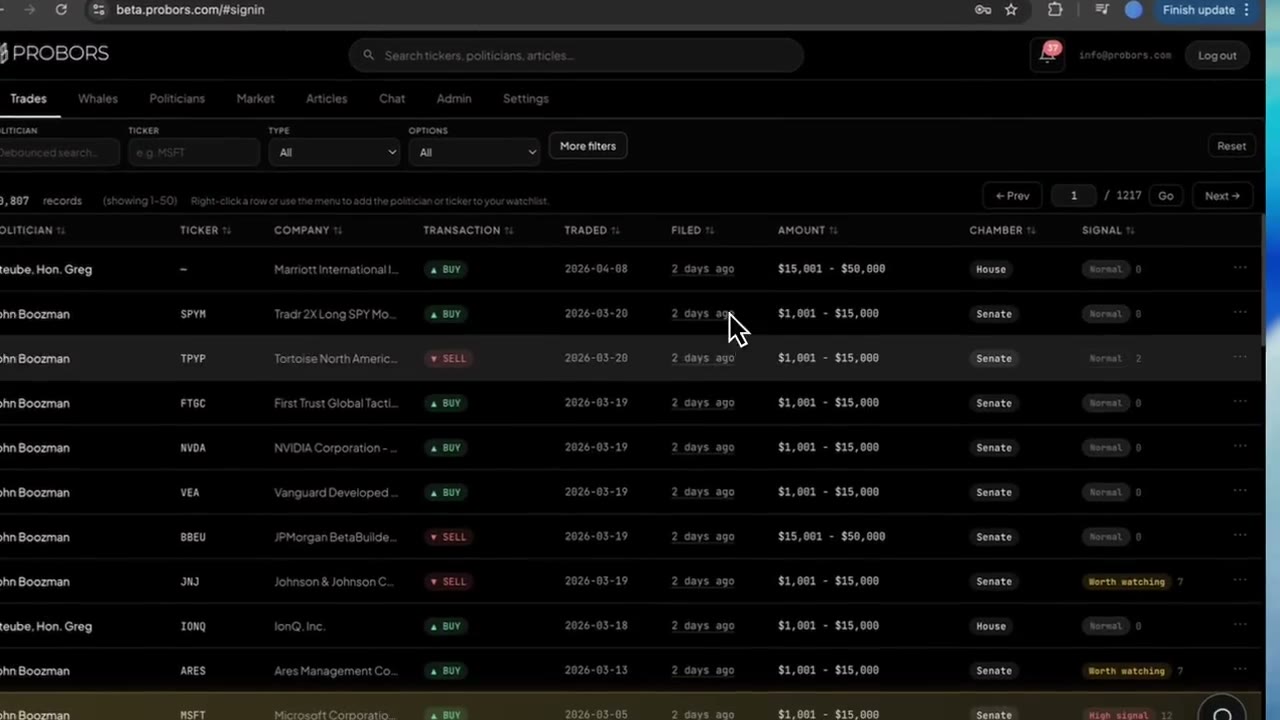
Search the ETF ticker, then split by chamber. In Congressional trades, filter by your fund symbol. Run House and Senate views separately. Senate ETF sales filed in August can carry November trade dates; House index-fund lines often cluster with shorter lag. Do not merge chambers into one timeline.
-
Read the security description, not only the ticker. ProBors maps many fund names to tickers, but the PTR text is the authority for fund family, share class, and whether the line is exchange-traded fund shares versus a similarly named mutual fund. If the description reads like a long legal fund name, treat it as a fund row even when the ticker looks like a stock.
-
Filter transaction type before narrative. Use purchase vs sale (and partial sale when labeled) filters so ETF purchases do not get averaged with sales on the same symbol. See how to filter congress trades by transaction type for type-first habits that apply directly to funds.
-
Log filing lag per row and per batch. Compute calendar days from transaction date to filing date. Express lag in plain language ("18-day lag", "about nine months") and note when multiple ETF lines share one filing date—that is a batch event, not necessarily a single trading day. For backlog patterns, pair this step with how to trace a politician's disclosure history on ProBors.
-
Verify in the original filing, then watchlist. Open the linked House or Senate PDF, confirm owner account (spouse, trust, IRA), and only then add the ticker or politician to a watchlist. ETF lines are easy to misquote in social posts because the fund name is long and the economic story is dull compared with a single-stock purchase.
Examples from recent filings
Recent filings in ProBors as of October 15, 2026 show three common ETF patterns: a timely Senate commodity-fund sale, a Senate backlog line on a small-cap index ETF, and a House S&P 500 fund trim with typical House lag.
| Politician | Chamber | Ticker | Type | Traded | Filed | Lag | Amount | Signal |
|---|---|---|---|---|---|---|---|---|
| John Boozman | Senate | FTGC | Sale | June 25, 2026 | July 13, 2026 | 18 days | $1,001–$15,000 | Normal |
| John Boozman | Senate | IWM | Sale | November 21, 2025 | August 24, 2026 | 276 days | $1,001–$15,000 | — |
| Michael McCaul | House | VOO | Sale | January 26, 2026 | February 5, 2026 | 10 days | $1,001–$15,000 | — |
How to read this without overfitting:
- Boozman / FTGC (Normal) is a modest Senate sale of a tactical commodity-strategy fund with an 18-day lag—allocation housekeeping inside a periodic report, not a single-company exit.
- Boozman / IWM shares a filing date with other long-dated Senate ETF lines; the 276-day lag means the Russell 2000 ETF sale happened in late 2025 and became public in August 2026. Member history matters more than the ticker alone.
- McCaul / VOO is a small-bracket House sale of an S&P 500 index ETF with 10-day lag—typical index-fund trimming, not a verdict on every large-cap name in the index.
Use the table as a template: fund ticker → chamber split → lag → type → PDF owner check.
Common mistakes with congressional ETF lines
- Treating an ETF sale as a stock thesis. Selling VOO is not the same as selling every S&P 500 constituent.
- Ignoring batch filing dates. One Senate submission date can carry a dozen fund lines from different months.
- Pooling House and Senate ETF rows without comparing lag distributions.
- Skipping partial-sale labels on fund lines when they appear—partial trims are routine on broad ETFs.
- Forcing mutual-fund or note lines into an ETF ticker search when the description has no listed symbol. Route those to non-equity congressional disclosure research.
What this does not prove
An ETF purchase or sale in a PTR does not prove macro forecasting skill, committee foreknowledge, or coordination between members. Amount brackets are ranges, not exact dollars. Signal labels on fund rows prioritize attention inside ProBors—they are not trade instructions. Long Senate lag can mean the market fully priced the underlying index move before the filing appeared. Always verify owner, fund name, and transaction type in the original disclosure.
FAQ
Are congressional ETF trades reported the same way as stock trades?
Yes on form structure—transaction date, amount range, and buy/sell disposition—but the economic meaning differs. Funds bundle many underlying holdings, so the PTR line describes fund shares, not a single issuer earnings story.
Should I research ETFs before or after single-stock filters?
If your narrative is sector or index exposure, start with ETF tickers (or fund-name search) and exclude them from a "Congress bought this company" tally. If your narrative is one issuer, exclude known index-fund tickers from that issuer search so VOO or QQQ lines do not pollute the table.
How do partial sales on ETFs appear in ProBors?
When the source filing labels a partial disposition, the transaction type reflects Sale (Partial) or equivalent wording. Filter on that type so full exits and trims stay in separate buckets—especially on broad market funds where partial sales are common.
Why do Senate ETF rows often show longer lag than House lines?
Senate periodic reporting habits and batch uploads produce multi-week or multi-month gaps more often than same-week House PTR cycles. Lag is a disclosure-timing fact, not a data error—log it before you compare ETF activity across chambers.
Can the same politician file multiple ETF types in one month?
Yes. A member can buy a total-market fund while selling a sector ETF, or file several sales from one statement date. Search by politician profile and sort by filing date to see clusters instead of treating each row as an independent decision day.
Separate ETF lines from stock picks on ProBors
Filter congressional trades by ticker and chamber, read lag and transaction type, then confirm fund names in the original PTR before you cite a row.
Get startedRelated reading
- How to filter congress trades by transaction type
- How to research non-equity congressional disclosures
- How to trace a politician's disclosure history on ProBors
- Senate stock trading tracker
- How to screen congress trades by filing lag
Sources
- House Committee on Ethics — Financial Disclosure
- Senate Select Committee on Ethics — Financial Disclosure
- STOCK Act (Pub. L. 112-105)
- Rows were checked in ProBors and should be verified against the original filing.
- Ingestion health: probors.com/status
Sources & methodology
Last updated:
ProBors uses public disclosure records, SEC filings, House and Senate financial disclosure portals, market data, and in-product workflow checks. Articles are written as research education, not investment advice.