Bloomberg Terminal and Bloomberg.com are where many professionals first see markets, policy, and corporate news—including occasional stories about members of Congress trading stocks. ProBors is built for the verification layer: structured House PTR and Senate periodic transaction rows, filing lag, chamber filters, insider whale context on the same ticker, and watchlist alerts when a new disclosure lands. If you already pay for Bloomberg and wonder whether you still need a STOCK Act workspace, the short answer is that Bloomberg excels at macro and company coverage while ProBors excels at repeat PTR triage, member history, and cross-checking insiders on a symbol. This is research context, not investment advice.
Quick answer
Use Bloomberg when you need institutional-grade news, fixed income and equity analytics, earnings models, and the context that surrounds a political trading headline.
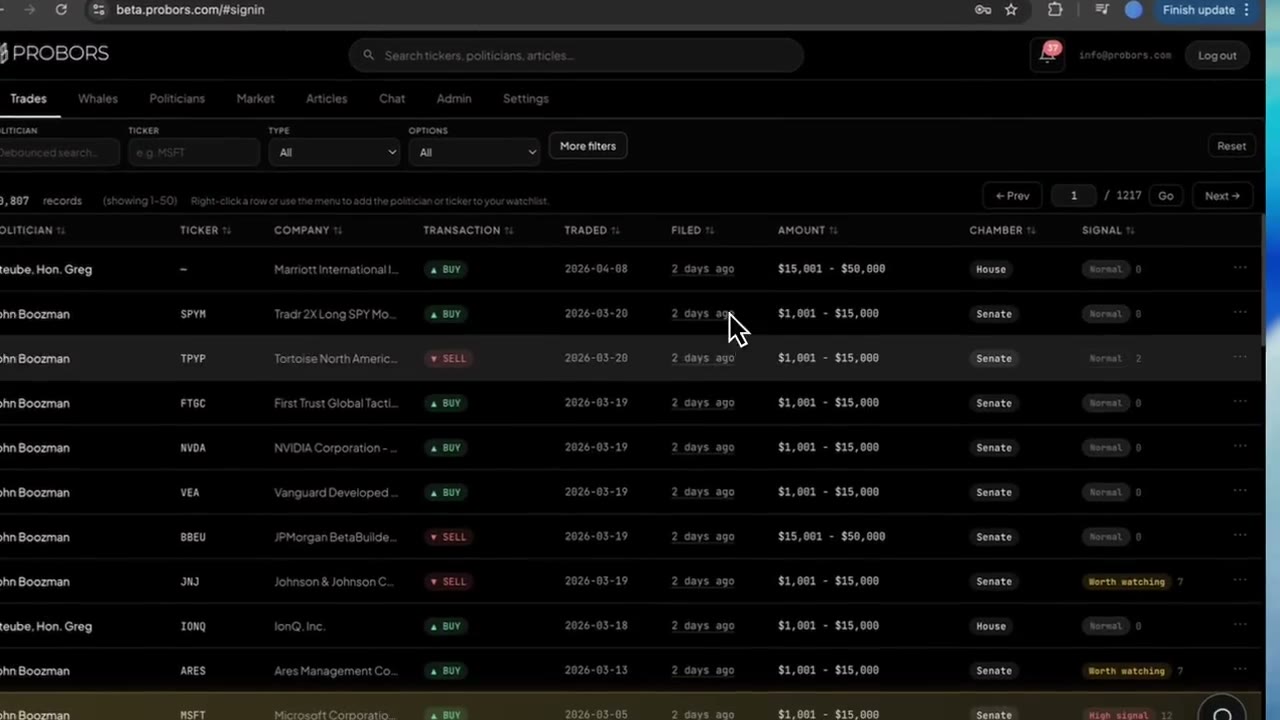
Use ProBors when congressional disclosures are part of a daily loop—search by politician or ticker, compare transaction date to filed date, review whale Form 4 activity on the same symbol, and get inbox alerts instead of hoping the story hits your terminal feed.
Many researchers keep Bloomberg for market structure and open ProBors when a PTR batch posts, a senator files a periodic report, or they need to document lag and amount brackets before citing a trade in a memo.
Side-by-side comparison
| Capability | Bloomberg (Terminal + web) | ProBors |
|---|---|---|
| Primary focus | Global markets, news, analytics, data terminals | Disclosure-first congress + insider whale workspace |
| Structured House/Senate PTR browsing | Not a dedicated STOCK Act module; stories and wires cite filings | Yes — sortable rows with chamber, dates, amount bands |
| Filing lag visibility | Rarely the centerpiece of a wire | Trade date and filed date on every row |
| Insider / Form 4 whale layer | SEC filings accessible via functions; not unified with congress rows | Yes — whale transactions with optional signal scores |
| Congressional search by politician | Manual follow-up to official sites or third-party trackers | Politician profiles and trade history in one place |
| Watchlist + alerts on new disclosures | News and price alerts; not PTR-specific | Inbox alerts on politicians and tickers you choose |
| Market charts with disclosure context | Deep charting and fundamentals | Built-in charts with optional congress markers |
| Trade signal scores for triage | No dedicated congress signal layer | Yes on congress and whale rows |
| AI tables on live disclosure data | Terminal AI features vary by license | Yes — paid tier for table-style research questions |
| Best fit | Institutional news and analytics | Daily PTR verification and cross-chamber research |
What Bloomberg does well for disclosure-adjacent research
Bloomberg’s strength is breadth: breaking wires, sector dashboards, credit and rates context, and the interview layer that explains why a policy story might matter for a ticker. When Congress and markets overlap, Bloomberg can:
- Surface politician trading as part of a broader ethics or policy narrative
- Connect a headline ticker to peers, supply chains, and macro drivers quickly
- Give fund managers the same price and news context they already use for every other thesis
That framing is valuable for understanding market attention. It does not replace opening the underlying House or Senate report to confirm owner codes, transaction type, or whether the line was amended later.
Where terminal headlines stop and ProBors starts
Professional news wires compress STOCK Act reports into a sentence or two. Researchers who publish findings, run compliance reviews, or maintain politician watchlists often need details wires skip:
- Chamber and form type — House PTR batches differ from Senate periodic reports in timing and layout.
- Owner attribution — spouse, joint, dependent, or trust lines change how you read the row.
- Transaction vs filing date — a trade from summer may not appear in public data until weeks later; lag affects how you compare price action.
- Same-ticker insider activity — a congress buy on a symbol may coincide with Form 4 sales; both layers matter for context, not as a single verdict.
- Repeat monitoring — a one-time wire does not alert you when the same member files again next month.
ProBors is designed for that loop: open the row, read dates and amount brackets, jump to the politician’s history, and optionally review whale rows on the ticker before you write up the finding.
When to choose each
Stay with Bloomberg (plus official .gov sources) if you:
- Hear about politician trading rarely and only need the institutional news frame
- Are comfortable opening House or Senate disclosure sites manually for the one name in the wire
- Do not maintain a watchlist of members or tickers tied to STOCK Act data
Add ProBors if you:
- Track more than a handful of politicians or symbols and need filing-date sorting
- Compare House and Senate activity on the same ticker without rebuilding spreadsheets
- Want insider whale context and optional signal scores on the same screen
- Need inbox alerts when a watched member files, not when an editor assigns the story
Use both if you like Bloomberg for macro and company context and ProBors for the filing table—then confirm every cited row on the original House, Senate, or SEC source before publishing.
Common mistakes when mixing terminal news and disclosure data
- Treating the wire timestamp as the filing date — the story may run days after the STOCK Act report was published.
- Assuming the headline ticker is complete — some disclosures list fund names or descriptions before a clean symbol appears in structured data.
- Ignoring amendments — a follow-up PTR can change how the first story read.
- Skipping spouse and joint lines — headlines often center the member; the filing may attribute the trade differently.
- Paying for two tools without a habit — if you only react to wires once a quarter, Bloomberg plus free official sites may be enough.
FAQ
Does Bloomberg publish every congressional stock trade?
No. Bloomberg covers newsworthy market and political stories; it does not maintain a complete, searchable database of every House PTR and Senate periodic transaction report. When a trade makes a wire, treat it as a pointer to verify—not as the authoritative record.
Can ProBors replace Bloomberg for institutional market data?
No. ProBors focuses on public disclosure rows, watchlists, and research workflows. It is not a full terminal with fixed income analytics, broker estimates, and the breadth of licensed market data Bloomberg provides.
Do compliance teams need ProBors if they already have Bloomberg?
Teams still need primary sources for STOCK Act citations. Bloomberg helps with context and timeliness; ProBors helps organize PTR rows, dates, and history before quoting amount ranges or implying timing a wire did not show.
Is either platform investment advice?
No. Both surface information for research; you decide what to do with it.
Where should I verify a row before publishing?
Use the House Clerk disclosure search or Senate eFD search, and SEC EDGAR for Form 4 insider filings when relevant.
Verify headline trades against real filings
Congress rows, insider whales, watchlists, and signal scores—on ProBors.
Get startedRelated reading
- CNBC vs ProBors: TV headlines vs congressional disclosure research
- Yahoo Finance vs ProBors: News charts vs congressional disclosure research
- Seeking Alpha vs ProBors: Congress disclosure workflow
- How to verify congressional trade disclosures before sharing
- How to read politician trade disclosures
Sources
- House Clerk — Financial Disclosure Reports
- Senate Office of Public Records — Financial Disclosures
- STOCK Act (Pub. L. 112-105)
- SEC — EDGAR Form 4 overview
- Rows were checked in ProBors and should be verified against the original filing.
- Ingestion health: probors.com/status
Sources & methodology
Last updated:
ProBors uses public disclosure records, SEC filings, House and Senate financial disclosure portals, market data, and in-product workflow checks. Articles are written as research education, not investment advice.