FDX congressional disclosures help disclosure researchers see when members of Congress report FedEx trades—not because logistics stocks predict earnings, but because PTR lines show portfolio moves with real filing lag and amount brackets. In the last 90 days, ProBors shows a short burst of House sales filed in early October 2026, plus Senate rows tied to a July filing batch for earlier trade dates. This spotlight walks through recent FedEx PTR lines, how they relate to other tickers in the same filing clusters, and what the table does not prove. It is research context, not investment advice.
Why FedEx shows up in congress trackers
FedEx (FDX) is a large-cap industrial and transport name that appears in diversified equity portfolios and sector funds. Congressional PTR activity on FDX is usually rebalancing or trimming—not a dedicated “shipping policy” bet. Useful questions on the ticker stay narrow:
- Which members filed FedEx activity with filing dates since late July 2026?
- Were recent rows purchases or sales?
- How many days passed between the transaction date and the public filing date?
- Do multiple symbols share one trade date (portfolio cluster)?
- Is Senate activity on different trade dates than the fall House sales?
A ticker spotlight should answer those fields from verified rows, then let you decide whether chart or insider context is worth a second pass.
Recent FDX filings in ProBors
The table below reflects FedEx PTR rows in ProBors as of October 19, 2026, limited to deduplicated lines with filing dates on or after July 21, 2026, sorted by filing date (newest first). Filing lag is calendar days between the transaction date and the filed date as reported in ProBors.
| Politician | Type | Traded | Filed | Lag (days) | Amount range | Chamber |
|---|---|---|---|---|---|---|
| Rick Larsen | Sale | 10/08/2026 | 10/12/2026 | 4 | $1,001 - $15,000 | House |
| Maria Elvira Salazar | Sale (Partial) | 09/24/2026 | 10/01/2026 | 7 | $1,001 - $15,000 | House |
| Gilbert Cisneros | Sale | 07/21/2026 | 08/14/2026 | 24 | $1,001 - $15,000 | House |
| Alan Armstrong | Purchase | 03/27/2026 | 07/21/2026 | 116 | $1,001 - $15,000 | Senate |
| Alan Armstrong | Sale | 03/24/2026 | 07/21/2026 | 119 | $50,001 - $100,000 | Senate |
Snapshot summary (filed since late July 2026): 5 deduplicated FDX PTR rows—1 purchase and 4 sales; 3 House and 2 Senate. For rows with 2026 transaction dates filed in this window (excluding the March-dated Senate pair), median filing lag is 7 days (range 4–24 days). ProBors holds additional historical FDX lines outside this filing window if you need a longer politician trail.
Always verify individual rows against the official source before citing them:
- House PTR search: disclosures-clerk.house.gov
- Senate eFD search: efdsearch.senate.gov
Cross-chamber patterns worth noting
Three patterns stand out in this FedEx sample—and none of them are trading signals on their own.
1. Fall House activity is sales-heavy
Rep. Rick Larsen and Rep. Maria Elvira Salazar filed sales on FDX in early October 2026, with 4-day and 7-day lags respectively. Rep. Gilbert Cisneros filed a July sale that became public in mid-August (24-day lag). Direction alone does not resolve a narrative; transport and industrial names can show offsetting member activity in other months.
2. Larsen’s October cluster spans multiple tickers
Larsen’s October 12, 2026 House filing reports an October 8, 2026 trade date on FDX (sale) alongside lines on other symbols in the same batch—including a purchase on Williams-Sonoma (WSM) and a sale on Home Depot (HD). That pattern is portfolio-style rebalancing, not a FedEx-only story. For HD context in the same cluster, see Home Depot congressional disclosures explained and the mid-October 2026 filing snapshot.
3. Senate rows can carry long lag on older trade dates
Sen. Alan Armstrong’s FedEx purchase and sale share a July 21, 2026 filing date but list March 2026 transaction dates—116 and 119 calendar days between trade and filing in ProBors. Treat those as stale-date reminders: open the Senate eFD PDF before comparing them to October House sales. For the legal timing framework, see STOCK Act filing delay explained.
How to research FDX on ProBors
Use a ticker-first workflow when FedEx is on your watchlist:
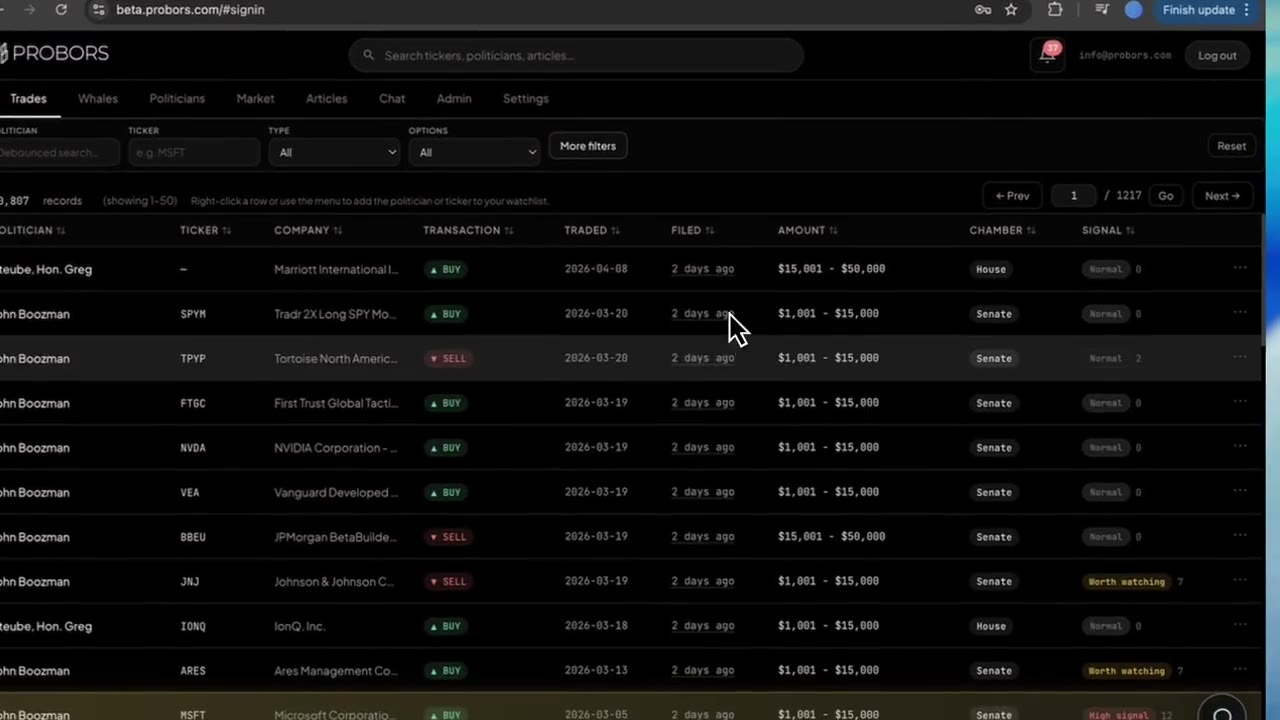
- Open Market → FDX (or search
FDXin the dashboard). - Scroll to the Congress trades table and sort by filed date.
- Click a row for transaction type, amount range, chamber, and signal tier when available.
- Toggle congress markers on the price chart to see where disclosures landed relative to daily bars.
- Filter by chamber when you want Senate-only or House-only lines on the same ticker.
- Open the politician profile when several FDX rows share one filing date—you may see other symbols in the same PTR.
For chart markers, see the market chart congress markers guide. For cross-chamber habits, see how to research a ticker across House and Senate.
What this FDX data does not prove
A congressional disclosure table on FedEx does not prove:
- That members traded on non-public information
- That FDX will rise or fall because a PTR was filed
- Exact share counts or dollar proceeds (ranges are bands, not precise fills)
- Real-time intent—many rows posted days or weeks after the transaction date
- Parcel volume, fuel cost, or macro shipping outcomes tied to a single trade line
PTR data is a public transparency record, not a timing edge. The useful output is a verified trail: who filed, what type, when it traded, when it became public, and how that row compares to other disclosures on the same ticker.
FAQ
How active is FedEx in congressional PTRs compared with other industrials?
Volume follows member portfolios, not weekly package counts. In ProBors, FDX in this 90-day filing window is sales-heavy with one Senate purchase line tied to March trade dates. For peer transport and consumer context, see track congress stock trades by ticker and PG congressional disclosures explained.
Why does Rick Larsen show FDX on the same trade date as HD and WSM?
Multiple symbols can share one trade date inside a single PTR filing. Larsen’s October 8, 2026 trade date appears on FedEx (sale) alongside other lines filed October 12, 2026—open the underlying House disclosure to confirm each line and any footnotes.
What is a typical filing lag for recent FDX disclosures?
Among rows with 2026 transaction dates filed since late July 2026 (excluding the March-dated Senate pair), median lag in ProBors is about 7 days, with a low of 4 days on Larsen’s October sale and 24 days on Cisneros’s July sale.
Can I filter FDX to sales only or Senate only?
Yes. On ProBors, filter congressional trades by ticker, transaction type, and chamber. The trades tab guide covers sort and filter habits.
Does a congressional FedEx sale mean corporate insiders also sold?
Not necessarily. PTRs and SEC Form 4 filings follow different rules and timelines. Keep congress rows and insider rows in separate lanes—see how to combine congress and insider research.
Research FDX disclosures in one workspace
Filter congressional PTRs by ticker, overlay markers on price, and cross-check insider filings on ProBors.
Get startedRelated reading
- Track congress stock trades by ticker
- How to read politician trade disclosures
- Congress trades filed mid-October 2026
- HD congressional disclosures explained
Sources
- House Financial Disclosure (PTR search)
- Senate eFD search
- STOCK Act (Pub. L. 112-105)
- SEC investor guidance on insider reporting
- Rows were checked in ProBors and should be verified against the original filing. Ingestion health: probors.com/status
Sources & methodology
Last updated:
ProBors uses public disclosure records, SEC filings, House and Senate financial disclosure portals, market data, and in-product workflow checks. Articles are written as research education, not investment advice.