Congressional stock trades filed in late October 2026 are a short, House-only week after the large mid-October batches. As of October 21, 2026, ProBors shows eleven deduplicated disclosure rows with filing dates between October 14 and October 16—five House members and no new Senate PTR lines in this window. Rep. Michael Rulli filed two same-day sales on October 16, including a $50,001–$100,000 bracket sale of Alphabet Class C (GOOG). Rep. David Taylor’s October 15 filing bundles four small-bracket lines tied mostly to October 9 trade dates. This is research context, not investment advice.
Snapshot summary
ProBors sorts congressional disclosures by filing date. In the October 14–October 16 filing window:
- 11 rows after deduplication (identical politician, ticker or asset description, transaction type, trade date, filing date, amount, and chamber removed)
- 5 politicians with at least one filing: Michael Rulli (2), David Taylor (4), Richard Allen (2), Richard McCormick (1), Mike Kelly (2)
- Chamber split: 11 House rows, 0 Senate rows
- Transaction mix: 6 purchase-type rows, 5 sales
- Signal tiers: 0 High signal, 0 Worth watching, 11 Normal
- Filing lag: 0-day minimum (Rulli’s October 16 trades filed the same day), 6-day median, 28-day maximum on a Mike Kelly municipal-bond purchase line
- Notable clusters: Rulli’s October 16 WSBC and GOOG sales; Taylor’s October 15 four-line trust batch (PG sale plus RPM, FITB, and AT&T purchases); Allen’s October 14 Costco and AutoZone sales on September trade dates
This window is much smaller than mid-October’s 63-row week, which was dominated by one large House batch. Late October reads like routine PTR housekeeping—worth logging, not treating as a market narrative.
Recent disclosures worth a closer look
The table below shows deduplicated rows from ProBors as of October 21, 2026. Lag is calendar days between transaction date and filing date as reported in each disclosure.
| Politician | Chamber | Ticker / asset | Type | Traded | Filed | Lag | Amount range | Signal |
|---|---|---|---|---|---|---|---|---|
| Michael Rulli | House | GOOG | Sale | October 16, 2026 | October 16, 2026 | 0 | $50,001–$100,000 | Normal |
| Michael Rulli | House | WSBC | Sale | October 16, 2026 | October 16, 2026 | 0 | $1,001–$15,000 | Normal |
| David Taylor | House | PG (Procter & Gamble) | Sale | October 12, 2026 | October 15, 2026 | 3 | $1,001–$15,000 | Normal |
| David Taylor | House | RPM | Purchase | October 9, 2026 | October 15, 2026 | 6 | $1,001–$15,000 | Normal |
| Richard Allen | House | AZO (AutoZone) | Sale | September 22, 2026 | October 14, 2026 | 22 | $15,001–$50,000 | Normal |
| Richard McCormick | House | BRK.B | Purchase | September 18, 2026 | October 14, 2026 | 26 | $1,001–$15,000 | Normal |
| Mike Kelly | House | California Community Choice financing authority bonds (no equity ticker) | Purchase | September 16, 2026 | October 14, 2026 | 28 | $50,001–$100,000 | Normal |
How to read this without overfitting:
- Rulli’s same-day GOOG sale is the largest bracket in this snapshot. ProBors flags it Normal—not because the dollar range is small, but because none of the cross-filing context rules in this window pushed it to Worth watching. For Alphabet disclosure history across chambers, see Google congressional disclosures explained.
- Taylor’s October 15 cluster mixes one October 12 PG sale with October 9 purchases in RPM, Fifth Third (FITB), and AT&T (T). PTR text references a trust account—read it as one filing event, not four unrelated bets.
- Allen’s October 14 pair reports September sales in AutoZone and Costco (COST). Both carry Normal signal tiers with reversal-style context on the equity lines.
- McCormick’s BRK.B purchase is a small bracket with a 26-day lag from a September 18 trade date—typical periodic-report timing, not a live feed.
- Kelly’s bond lines (including a separate October 14 call-option purchase on a gas-district revenue bond without a stock ticker) are fixed-income disclosures. Do not map them to an equity watchlist without reading the House PDF.
Filing lag in plain language
STOCK Act disclosures are periodic reports, not live trade feeds. In this late-October snapshot:
- Fastest filings: Rulli’s October 16 WSBC and GOOG sales were filed the same day as the reported trade dates (0-day lag).
- Trust batch timing: Taylor’s October 15 filing covers October 9 and October 12 trade dates—mostly 3- to 6-day lag on the equity lines shown above.
- Older trade dates: Allen’s AutoZone sale (traded September 22, filed October 14) shows a 22-day lag. McCormick’s Berkshire purchase and Kelly’s authority-bond purchase stretch to 26- and 28-day lag, reflecting September activity disclosed in mid-October.
When a headline says a member “just filed,” check both dates. An October 16 filing can still describe trades from late September. For the rules behind that gap, see STOCK Act filing delay explained.
How to research this week's filings on ProBors
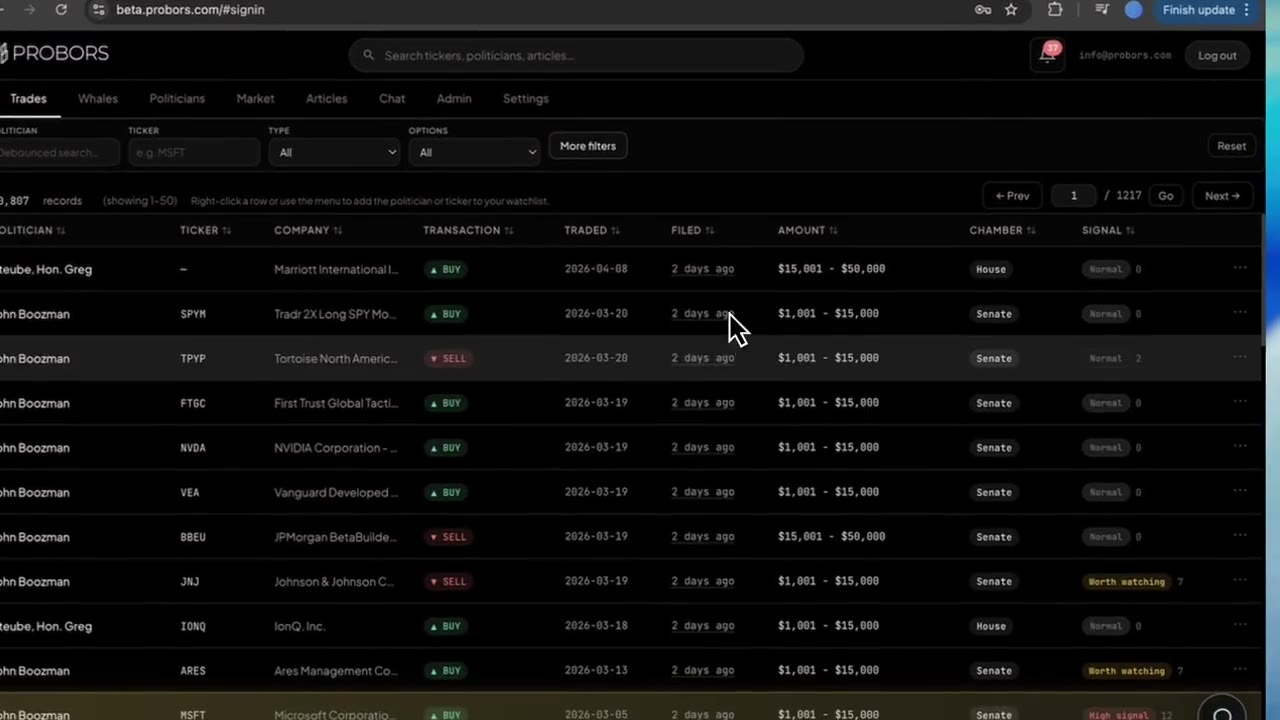
- Open Congressional trades and sort by filing date descending to mirror this snapshot.
- Filter by House and search Rulli to isolate the October 16 GOOG and WSBC lines before reading other members.
- Filter by politician Taylor for the October 15 trust cluster (PG, RPM, FITB, T).
- Sort by amount bracket when you want the few larger lines (Rulli GOOG, Kelly bond purchase) ahead of small-equity rows.
- Open each politician profile for bond or call-option lines missing tickers—the security description lives in the disclosure text.
- Cross-check any row you plan to cite against the original House PTR PDF before publishing notes or journalism.
For chamber-specific workflows, see the House stock trading tracker and Senate stock trading tracker guides.
What this does not prove
Eleven House rows do not show that Congress “moved into” or “out of” tech this week. Rulli’s GOOG sale is one bracket in one account—it is not proof of a sector view. Taylor’s mixed buy-and-sell cluster may reflect trust rebalancing described in the filing text. Allen’s September-dated sales filed in October are not evidence of trading on filing day. Kelly’s municipal and revenue-bond lines are not stock picks. Normal signal tiers across the entire window mean ProBors did not flag elevated cross-context on these rows—not that the disclosures are unimportant for compliance research. None of this is investment advice or proof of non-public information.
FAQ
How many congressional trades were filed in late October 2026?
ProBors shows 11 deduplicated disclosure rows with House filing dates between October 14 and October 16, 2026, across five members. The count removes identical politician-asset-type-date-amount-chamber duplicates.
Why are there no Senate rows in this window?
In this ProBors pull sorted by recent filing date, every row with a filing date from October 14 through October 16, 2026, is tagged House. Senate activity may appear in adjacent weeks—compare to mid-October’s mixed-chamber snapshot.
Which filing had the shortest lag?
Rep. Michael Rulli’s October 16 House filing reports October 16 trade dates on WSBC and GOOG—a 0-day lag on both lines in this snapshot.
Were there any Worth watching or High signal disclosures?
No. All 11 deduplicated rows in this window carry a Normal signal tier in ProBors as of October 21, 2026.
Where can I verify these rows against original filings?
Each House PTR is available through the House Clerk's disclosure search. Senate reports are published through the Senate eFD system. Rows were checked in ProBors and should be verified against the original filing.
Track congressional filings as they land
Use ProBors to sort House and Senate PTR rows by filing date, signal score, and politician—then cross-check against original disclosures.
Get startedRelated reading
- Congress trades filed mid-October 2026
- Google (GOOG) congressional disclosures explained
- How to read politician trade disclosures
- How to screen congress trades by filing lag
- STOCK Act filing delay explained
Sources
- House Clerk financial disclosure search
- Senate eFD search
- STOCK Act (Pub. L. 112-105) overview
- ProBors data status
Rows were checked in ProBors and should be verified against the original filing.
Sources & methodology
Last updated:
ProBors uses public disclosure records, SEC filings, House and Senate financial disclosure portals, market data, and in-product workflow checks. Articles are written as research education, not investment advice.