A House-only congressional disclosure week is when new Periodic Transaction Report lines land from the House Clerk but the Senate side of your filing-date window stays empty—not a data outage, and not proof that “Congress stopped trading.” Quiet House weeks often follow a large batch dump; they mix same-day equity sales, small trust-account rebalancing, and Treasury bill purchases with no equity ticker. ProBors lets you filter by chamber, sort by filing date, and open the source PDF before you write a narrative. This seven-step workflow is for those thin weeks when row count is low but verification discipline still matters. This is research context, not investment advice.
Why House-only weeks confuse researchers
Congressional feeds sort by filing date, so a week with eleven House rows can look “dead” next to a sixty-row mid-month batch. Three mistakes follow:
- Treating silence in the Senate column as “no congressional activity.” Senate periodic reports arrive on a different rhythm; a House-only window is common in late October and other short gaps between Senate dumps.
- Over-weighting the few equity lines. One $50,001–$100,000 sale can dominate headlines while bond and bill purchases share the same filing week.
- Skipping verification because the week feels small. Low volume is when owner codes, trust labels, and missing tickers are easiest to misread.
House-only weeks are a chamber labeling problem first and a ticker story second. Pair this pass with the House stock trading tracker for PTR mechanics and with late October’s filing snapshot for a recent real-world example.
Seven-step workflow on ProBors
-
Define the filing-date window before you open tickers. Pick seven calendar days (or match your weekly review). Write the start and end dates at the top of your notes. You are tracking what became public in that window, not when trades occurred.
-
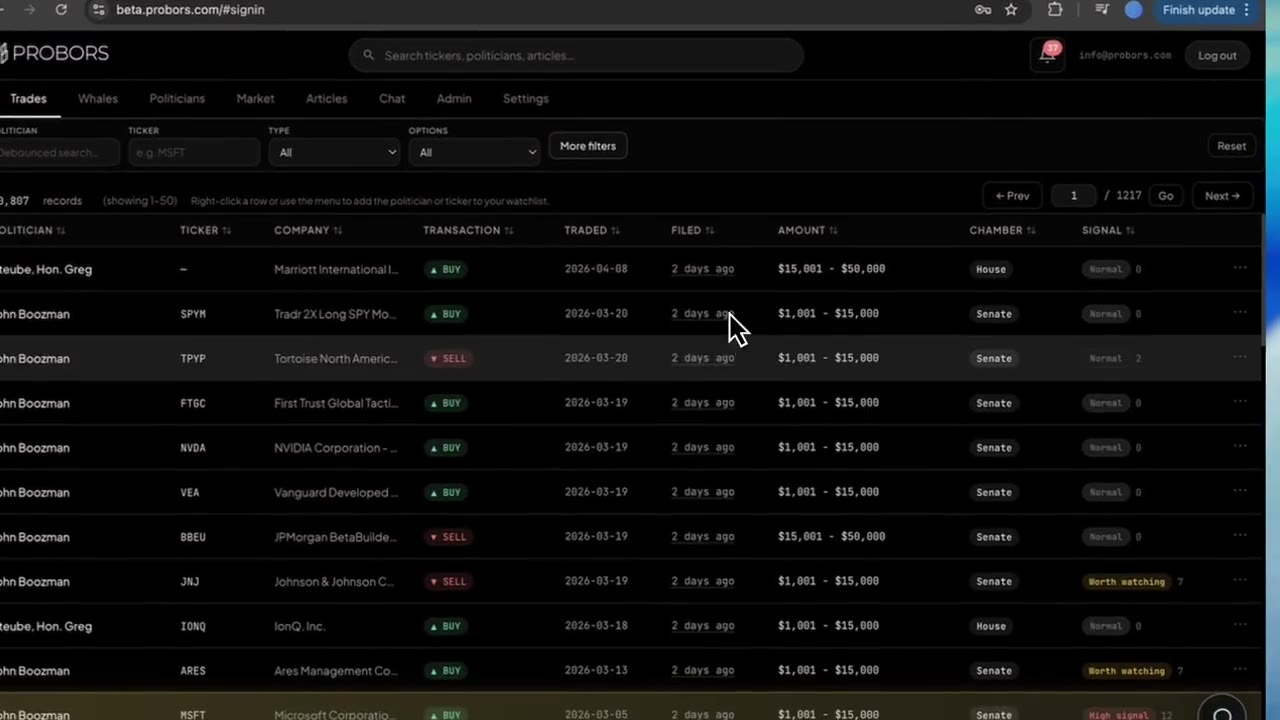
Run a House-first pass with chamber filter. Open Congressional trades on probors.com, sort by filing date descending, and restrict to House rows. Count how many distinct members filed at least one line. If the count is under fifteen, label the week “House-only / low volume” in your memo so future you does not compare it to a batch week.
-
Confirm Senate absence explicitly. Switch the chamber filter to Senate with the same filing-date window. If you see zero rows, note “no Senate filings in window” rather than assuming sync failure. When Senate rows do appear, split them into a separate section—trade dates inside Senate batches are often weeks older than the filing date. See how to investigate stale Senate disclosure batches for long-lag periodic reports.
-
Bucket rows by asset type before signal labels. Separate common-stock lines (liquid ticker), trust or spouse owner strings in the description, and no-ticker government securities. Route no-ticker rows to non-equity congressional research instead of mixing them into an equity watchlist. Trust-heavy weeks belong in the large batch triage workflow even when total row count is small.
-
Log filing lag per row in whole days. For each shortlisted line, write transaction date, filing date, and lag (“same-day,” “3-day lag,” “22-day lag”). House PTRs often file within a week of the trade, but municipal and bond lines can still show multi-week gaps. Use filing lag screening so a timely House sale is not described as “breaking” when the trade date is three weeks old.
-
Verify owner and account context in the PDF. Open the source link from row detail. Confirm whether the line is self, spouse, joint, or trust; check for amended forms. A four-line trust filing on one date is one event, not four independent “Congress bought four stocks” stories. Follow verification before sharing for any row that leaves private notes.
-
Close with a proportionality check. Ask whether this week changes anything on your watchlist. If the answer is no, archive the memo and wait for the next batch. If yes, add one politician or ticker—not every small-bracket line. Fold the outcome into your weekly disclosure review so House-only weeks do not feel like wasted sessions.
Examples from a late-October House window
Recent filings in ProBors as of October 22, 2026 illustrate the pattern: filing dates October 15–October 20 with House rows only in that slice, mixing a same-day Treasury bill purchase, same-day mega-cap sales, and a multi-line trust batch filed on one date.
| Politician | Chamber | Ticker / asset | Type | Traded | Filed | Lag | Amount range | Signal |
|---|---|---|---|---|---|---|---|---|
| Rudy Yakym | House | Treasury Bill (6-Week, matures December 2026) | Purchase | October 20, 2026 | October 20, 2026 | 0 | $15,001 - $50,000 | Normal |
| Michael Rulli | House | GOOG | Sale | October 16, 2026 | October 16, 2026 | 0 | $50,001 - $100,000 | Normal |
| David Taylor | House | PG | Sale | October 12, 2026 | October 15, 2026 | 3 | $1,001 - $15,000 | Normal |
The Yakym row is a reminder that House-only weeks still include non-equity lines with no ticker. Rulli’s same-day GOOG sale is timely on filing lag but still a single member’s disclosure. Taylor’s Procter & Gamble sale is one line inside a broader trust filing dated October 15—open the full batch before inferring a theme.
What this does not prove
A House-only week does not show that the Senate stopped trading, that insiders are quiet, or that the few equity sales are coordinated. It only shows which chamber filed in your chosen filing-date window. Low row counts can still hide misread trust labels or bond purchases mistaken for stock picks. Signal labels rank attention inside a row; they are not predictions. Always confirm against the original House Clerk PDF.
FAQ
Does House-only mean ProBors is missing Senate data?
Not necessarily. Check probors.com/status if every chamber looks empty. When House rows update but Senate does not, you may simply be in a gap between Senate periodic filings—note the window and keep the Senate filter ready for the next batch.
Should I publish a newsletter when only a handful of House rows filed?
Only if you lead with filing dates, lag, and owner context—not “Congress sold GOOG.” Thin weeks are better suited to internal watchlist updates or a short memo using how to write a congressional disclosure research memo.
How is this different from screening by filing lag?
Lag screening sorts timeliness inside rows. This workflow sorts chamber presence inside a week. Use both: a House-only week can still contain 22-day-lag sales from September trade dates.
When should I switch to a large-batch workflow?
When one politician files more than ten lines on a single filing date, switch to large congressional disclosure batch triage even if the rest of the week is quiet.
Can I follow only House members on my watchlist?
Yes—but label alerts by chamber in your notes so a House PTR does not imply Senate activity on the same ticker. Cross-chamber checks still matter on symbols you track; see how to research a ticker across House and Senate.
Research quiet disclosure weeks with structure
Filter House PTRs by filing date, open source PDFs, and keep Senate batches separate on ProBors.
Get startedRelated reading
- Congress trades filed late October 2026 — a recent House-only filing window with row-level context
- House stock trading tracker — how House PTRs differ from Senate periodic reports
- How to run a weekly congressional disclosure review — where House-only weeks fit in a standing cadence
- How to screen congressional trades by filing lag — lag buckets for timely vs stale rows
- Senate stock trading tracker — what to expect when Senate rows return
Sources
- House Clerk financial disclosure — Periodic Transaction Reports
- Senate Select Committee on Ethics — eFD search
- STOCK Act — Pub. L. 112-105
- House Committee on Ethics — PTR filing guidance
- Rows were checked in ProBors and should be verified against the original filing.
- Ingestion health: probors.com/status
Sources & methodology
Last updated:
ProBors uses public disclosure records, SEC filings, House and Senate financial disclosure portals, market data, and in-product workflow checks. Articles are written as research education, not investment advice.