Top whale tickers in late October 2026 are still a sell-heavy board, but the dollar story and the print-count story no longer point at the same names. As of October 27, 2026, ProBors ranks MU (Micron Technology) with about $394 million in net reported whale value over 14 days—far ahead of every other ticker on dollars—while UTHR (United Therapeutics) leads frequency at 140 whale-class prints with about $36.6 million net reported selling. CRWD (CrowdStrike) stays steady at 92 prints and zero purchases, and ATKR (Atkore) shows up near $63 million in net reported value even though it barely registers on open-market sale counts. This guide maps the late-October leaderboard, a five-step triage framework when tax withholding and dispositions inflate dollars, recent large Form 4 filings worth a second look, and what leaderboard volume does not prove. This is research context, not investment advice.
Why the late-October whale board shifted from mid-October
Whale leaderboards rank large Form 4 prints by frequency and reported value—they are not sentiment scores. Three changes stand out compared to the board as of October 20, 2026:
- Micron took a wider dollar lead. MU shows 121 whale-class prints with about −$394 million in net reported value, up from roughly −$368 million a week earlier. Most of that stack is code F tax withholding on CEO Sanjay Mehrotra’s October 13 trade date—not thirty separate open-market sales.
- Print-count leaders rotated. DELL and WBD dominated mid-October frequency and dollar headlines; neither sits in the top-fifteen print list as of October 27. UTHR still tops count at 140 prints (122 code S sales), but its 14-day dollar total is modest next to memory-sector withholding waves.
- Industrial and biotech names filled the gap. ATKR, ALMR, and JBL each carry tens of millions in net reported value with mixed SEC codes—dispositions and withholding rows matter as much as code S lines.
The research task is unchanged: decide which tickers deserve a footnote read, not whether the board is “bullish” or “bearish.”
14-day whale leaderboard (as of October 27, 2026)
The table below reflects ProBors whale activity over the last 14 days as of October 27, 2026. Print counts include large Form 4 rows indexed in the platform; net reported value sums directionally (sales, dispositions, and withholding show as negative).
| Ticker | Company | 14-day prints | Sales | Buys | Net reported value |
|---|---|---|---|---|---|
| UTHR | United Therapeutics | 140 | 122 | 0 | −$36.6M |
| MU | Micron Technology | 121 | 30 | 0 | −$394.0M |
| CRWD | CrowdStrike | 92 | 92 | 0 | −$21.5M |
| ADBE | Adobe | 75 | 0 | 0 | −$2.8M |
| JBL | Jabil | 75 | 6 | 0 | −$9.0M |
| UBER | Uber Technologies | 74 | 0 | 0 | −$1.3M |
| WAL | Western Alliance Bancorp | 73 | 0 | 0 | −$0.3M |
| ALMR | Alamar Biosciences | 52 | 52 | 0 | −$21.0M |
| NXDR | Nextdoor Holdings | 51 | 4 | 0 | −$1.6M |
| IAM | Iambic Therapeutics | 49 | 0 | 1 | +$14.0M |
| ATKR | Atkore | 46 | 0 | 0 | −$63.2M |
| FERG | Ferguson Enterprises | 45 | 12 | 0 | −$2.7M |
| MRVL | Marvell Technology | 44 | 2 | 0 | −$8.7M |
IAM is the rare positive net name on this board—a reminder to scan for purchase and conversion clusters even when the sector backdrop is exit-heavy. For purchase-pattern habits, see insider buying clusters: what to look for.
Note on mixed codes: Tickers like MU, ATKR, and ADBE can show large net values with low code S counts because tax withholding (F), dispositions (D), and conversions (C) also flow through whale feeds. Open the underlying filing before treating rank as a directional signal.
A five-step triage framework when dollars and print counts diverge
Use the same checklist when MU tops dollars but UTHR tops prints so compensation mechanics do not masquerade as discretionary flow.
1. Confirm the SEC transaction code
Open-market sales use code S; open-market purchases use code P. Tax withholding (F), dispositions (D), conversions (C), grants (A), and option exercises (M, X) are different economic events. ProBors shows the code and trade type on each whale row—filter here before reacting to dollar size.
2. Separate one trade date from a multi-week program
Three code S lines from the same officer on one trade date may be one decision split across tranches. KSPI-style stacks filed on the same October 26 batch read differently from a single ATKR disposition wave on October 19. Group by trade date and filer before you merge narratives.
3. Measure filing lag in calendar days
Form 4 is generally due within two business days after the transaction. A 4-day lag on an October 16 trade filed October 20 is worth a footnote check on SEC EDGAR even when the delay is not automatically a red flag.
4. Read signal scores as a sort key—not a verdict
ProBors signal scores weigh size, role, timing, and pattern history. A score of 8 on repeated open-market sales flags sustained attention; a score of 5 on a large disposition still deserves a footnote read when the dollar value is unusual for that filer. Sort by signal after filtering codes. For scoring details, see how ProBors trade signal scores work.
5. Cross-check chart and congressional context
Open the ticker workspace on ProBors: review price reaction since the trade date, any congressional markers, and whether the AI summary flags earnings, M&A, or lock-up events. Whale flow plus politician activity on the same name is a stronger research prompt than either feed alone.
For a full whale-tab walkthrough, see how to triage whale transactions on ProBors.
Recent filings worth a second look
The table below shows deduplicated whale rows from ProBors as of October 27, 2026, chosen to illustrate code mix and filing lag. Values match reported amounts indexed in the platform.
| Ticker | Company | Insider | Type | Traded | Filed | Lag | Reported value | Signal |
|---|---|---|---|---|---|---|---|---|
| MU | Micron Technology | Sanjay Mehrotra | Tax withholding | October 13, 2026 | October 15, 2026 | 2 days | −$46,626,312 | 5 |
| MU | Micron Technology | Scott J. Deboer | Sale | October 16, 2026 | October 20, 2026 | 4 days | −$25,599,600 | 5 |
| ATKR | Atkore | William E. Waltz Jr. | Disposition | October 19, 2026 | October 21, 2026 | 2 days | −$18,204,151 | 5 |
| PACS | PACS Group | Jason Hulse Murray | Sale | October 23, 2026 | October 26, 2026 | 3 days | −$2,253,784 | 5 |
| GPI | Group 1 Automotive | Conifer Management, L.L.C. | Purchase | October 23, 2026 | October 26, 2026 | 3 days | $2,273,379 | 5 |
| KSPI | Joint Stock Co Kaspi.kz | Vyacheslav Kim | Sale | October 23, 2026 | October 26, 2026 | 3 days | −$1,940,468 | 8 |
How to read this snapshot without overfitting:
- Micron’s dollar lead is mostly withholding, not thirty open-market sales. Mehrotra’s October 13 F rows explain much of the −$394 million 14-day total; Deboer’s $25.6 million code S sale is a separate officer bucket worth tagging by role.
- Atkore’s board rank is disposition-heavy. Waltz’s $18.2 million D row is one economic event in a broader October 19 cluster—not automatically equivalent to daily CEO code S flow on CRWD.
- Kim’s repeated KSPI sales carry signal 8—useful for sorting a multi-line seller, not proof of insider “conviction” either way.
How to research late-October whale flow on ProBors
- Open the Whales tab and set your date window to the last 14 days to match leaderboard rankings.
- Sort by net reported value and by print count separately—leaders rarely overlap in late October.
- Filter transaction codes before sorting by size; withholding and disposition rows can dominate dollars without adding code S sales.
- Click a ticker (for example MU or UTHR) to see filer-level clustering by trade date.
- Note signal scores as a second sort after codes are clean.
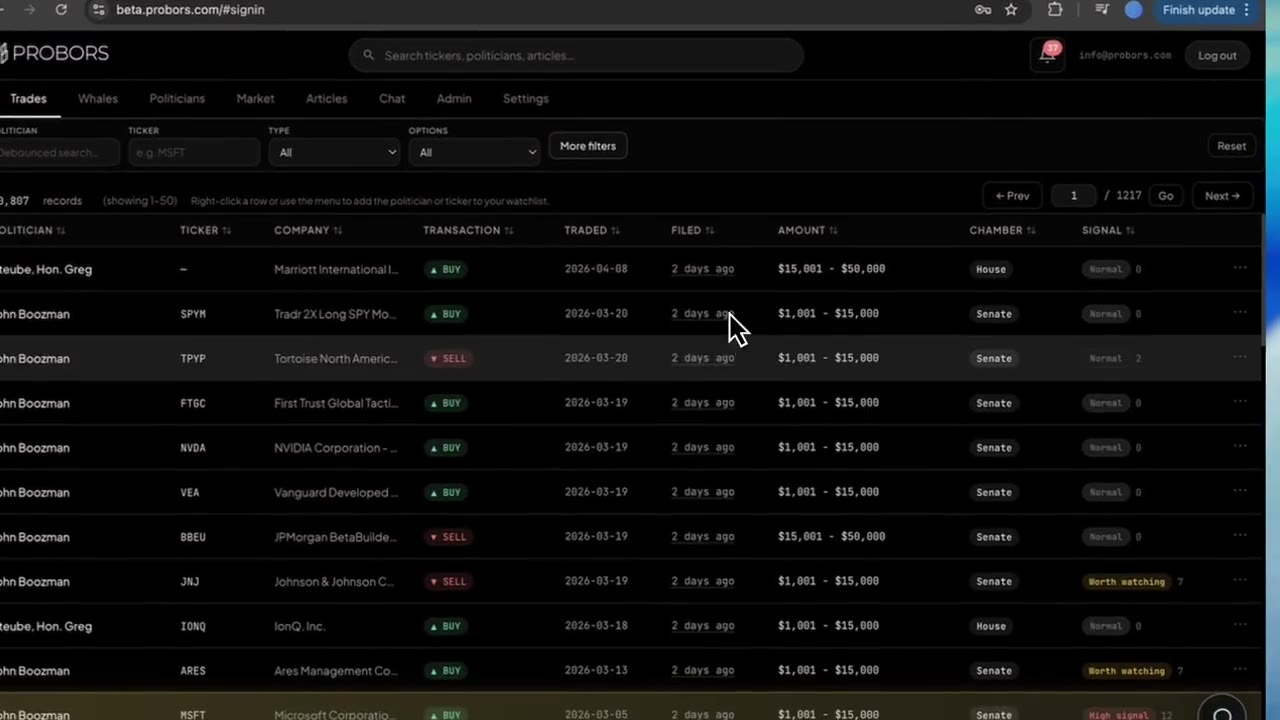
- Switch to the Trades tab on the same ticker if you want congressional PTR context in the same window.
- Add tickers to a watchlist when a filer pattern repeats across multiple trade dates. See ProBors watchlist alerts for setup steps.
What this does not prove
A crowded sell-heavy whale board does not mean every insider knows something the market does not. Large prints can reflect 10b5-1 plans, tax withholding after vesting, fund distributions, or estate planning—withholding rows on MU are a textbook example. Leaderboard rank also does not prove that UTHR and CRWD belong in the same thesis bucket just because both show zero buys. Finally, sparse purchase clusters like IAM do not offset sector-wide exit flow without reading each filer’s code and footnotes.
FAQ
Why does MU rank first on dollars but not on print count?
Because net reported value sums every large row in the window, including multi-million-dollar tax withholding lines. Print count measures how many whale-class filings arrived, which is why UTHR can lead on frequency while MU leads on dollars.
Are zero buys on the 14-day board unusual in October 2026?
For the top fifteen frequency names as of October 27, open-market purchases are rare—IAM is the standout positive net name. That is a snapshot, not a forecast; buy clusters can return quickly when biotech or SPAC names file code P lines.
How is this different from the mid-October whale post?
The mid-October leaderboard still referenced DELL and WBD in the top print table. Those names rotated out of the top-fifteen frequency list by October 27 while MU’s dollar total widened and ATKR dispositions added a new industrial story.
Should I treat signal score 8 on KSPI as a sell signal?
No. Signal scores help you sort attention within a session. A score of 8 on repeated KSPI sales means the platform weighted size, repetition, and role heavily—it is not a trading recommendation.
Where can I confirm ingestion health before sharing a table?
Check ProBors data status for filing freshness, then verify any high-stakes row on the original SEC Form 4.
Track whale and insider flow on ProBors
Filter Form 4 whales by ticker, code, signal score, and filing date—alongside congressional disclosures and market context.
Get startedRelated reading
- Top whale tickers in mid-October 2026
- How to triage whale transactions on ProBors
- CRWD whale insider sales explained
- Insider buying clusters: what to look for
Sources
- SEC Form 4 overview
- SEC EDGAR search
- 17 CFR § 240.16a-2 — filing deadlines for insiders
- Rows were checked in ProBors and should be verified against the original filing.
- Filing ingestion health: probors.com/status
Sources & methodology
Last updated:
ProBors uses public disclosure records, SEC filings, House and Senate financial disclosure portals, market data, and in-product workflow checks. Articles are written as research education, not investment advice.