Walt Disney (DIS) congressional disclosures show up in both House and Senate Periodic Transaction Reports because the stock sits in diversified portfolios, theme-park-adjacent headlines, and media-sector watchlists—not because every PTR implies policy foresight. ProBors shows 19 deduplicated DIS rows with 2026 filed dates, split between 17 House and 2 Senate lines, with filing lag from same-day reporting to a 116-day Senate batch. This spotlight walks through eight recent examples, how to compare chambers on one ticker, and what the public record does not prove. It is research context, not investment advice.
Why DIS appears in congress trackers
Disney is a large-cap consumer and media name that members hold directly or through funds. Useful research questions stay narrow:
- Which politicians filed Disney activity in the current calendar year?
- Were recent lines mostly purchases, partial sales, or full sales?
- How many days passed between the transaction date and the public filing date?
- Do House PTRs dominate the sample, or does Senate activity show up in delayed batches?
- Does the amount bracket suggest a small rebalance or a larger trim?
A ticker spotlight should answer those fields from verified rows, then let you decide whether chart, insider, or committee context is worth a second pass.
Recent filings in ProBors as of November 5, 2026
The table below lists eight deduplicated DIS rows in ProBors, sorted by filing date (newest first). Filing lag is calendar days between the transaction date and the filed date as reported in ProBors. Amount strings match the disclosure brackets in the source filings.
| Politician | Type | Traded | Filed | Lag (days) | Amount range | Chamber |
|---|---|---|---|---|---|---|
| Pete Sessions | Sale | 10/28/2026 | 10/28/2026 | 0 | $1,001 – $15,000 | House |
| Kevin Hern | Sale | 08/10/2026 | 08/27/2026 | 17 | $15,001 – $50,000 | House |
| Mike Kelly | Sale | 07/17/2026 | 08/12/2026 | 26 | $1,001 – $15,000 | House |
| Alan Armstrong | Purchase | 03/27/2026 | 07/21/2026 | 116 | $1,001 – $15,000 | Senate |
| Ro Khanna | Purchase | 05/27/2026 | 06/09/2026 | 13 | $1,001 – $15,000 | House |
| Ro Khanna | Purchase | 05/15/2026 | 06/09/2026 | 25 | $1,001 – $15,000 | House |
| Ro Khanna | Purchase | 04/24/2026 | 05/11/2026 | 17 | $1,001 – $15,000 | House |
| Ro Khanna | Purchase | 04/13/2026 | 05/11/2026 | 28 | $1,001 – $15,000 | House |
Snapshot summary (2026 filed dates in ProBors): 19 deduplicated DIS rows—10 purchases and 9 sales—with 17 House and 2 Senate filings. Filing lag in that 2026 window runs from 0 to 116 days (median 17 days). ProBors holds 305 deduplicated historical DIS rows overall; older years include both small rebalance lines and larger bracket sales.
Always verify individual rows against the official PDF before citing them in a memo or story.
Cross-chamber and context analysis
Three patterns stand out in this ProBors sample—and none of them are trading signals on their own.
1. House PTRs carry most of the 2026 volume
Seventeen of nineteen 2026 DIS rows are House filings. That matches how often members report individual equity lines through the House PTR portal. When you see a single Senate purchase with a 116-day lag, treat it as a reminder that chamber workflows differ—not as proof that “Senate traders” moved on Disney differently from the House.
For chamber-specific habits, see the House stock trading tracker and Senate stock trading tracker.
2. Same-day House sales sit next to multi-week lags
Pete Sessions’ October 28 sale shows 0-day lag—traded and filed on the same calendar date in ProBors. Kevin Hern’s August sale and Mike Kelly’s July–August pair filed 17–26 days after the trade dates. Ro Khanna’s spring purchases landed in May and June batches with 13–28-day gaps. That spread is normal PTR noise: timely filers, vacation-week delays, and batched amendments all show up on the same ticker.
For lag vocabulary, see how to compare filing date vs. transaction date and STOCK Act filing delay explained.
3. One member can file several lines in one window
Four separate Ro Khanna purchase lines filed in May and June 2026 illustrate dollar-cost-averaging-style reporting—not four independent “signals.” When multiple rows share a filing date, read them as one disclosure event until the PDF confirms otherwise.
How to research Disney (DIS) on ProBors
Use a ticker-first workflow when the question is “who in Congress reported Walt Disney lately?” rather than “what did this member buy this month?”
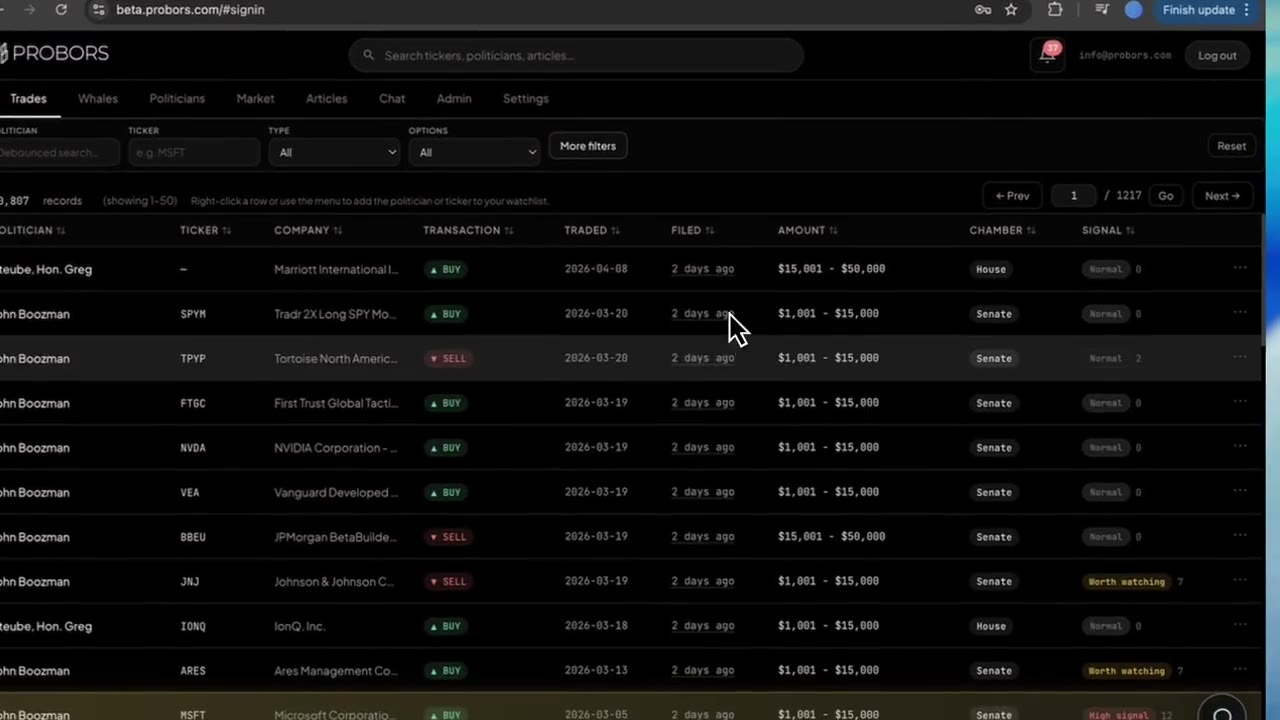
- Open Trades on probors.com and filter by ticker DIS (or search “Disney” in global search).
- Sort by filed date descending so delayed Senate batches do not hide under older trade dates.
- Toggle House and Senate source filters to see whether activity is chamber-specific in your window.
- Open the original filing link on any row you plan to cite; match transaction type and amount bracket to the PDF.
- Optional: open the market workspace for DIS to see price context—Congress PTRs still do not prove timing intent.
- Add recurring DIS rows to a watchlist if you monitor media names alongside congress stock trading tracker workflows.
What this does not prove
Congressional PTRs on Disney do not show non-public information, guaranteed returns, or coordinated trading across members. Amount ranges are brackets, not exact dollars. Filing lag can stretch for administrative reasons unrelated to market timing. Multiple purchases by one member can reflect routine portfolio management. None of this replaces SEC filings, company fundamentals, or your own risk limits.
FAQ
How often do members trade Disney stock in disclosures?
Frequency changes by year and by how many members hold the name directly. In ProBors, 19 deduplicated DIS rows carry 2026 filed dates, with 10 purchases and 9 sales—a balanced mix that still reflects only what was publicly filed, not total economic exposure (including funds).
Why does one Senate DIS row show a 116-day filing lag?
The Alan Armstrong Senate purchase traded in late March 2026 and filed in mid-July 2026 in ProBors—a 116-day calendar gap. Long lags appear in both chambers when batches arrive late; always read the PDF and compare transaction vs. filing dates before inferring intent.
Are recent Disney congressional disclosures mostly buys or sells?
In the 2026 ProBors window, purchases slightly outnumber sales (10 vs. 9). The newest row in this sample is a House sale by Pete Sessions on October 28, 2026 with same-day filing—one data point, not a trend line.
Can I research DIS without focusing on one politician?
Yes. Filter Trades by ticker DIS, then scan politician, chamber, and lag columns. Pair that with how to research a ticker across House and Senate when you need a repeatable weekly review.
Where do I check whether ProBors ingested the latest PTRs?
Use the public data status page for ingestion health, then confirm any critical row on the official House or Senate disclosure site.
Track Disney and other tickers in one workspace
Filter congressional disclosures by ticker, chamber, and filing date on ProBors—then verify every row against the original PTR.
Get startedRelated reading
- How to research a ticker across House and Senate
- How to read politician trade disclosures
- Track congress stock trades by ticker
- Congress trades filed in late October 2026
Sources
- U.S. House Financial Disclosure search: disclosures-clerk.house.gov
- U.S. Senate Financial Disclosures: efdsearch.senate.gov
- STOCK Act background: Congress.gov STOCK Act overview
- Rows were checked in ProBors and should be verified against the original filing.
- Ingestion health: probors.com/status
Sources & methodology
Last updated:
ProBors uses public disclosure records, SEC filings, House and Senate financial disclosure portals, market data, and in-product workflow checks. Articles are written as research education, not investment advice.