BBIO congressional disclosures are easy to miss next to mega-cap tickers, yet BridgeBio Pharma can show up in periodic financial disclosure (PTR) reports when a member holds or trades a smaller biotech name. As of mid-November 2026, ProBors shows only House PTR activity on BBIO in the recent filing window, with the newest rows filed on November 9, 2026 after purchases dated in late October and early November. This spotlight walks through those verified rows, filing lag, and what the record does not prove. It is research context, not investment advice.
Why BBIO appears in congress trackers
BridgeBio Pharma (NASDAQ: BBIO) is a clinical-stage biotech—far from the S&P 500 names that dominate headline congressional trade lists. When BBIO appears, it usually signals individual portfolio choice, not broad index overlap. Questions worth asking on this ticker are practical:
- Who filed BridgeBio activity recently, and in which chamber?
- Were the lines purchases, sales, or partial sales?
- How many days passed between the transaction date and the public filing date?
- Do amount ranges stay in the smallest disclosure bracket, or step up?
A useful spotlight answers those fields from source-backed rows before you layer in chart, insider, or news context.
Recent BBIO filings in ProBors
The table below reflects deduplicated BridgeBio PTR rows in ProBors as of November 12, 2026, limited to 2026 transaction dates and sorted by filing date (newest first). Filing lag is calendar days between the transaction date and the filed date as reported in ProBors. Politician names are cleaned for readability; chamber is shown separately.
| Politician | Type | Traded | Filed | Lag (days) | Amount range | Chamber |
|---|---|---|---|---|---|---|
| Gilbert Cisneros | Purchase | 11/02/2026 | 11/09/2026 | 7 | $1,001 – $15,000 | House |
| Gilbert Cisneros | Purchase | 10/27/2026 | 11/09/2026 | 13 | $1,001 – $15,000 | House |
| Gilbert Cisneros | Sale (Partial) | 09/29/2026 | 10/09/2026 | 10 | $1,001 – $15,000 | House |
| Gilbert Cisneros | Purchase | 05/11/2026 | 06/05/2026 | 25 | $1,001 – $15,000 | House |
| Gilbert Cisneros | Purchase | 04/29/2026 | 05/07/2026 | 8 | $1,001 – $15,000 | House |
Snapshot summary (2026 rows above): 5 deduplicated PTR lines, 4 purchases and 1 partial sale, all House, all attributed to Gilbert Cisneros in ProBors. Every amount sits in the $1,001 – $15,000 bracket. Median filing lag on these rows is 10 days (range 7–25 days). Two late-October purchases were disclosed together on November 9, 2026—a common batch-filing pattern rather than two separate public events.
ProBors assigned a modest signal score on some related rows in the full history (for example 6 on the October 27 purchase in the same filing batch); scores summarize context inside ProBors and are not official filing fields. Open the original PTR before citing any line in a memo or story.
Cross-chamber and context notes
Three patterns stand out in this BBIO sample—and none of them are buy or sell signals on their own.
1. Activity is concentrated in one House disclosure stream
In the 2026 window above, every BBIO row traces to the same House member in ProBors. That does not mean no other member has ever owned BridgeBio; it means recent searchable PTR volume on this ticker is thin. When a ticker is member-specific, compare rows to that member’s other disclosures—not only to mega-cap peer tables.
2. Buys resumed after a fall partial sale
After a partial sale filed on October 9, 2026 (September 29 transaction date), ProBors shows two purchases filed together in early November. Direction flipped within weeks on the same smallest amount bracket. Without the original PDF, you cannot tell whether that was tax-lot management, rebalancing, or another routine portfolio move.
3. No Senate BBIO rows in this recent window
ProBors shows no Senate BBIO lines with 2026 transaction dates in the same pull. Senate eFD filings use a different search workflow; absence here is “no matching rows in ProBors,” not proof that the Senate has zero BridgeBio history. Filter by chamber when you compare PTR depth across tickers.
For broader biotech disclosure habits, see the ABBV congressional disclosures guide and JNJ congressional disclosures guide—different issuers, same PTR reading rules.
How to research BBIO on ProBors
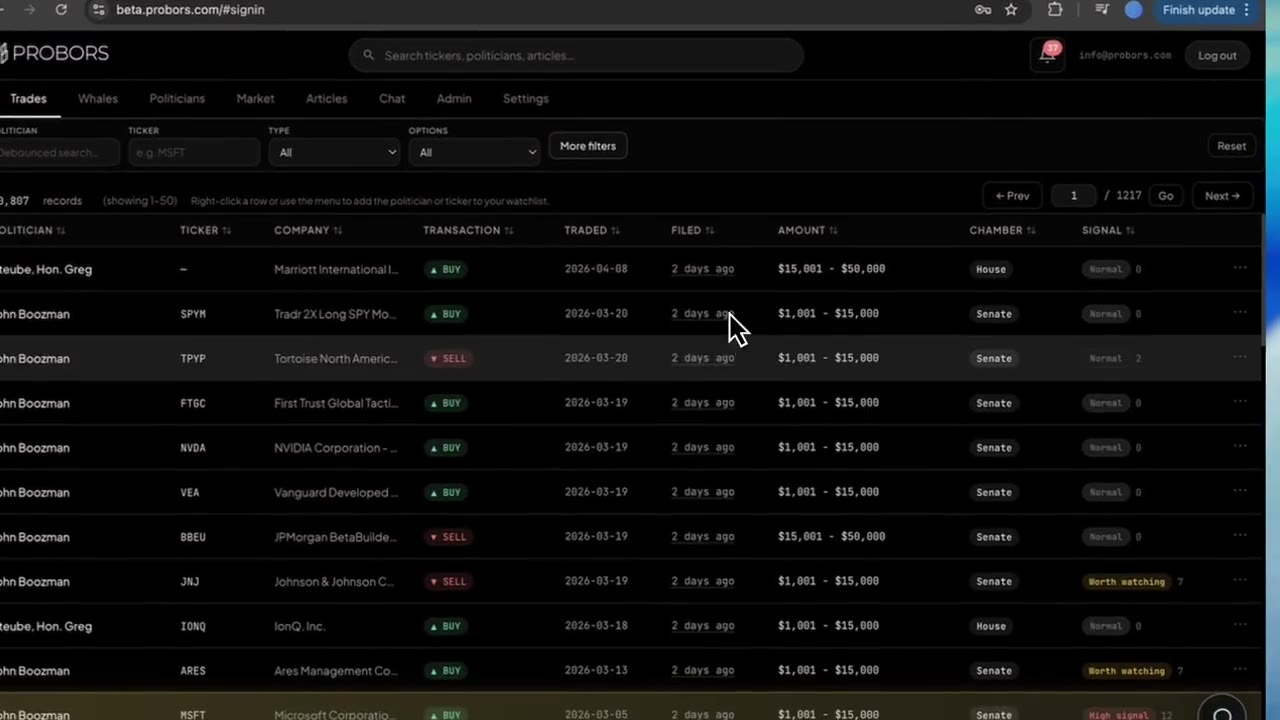
Use a ticker-first workflow when BridgeBio is on your watchlist:
- Search BBIO from the dashboard or open Market → BBIO if the symbol resolves in your workspace.
- Open the Congress trades table and sort by filed date (newest first).
- Click a row for disclosure context—transaction label, amount range, chamber, and any signal tier shown in the product.
- Toggle congress markers on the price chart to see where filings landed relative to daily bars (volatile small caps make date alignment especially important).
- Cross-check Form 4 / whale activity on BBIO separately—corporate insider rules differ from congressional PTR rules.
- Add BBIO to a watchlist if you want the next filing, not a live price alert.
For chamber-specific habits, pair this with the House stock trading tracker and Senate stock trading tracker. For date discipline, see how to compare filing date vs transaction date.
What this BBIO data does not prove
A congressional disclosure table on BridgeBio does not prove:
- That a member traded on non-public clinical or regulatory information
- That BBIO will rise or fall because a PTR was filed
- Exact share counts or dollar proceeds (ranges are bands, not precise fills)
- Real-time intent—several rows above posted one to three weeks after the transaction date
- That thin PTR volume implies broader “Congress is bullish on biotech”
PTR data is a transparency record, not a timing edge. The useful output is a verified trail: who filed, what type, both dates, and how that row compares to the same member’s other disclosures.
FAQ
How often do members disclose BBIO trades?
In the 2026 window summarized here, ProBors shows five deduplicated House rows on BridgeBio, all from Gilbert Cisneros—enough to monitor if BBIO is on your list, but not a busy congressional ticker like large-cap tech names.
Why were two BBIO purchases filed on the same date?
The November 9, 2026 filing carries both an October 27 and November 2 purchase. Batch disclosures are normal under PTR deadlines. Treat them as one public disclosure event with multiple line items, not as two independent “breaking” trades on the filing date.
What is typical filing lag for these BBIO rows?
Among the five 2026 rows in the table, lag runs from 7 days (November 2 trade) to 25 days (May 11 trade). Median lag is 10 days. Lag varies by member and reporting habit—not by ticker.
Does congressional BBIO activity mirror insider Form 4s?
Not automatically. PTRs and SEC insider reports follow different statutes, deadlines, and filers. Keep congressional rows and Form 4 rows in separate research lanes.
Can Senate BridgeBio filings be missing from a ticker filter?
Yes. Always run a Senate-specific pass when a ticker is thin on one chamber. ProBors chamber filters help, but the original Senate eFD search remains the verification step.
Research BBIO disclosures in one workspace
Filter congressional PTRs by ticker, review filing lag, and cross-check insider filings on ProBors.
Get startedRelated reading
- Track congress stock trades by ticker
- How to read politician trade disclosures
- STOCK Act filing delay explained
- ABBV congressional disclosures explained
Sources
- House Financial Disclosure (PTR search)
- Senate eFD search
- STOCK Act (Pub. L. 112-105)
- Congress.gov – financial disclosure requirements overview
- Rows were checked in ProBors and should be verified against the original filing. Ingestion health: probors.com/status
Sources & methodology
Last updated:
ProBors uses public disclosure records, SEC filings, House and Senate financial disclosure portals, market data, and in-product workflow checks. Articles are written as research education, not investment advice.